ADR transport explained: the European carrier's guide to moving dangerous goods by road
ADR transport explained for European carriers: hazard classes, driver certificate, vehicle approval, the 1000-point rule and DGSA duties in one guide.

Logifie Team
Logistics Technology Experts
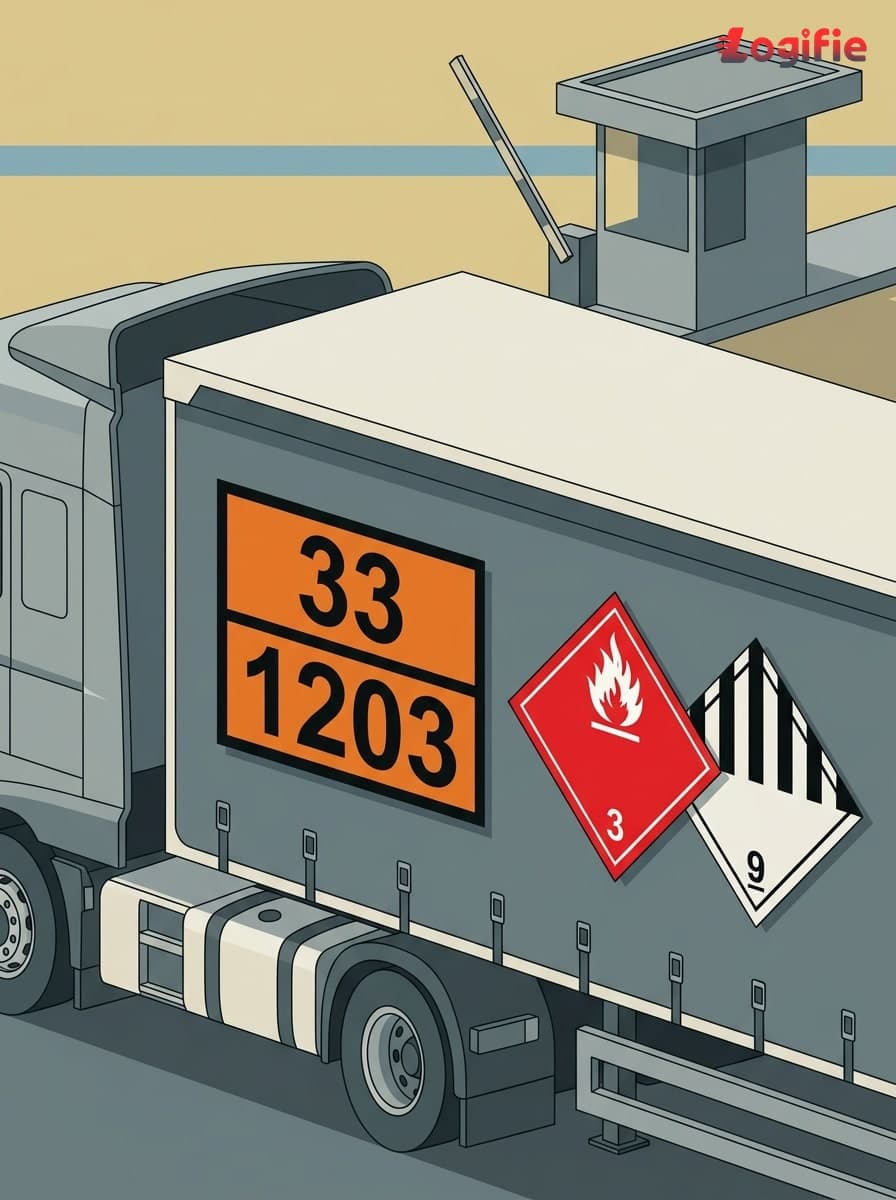
ADR transport is the road carriage of dangerous goods under the European Agreement concerning the International Carriage of Dangerous Goods by Road, the UNECE treaty that sets common rules for how hazardous materials are classified, packed, labelled and hauled across 55 Contracting Parties ( UNECE, 2025 ). The rules you must follow today come from the ADR 2025 edition , which has applied since 2025-01-01 and stays in force through the end of 2026, with the next biennial revision, ADR 2027, due on 2027-01-01. This guide walks European carriers through the four obligations that actually matter on the road: the hazard classes, the driver certificate, vehicle approval, and the exemptions and adviser duties that decide whether the full regime applies at all.
What is ADR transport, and which countries does it cover?
ADR is a multilateral agreement concluded under the auspices of the United Nations Economic Commission for Europe (UNECE) in Geneva in 1957, and it is the single rulebook that lets a tanker of solvent or a pallet of lithium batteries cross from Poland into Germany or France without being re-classified at each frontier. According to the UNECE , the agreement is revised on a fixed two-year cycle by its Working Party on the Transport of Dangerous Goods, which is why carriers track edition dates so closely.
Inside the European Union, ADR is not optional and not limited to cross-border work. Directive 2008/68/EC (consolidated 2024) extends the ADR provisions to purely domestic dangerous-goods movements as well, so a carrier running fuel only within one member state is bound by the same classification and documentation rules as one running international lanes. The European Commission's Mobility and Transport directorate keeps the EU framework aligned with each new ADR edition. The practical upshot is that ADR competence is a baseline requirement for any European carrier whose freight mix includes fuel, gases, chemicals, aerosols or batteries, not a niche specialism.
50+
ADR applies across more than fifty UNECE Contracting Parties, including every EU member state.
What are the nine ADR dangerous-goods classes?
Every dangerous good is assigned to one of nine classes based on its primary hazard, and the class drives the placarding, packaging and segregation rules that follow. The hazard diamond on the package and the orange-panel placard on the vehicle both encode this classification, so getting it right is the foundation of a compliant load.
| Class | Category | Common examples | Label colour |
|---|---|---|---|
| 1 | Explosives | Fireworks, blasting agents, airbag inflators | Orange |
| 2 | Gases | LPG, propane, oxygen, aerosols | Green (red for flammable) |
| 3 | Flammable liquids | Petrol, diesel additives, solvents, paints | Red |
| 4 | Flammable solids and reactive substances | Matches, sodium, sulphur | Red and white striped, or blue |
| 5 | Oxidising substances and organic peroxides | Ammonium nitrate, hydrogen peroxide | Yellow |
| 6 | Toxic and infectious substances | Pesticides, clinical samples | White |
| 7 | Radioactive material | Medical isotopes, industrial sources | Yellow and white |
| 8 | Corrosives | Battery acid, sodium hydroxide, hypochlorite | Black and white |
| 9 | Miscellaneous dangerous substances | Lithium batteries, dry ice, asbestos | Black and white striped |
Two classes drive a large share of European volumes: Class 3 flammable liquids, because of fuel distribution, and Class 9, because lithium batteries now travel in everything from e-bikes to electric-vehicle spares. A transport management system that captures the UN number, class and packing group against each consignment removes most of the manual error here; you can see how compliance fields sit inside an order with our TMS for compliance document handling .
Do I need an ADR transport certificate, and how do I get one?
Any driver carrying dangerous goods above the exemption thresholds must hold a valid ADR driver certificate, also called the ADR vocational training certificate or, informally, the ADR licence. The certificate is earned by completing accredited training and passing an examination set by the national competent authority, such as the DVSA in the United Kingdom or the relevant transport ministry body in each EU member state.
Training is modular. Every driver starts with the Core module, which covers general awareness, documentation and emergency response. From there, drivers add the modules their work demands:
- Packages — carriage of dangerous goods in packages and containers.
- Tanks — carriage in road tankers, tank containers and intermediate bulk containers (IBCs).
- Class-specific — additional modules for Class 1 explosives and Class 7 radioactive material.
5 years
The ADR driver certificate is valid for five years; renewal requires refresher training and an exam within the final twelve months of validity.
The certificate is valid for five years. To renew it, the driver must complete refresher training and pass the exam within the final twelve months of validity, so operators typically schedule renewals well before expiry to avoid a gap that would ground the driver. Because ADR is a stackable qualification on top of the Driver CPC, it is a genuine earnings and employability advantage; we cover how it fits a wider professional profile in our guide to becoming a truck driver in Europe , and ADR-qualified drivers can review current openings on our careers page . Operators that run mixed fleets find it far easier to keep these renewals visible when they track drivers' ADR certificates and expiry dates in one place rather than across spreadsheets.
Does my vehicle need ADR approval, and how often is it inspected?
Not every dangerous-goods vehicle needs a certificate of approval, but tank-vehicles, vehicles carrying certain explosives, and other specified units do. Where approval is required, the vehicle must pass a technical inspection and carry a valid ADR Certificate of Approval, issued by the competent authority and renewed annually. The inspection checks braking, electrical equipment, fire-fighting provision, tank integrity where relevant, and the marking and placarding arrangements.
For most carriers hauling packaged goods, the obligation is lighter: the vehicle does not need a type-specific ADR approval, but it must still carry the required safety equipment, fire extinguishers and the prescribed orange-panel placards when the load exceeds the exemption thresholds. The IRU and national authorities publish equipment checklists, but the principle is consistent across Europe — the heavier and more hazardous the load type, the more the vehicle itself is regulated.
What is the ADR 1000-point rule, and when am I exempt?
The 1000-point rule, formally the exemption in subsection 1.1.3.6 of ADR, lets carriers move smaller quantities of dangerous goods under a reduced regime. Each substance is assigned a transport category from 0 to 4 in column 15 of Table A, and you multiply the quantity carried by a category factor, then add the results across the load. If the total stays below 1000 points, the consignment qualifies for partial exemption.
The category factors work like this, as set out in the ADR 2025 rules and explained by specialists such as Boxlab Services :
| Transport category | Factor | Indicative meaning |
|---|---|---|
| 0 | No exemption | Most hazardous; full ADR always applies |
| 1 | 50 | High hazard |
| 2 | 3 | Medium hazard |
| 3 | 1 | Lower hazard |
| 4 | 0 | Counts as zero; effectively unlimited |
1,000
If your load's points total stays below 1,000, the consignment qualifies for partial exemption from placarding, the ADR vehicle requirement and the full driver certificate.
Important caveats on the 1000-point exemption: a transport document is still required, the goods must be correctly packaged and labelled, the driver still needs general dangerous-goods awareness training, and Category 0 goods can never be exempted this way.
A worked example: carrying 333 litres of a Category 2 substance gives 333 × 3 = 999 points, which sits just under the threshold. Under partial exemption the vehicle does not need orange placards, the driver does not need the full ADR certificate, and an ADR-approved vehicle is not required. Important caveats remain: a transport document is still required, the goods must be correctly packaged and labelled, the driver still needs general dangerous-goods awareness training, and Category 0 goods can never be exempted this way.
What are limited quantities, and how do they differ from the 1000-point rule?
Limited quantities (LQ), set out in Chapter 3.4 of ADR, are small amounts of dangerous goods packed in modest inner receptacles inside a combination package. Goods moved as LQ count as zero points in the 1.1.3.6 calculation and travel under a much lighter regime: they carry the distinctive LQ diamond marking rather than full hazard placards, and most carriage, vehicle and driver-certificate requirements fall away.
The key distinction is that LQ is a packaging-based concession tied to per-package limits, while the 1000-point rule is a load-based concession tied to total quantity on the transport unit. The two can interact — LQ goods contribute nothing to the points total — but they are governed by different chapters and should be assessed separately. A carrier moving consumer goods such as small paint tins or aerosols often relies on LQ, while a carrier moving bulk drums is more likely to be calculating points.
Do I need a dangerous goods safety adviser (DGSA)?
Most undertakings whose activities include the carriage, packing, loading or unloading of dangerous goods must appoint a Dangerous Goods Safety Adviser, a qualified individual whose role is set out in Chapter 1.8.3 of ADR. The DGSA monitors compliance, advises on procedures, investigates incidents and prepares the annual report the competent authority can request. The adviser can be an employee or an external consultant, but must hold a valid DGSA certificate for the relevant classes and transport modes.
There are exemptions: operations that fall entirely under the 1.1.3.6 exemption or other minor thresholds may not trigger the DGSA requirement, which is one more reason carriers map their loads against the exemption rules carefully. National authorities such as Germany's BAG and the UK's DVSA enforce the appointment, and penalties for operating without a required adviser are significant. If you are unsure whether your freight mix crosses the threshold, speak to Logifie about ADR-compliant shipments before you commit a load.
ADR 2025 versus ADR 2027: what should carriers track on the two-year cycle?
The single most useful habit for a dangerous-goods operator is to watch the edition calendar. ADR 2025 is the edition in force now; ADR 2027 takes effect on 2027-01-01, and the UNECE Working Party has already adopted the draft amendments. Each cycle typically refines classification entries, packaging provisions, and items such as lithium-battery and fuel-cell rules — areas of constant change as the European vehicle fleet electrifies.
A six-month transitional period normally bridges each edition, so carriers are not forced to switch documentation overnight. The practical discipline is to confirm, ahead of each 1 January changeover, which UN numbers in your regular freight mix have moved category, changed packing instructions, or gained new marking duties, and to brief drivers and DGSA accordingly.
Frequently asked questions
Who needs an ADR certificate?
Any driver who carries dangerous goods above the ADR exemption thresholds needs an ADR driver certificate covering the relevant classes and load types. Below the 1.1.3.6 points threshold or under limited-quantity rules, the full certificate may not be required, though general awareness training still applies. The certificate is issued by the national competent authority after accredited training and an exam.
How long is an ADR certificate valid?
The ADR driver certificate is valid for five years from the date of the exam. To renew it, the driver must complete refresher training and pass the exam within the final twelve months of validity. Operators usually schedule renewals before the last few weeks to avoid any gap that would prevent the driver from carrying dangerous goods.
What is the ADR 1000-point rule?
The 1000-point rule is the exemption in subsection 1.1.3.6 of ADR. You multiply the quantity of each dangerous good by its transport category factor and add the results; if the total is below 1000 points, the load qualifies for partial exemption from placarding, the ADR vehicle requirement and the full driver certificate. A transport document and correct packaging are still required, and Category 0 goods can never be exempted.
What are limited quantities in ADR?
Limited quantities (LQ), under Chapter 3.4, are small amounts of dangerous goods in modest inner receptacles within a combination package. They travel under a lighter regime, carry the LQ diamond marking instead of full placards, and count as zero in the 1000-point calculation. LQ is a packaging-based concession, distinct from the load-based 1000-point rule.
Does my vehicle need ADR approval?
Tank-vehicles, vehicles carrying certain explosives and other specified units need an ADR Certificate of Approval, which requires an annual technical inspection. Vehicles carrying packaged goods generally do not need type-specific approval but must still carry the prescribed safety equipment and orange-panel placards when above the exemption thresholds.
Do I need a dangerous goods safety adviser?
Most undertakings that carry, pack, load or unload dangerous goods must appoint a DGSA under Chapter 1.8.3 of ADR. The adviser can be in-house or external but must hold a valid DGSA certificate for the relevant classes and modes. Operations falling entirely under minor exemptions may be excused, so it is worth mapping your loads against the thresholds.
Which countries require ADR compliance?
ADR applies across more than fifty UNECE Contracting Parties, including every EU member state, where Directive 2008/68/EC extends the rules to domestic as well as cross-border movements. In practice, any carrier moving dangerous goods within or between European countries must comply.
What happens if I carry dangerous goods without ADR compliance?
Carriers face fixed penalties, prohibition notices, vehicle immobilisation and, in serious cases, prosecution and loss of operator licence. Enforcement bodies such as the UK DVSA and Germany's BAG conduct roadside checks on placarding, documentation and driver certificates. Beyond the fines, an uninsured incident involving non-compliant dangerous goods can be financially catastrophic.
For compliant quotes on dangerous-goods shipments across Europe, request an ADR-capable freight quote — Logifie matches you with vetted carriers who hold the relevant ADR driver certificates and vehicle approvals, so your hazardous loads move legally across every border.