Air Cargo Rates 2026: Middle East Crisis Cuts 18% of Global Capacity as Asia-Europe Routes Surge 80%
Air cargo rates in 2026 have surged 35–80% as the Middle East crisis removes 18% of global capacity. What European shippers must do now.

Logifie Team
Logistics Technology Experts
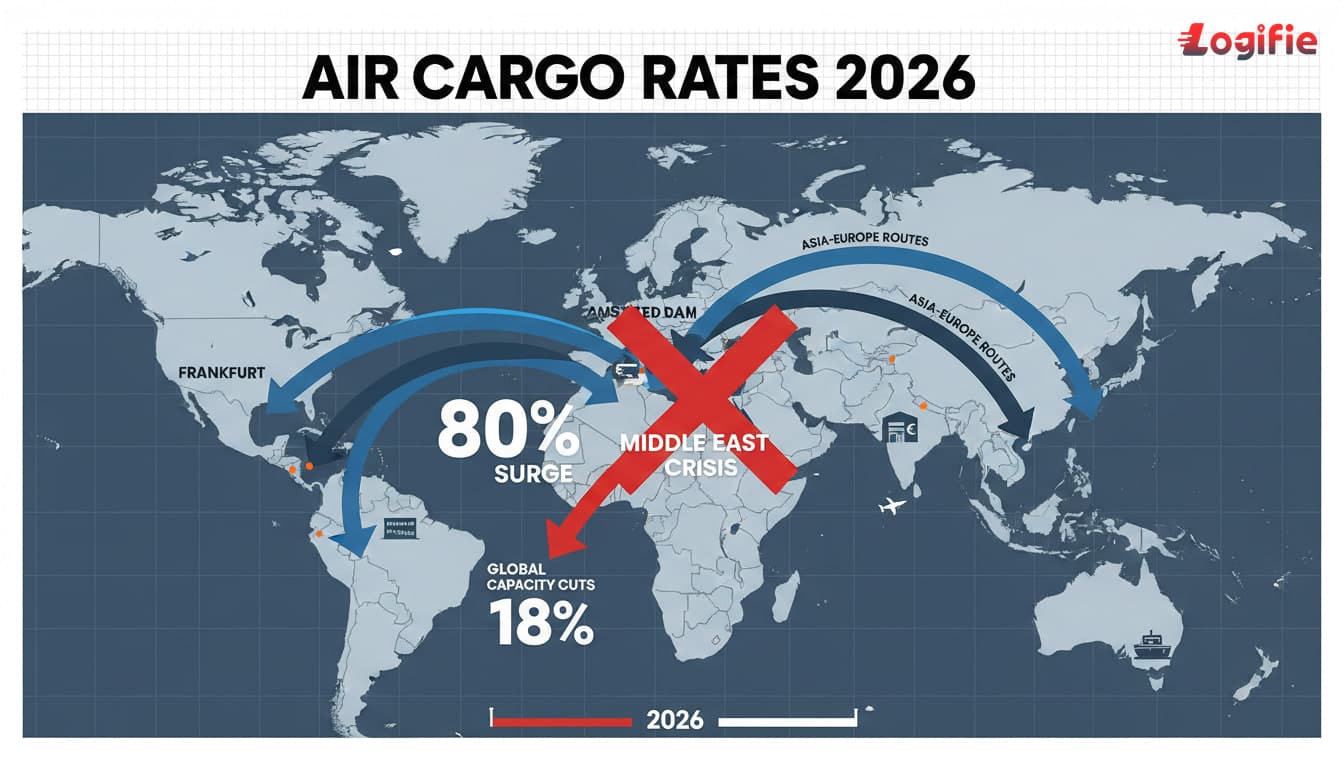
Joint US-Israeli strikes on Iran (Feb 28) closed Dubai, Abu Dhabi and Doha hubs, cutting 18% of global air cargo capacity and driving Asia-Europe rates up 35–80% in under three weeks.
Air Cargo Rates 2026: Middle East Crisis Cuts 18% of Global Capacity as Asia-Europe Routes Surge 80%
In less than three weeks, air cargo rates in 2026 have undergone their sharpest shock since the pandemic. On 28 February, a joint US-Israeli military strike on Iran triggered immediate closure of Dubai, Abu Dhabi, and Doha — the three mega-hubs that handle roughly 25% of all China-to-Europe airfreight. Global air cargo capacity collapsed by 18% overnight. Hong Kong-to-Europe spot rates surged past $5.15 per kilogram. For pharmaceuticals and electronics — sectors dependent on same-day hub connections — rates spiked as much as 400% in a 48-hour window. If your supply chain relies on air freight between Asia and Europe, this disruption is not temporary noise: it is a structural shock that demands immediate operational response.
What Happened: A 48-Hour Cascade That Rewired Global Air Cargo
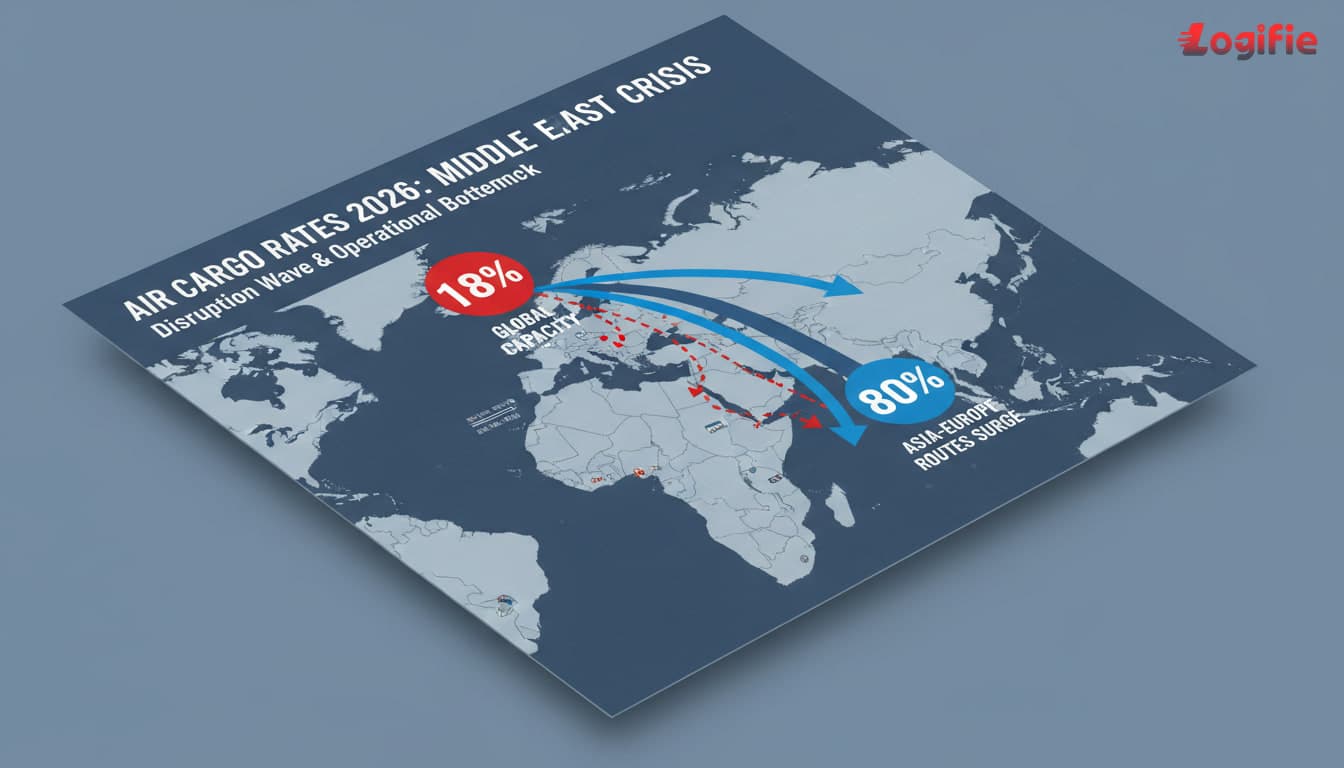
The trigger was swift. On 28 February 2026, following strikes on Iranian military infrastructure, Iran launched retaliatory missile attacks across the Gulf, striking near Fujairah and within range of Dubai International Airport. Within hours, Dubai (DXB/DWC), Abu Dhabi (AUH), and Hamad International Airport in Doha (DOH) suspended all commercial traffic. Some emergency-status flights were later permitted, but cargo operations — which depend on large-capacity freighters with inflexible scheduling windows — remained effectively grounded.
As Supply Chain Dive reported , Emirates SkyCargo, Qatar Airways Cargo, and Etihad Cargo collectively account for 13% of global airfreight capacity. Their near-total suspension, combined with dozens of other carriers halting flights to and through the Gulf, removed capacity at a rate the market had never absorbed before in a single week.
FedEx issued a service alert suspending flights to and from 11 countries: Bahrain, Iran, Iraq, Israel, Jordan, Kuwait, Lebanon, Oman, Qatar, UAE, and Saudi Arabia. DHL and UPS followed with similar advisories. Within 72 hours, the airspace over Iran, Iraq, and most of the Gulf peninsula was entirely closed to commercial overflights — eliminating the direct routing that connects European hubs to South and Southeast Asian origins.
CargoForwarder Global confirmed the scale: global air cargo capacity fell 18% week-on-week, with the South Asia–Europe corridor alone seeing available cargo tonne kilometres (ACTK) drop 39%.
By the Numbers: Air Cargo Rate Increases Since 28 February 2026
-18%
Week-on-week capacity shock after Gulf mega-hub closures on 28 February 2026.
+80%
Mid-March 2026 uplift on one of Europe’s most exposed airfreight corridors.
+400%
Peak 48-hour spot-rate jump on the most time-sensitive cargo segments.
| Route | Pre-Conflict Rate | Rate as of Mid-March 2026 | Change |
|---|---|---|---|
| Hong Kong → Europe | ~$4.00/kg | $5.15+/kg | +~30% |
| China/SE Asia → Europe | Q4 2025 baseline | 35–60% above baseline | +35–60% |
| India → Europe | Baseline | +80% | +80% |
| India → US | Baseline | +60% | +60% |
| Pharma/electronics (time-sensitive) | Spot rate | Up to 400% in 48h spike | +400% peak |
| Global capacity | Pre-crisis baseline | -18% week-on-week | -18% |
| South Asia–Europe ACTK | Normal supply | -39% | -39% |
Why Dubai, Abu Dhabi, and Doha Matter So Much to European Air Cargo
To understand the severity of this disruption, it helps to understand the hub-and-spoke architecture that powers most air cargo between Asia and Europe. Traditional point-to-point freighters exist but are expensive and infrequent. Instead, the dominant model routes cargo through a Gulf mega-hub — most commonly Dubai or Doha — where freight from dozens of Asian origins is consolidated and loaded onto widebody aircraft bound for Frankfurt, Amsterdam, London, or Paris.
According to The Loadstar , approximately 25% of all China-to-Europe air cargo moves through these Gulf hubs. For South and Southeast Asian origins (India, Bangladesh, Vietnam, Sri Lanka), the dependence is even higher — in some trade lanes, over 50% of capacity is routed through Gulf connections.
The closure of these hubs has not simply shifted cargo elsewhere. It has forced aircraft to take entirely different routes. Carriers rerouting through Central Asian corridors (over Kazakhstan, Uzbekistan) or southward through Indian airspace are adding 2 to 4 hours of flight time per sector. For a widebody freighter, that translates to higher fuel burn, reduced payload capacity per trip, and fewer rotations per aircraft per week — compounding the effective capacity shortage beyond the headline 18% figure.
How Air Cargo Rates 2026 Are Hitting European Freight Operations
For European importers and logistics managers, the disruption ripples across several categories of cargo.
Pharmaceuticals and medical devices: The European pharmaceutical sector relies heavily on air freight for temperature-sensitive active pharmaceutical ingredients (APIs) from India, which supplies more than 60% of Europe's generic drug inputs by volume. With India-Europe rates up 80%, and dedicated cold-chain capacity near-exhausted, procurement teams are reporting spot rates that render some shipments economically unviable. Airspace closure freight impact is not abstract here — it translates directly to medicine cost inflation.
Consumer electronics and high-value components: German, Dutch, and French electronics distributors sourcing from China and Vietnam have seen Hong Kong-Europe rates move from approximately $4.00/kg to above $5.15/kg. For a 10-tonne shipment of smartphones or semiconductor boards, that is an additional cost of over €11,000 per consignment at current exchange rates.
Fast fashion and apparel: The Asia-Europe airfreight spike is hitting fast-fashion supply chains disproportionately. Brands with April-May seasonal launches sourcing from Bangladesh, Vietnam, or Indonesia have limited alternatives: absorb the rate increase, shift to ocean (adding 6–8 weeks of lead time), or delay the season.
Perishables and fresh produce: Although typically less dependent on Gulf hubs, some perishable routes that used Emirates SkyCargo's belly capacity are now booking onto rerouted flights with less capacity and less predictable temperature control.
"Higher logistical costs will result for the owner of the goods, but shippers will temporarily have no issue with paying such additional fees as long as they can serve their customers on time."
- MATHEZ FREIGHT
The Rerouting Problem: Central Asia and Indian Airspace Can't Absorb the Load
The narrative that "cargo can simply reroute" is technically true but operationally painful. According to The Loadstar , aircraft being sent through Central Asian corridors or southward via India face:
Delaying reroute decisions now leaves shippers exposed to rolling airspace closures, emergency surcharges, and avoidable stock-out risk.
- 2–4 additional flight hours per sector
- Reduced effective aircraft utilisation (fewer rotations per week)
- Higher fuel burn per tonne of cargo delivered
- Slot limitations at secondary airports used as technical fuel stops (Almaty, Tashkent, Delhi)
These aren't problems that disappear with goodwill. They mean that even airlines with the will to redirect capacity cannot fully compensate for the lost Gulf throughput. The market consensus, per Freightos' weekly update , is that rates will remain elevated as long as Gulf operations are restricted — and with no clear resolution to the military conflict in sight, logistics operators should not plan around a fast return to normalcy.
What This Means for Road Freight in Europe
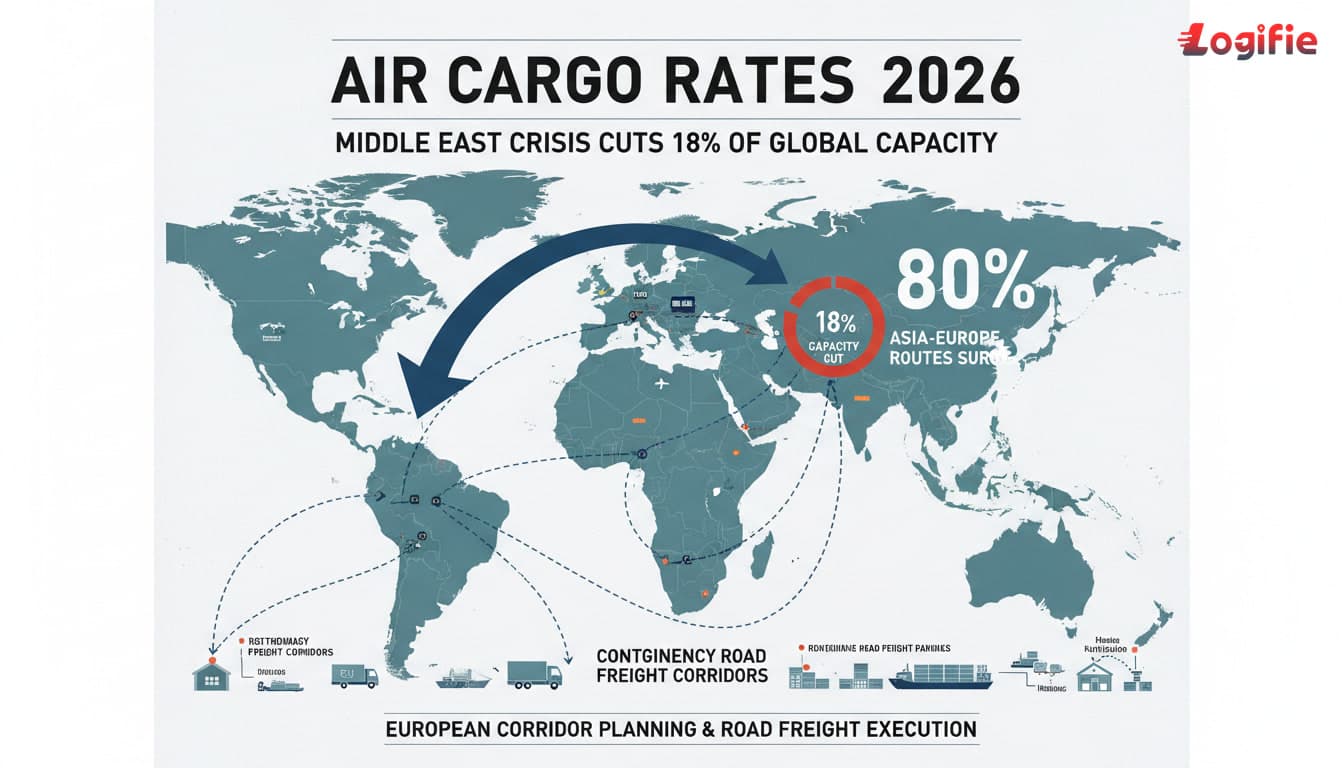
Here is the angle that rarely gets explored in air cargo coverage: when air freight becomes too expensive or unavailable, some cargo migrates to road — particularly for intra-European distribution of goods that have already reached Europe by sea or by alternative air routes.
European road freight operators serving Germany, the Netherlands, Belgium, France, and Spain can expect:
- Increased express truck demand for goods that would previously have used overnight air connections within Europe
- Higher volumes of time-critical cross-border loads as importers scramble to rebalance inventory after delayed air deliveries
- Premium rates for refrigerated road transport, as pharmaceutical companies reroute API shipments via sea-air combinations that arrive at European seaports rather than airports
For shippers managing EU cross-border distribution on tight timelines, using a platform like Logifie that provides real-time ETA visibility and route optimization across FTL and LTL lanes becomes substantially more valuable when the air option has become either unavailable or prohibitively expensive.
Check Logifie's public holidays hub to factor in upcoming national holidays across transit countries — especially relevant when re-planning deliveries around disrupted air schedules.
Practical Action Items for Logistics Managers Right Now
- Audit every air freight booking for the next 60 days: Flag shipments routing through UAE, Qatar, or Saudi Arabia — these are at direct risk of cancellation or severe delay.
- Obtain written confirmation from your air freight forwarder on routing, alternative hub options, and whether their quoted rates are spot or contract (contract rates may not protect against current surcharge clauses).
- Model the air vs. expedited ocean trade-off for non-time-critical shipments: Ocean China-Europe is running 25–35 days, but at a fraction of current air rates.
- Evaluate air-to-road alternatives for intra-European distribution legs: if air cargo lands at Frankfurt or Amsterdam instead of your preferred airport, identify pre-approved road partners who can complete the final delivery segment within SLA.
- Notify customers of potential delays and update ETA commitments proactively — especially for pharmaceuticals, electronics, and seasonal goods.
- Check whether your cargo insurance covers conflict-zone disruption — most standard policies require a war-risk endorsement for cargo affected by active military conflict.
- Increase safety stock for critical items with 8–12 week supplier lead times sourced from South Asia; even if air rates normalise in weeks, the capacity backlog will take longer to clear.
- Review fuel surcharge clauses in carrier contracts: emergency surcharges are being applied on top of base rates, and the contractual right to pass these on needs to be confirmed before accepting bookings from your own customers.
- Consider sea-air combinations via non-Gulf hubs: Istanbul (SAW), Delhi (DEL), and Colombo (CMB) are emerging as alternative transshipment points — transit time is 2–4 days longer than Gulf routing but available.
- Set up automated alerts on booking platforms for rate changes exceeding 10% — the market is moving day by day and static contract rates are no longer a reliable guide.
- Engage your road freight partner in Germany, Poland, or the Netherlands to reserve capacity for inbound re-routing — when air cargo lands at an unexpected port of entry, truck capacity is the bottleneck that determines your customer's delivery window.
- Track the [Logifie fuel prices hub](https://logifie.com/fuel) to monitor diesel trends across Germany, France, Poland, and Spain — air disruptions combined with fuel volatility will interact in freight rate negotiations over the coming weeks.
FAQ
How much have air cargo rates increased in 2026? Air cargo rates in 2026 have increased significantly depending on the trade lane. China and Southeast Asia to Europe have seen rates rise 35–60% above Q4 2025 levels. India-to-Europe rates are up approximately 80%. On time-sensitive routes for pharmaceuticals and electronics, spot rates spiked as much as 400% in a 48-hour window following the closure of Gulf hubs on 28 February. The Hong Kong-to-Europe spot rate is now above $5.15 per kilogram, up from approximately $4.00 before the conflict.
Which airlines have suspended flights to the Middle East? FedEx suspended cargo operations to and from 11 countries including UAE, Qatar, Saudi Arabia, Israel, Iraq, and Iran. Emirates SkyCargo, Qatar Airways Cargo, and Etihad Cargo suspended or severely reduced operations after their home airports were closed or restricted. DHL and UPS issued similar advisories. These three Middle Eastern mega-carriers collectively represent around 13% of global air cargo capacity, explaining why the market-wide impact has been so severe.
How does the Middle East air cargo crisis affect European logistics? European importers face higher costs and longer lead times for goods sourced from Asia and South Asia. South Asia-to-Europe available cargo tonne kilometres (ACTK) fell 39%, creating an acute capacity shortage. Pharmaceuticals, electronics, and seasonal apparel — all heavily reliant on Gulf hub connections — are most affected. European road freight is seeing secondary demand increases as importers reroute shipments through European seaports and need inland distribution completed faster. Logistics managers should not expect rates to normalise until Gulf airspace reopens and the capacity backlog clears — a process that typically takes 4–8 weeks after the initial disruption resolves.
Ready to move freight across Europe with real-time visibility? Get a Free Quote | Join Our Carrier Network
Sources
Middle East Supply Chain Disruptions Shake Global Air and Sea Freight
Iran conflict tests 2026 air cargo outlook
Airfreight rates on Asia-Europe and India trade lanes soar
Air cargo shippers scramble to mitigate Iran war impacts
Middle East crisis forces air cargo re-routes as Asia-Europe rates jump
The Cost of Air Cargo Is Rising Amid Mideast War Disruptions
Iran war pushing air rates up, and disrupting ocean