Digital Freight Forwarding vs Traditional Forwarding
Freight forwarding sits at the heart of global trade, orchestrating the movement of goods across oceans, borders and last-mile networks. For decades, forwarding relied on phone calls, faxes and spreadsheets. Today,...

Logifie Team
Logistics Technology Experts
Freight forwarding sits at the heart of global trade, orchestrating the movement of goods across oceans, borders and last-mile networks. For decades, forwarding relied on phone calls, faxes and spreadsheets. Today, digital platforms promise instant quotations, real-time tracking and automated documentation. But how do digital freight forwarders differ from their traditional counterparts, and why does it matter to shippers? This article contrasts old-school forwarding with modern digital freight forwarding and offers guidance on choosing the right logistics partner.
The Legacy Model: Manual Processes and Limited Visibility
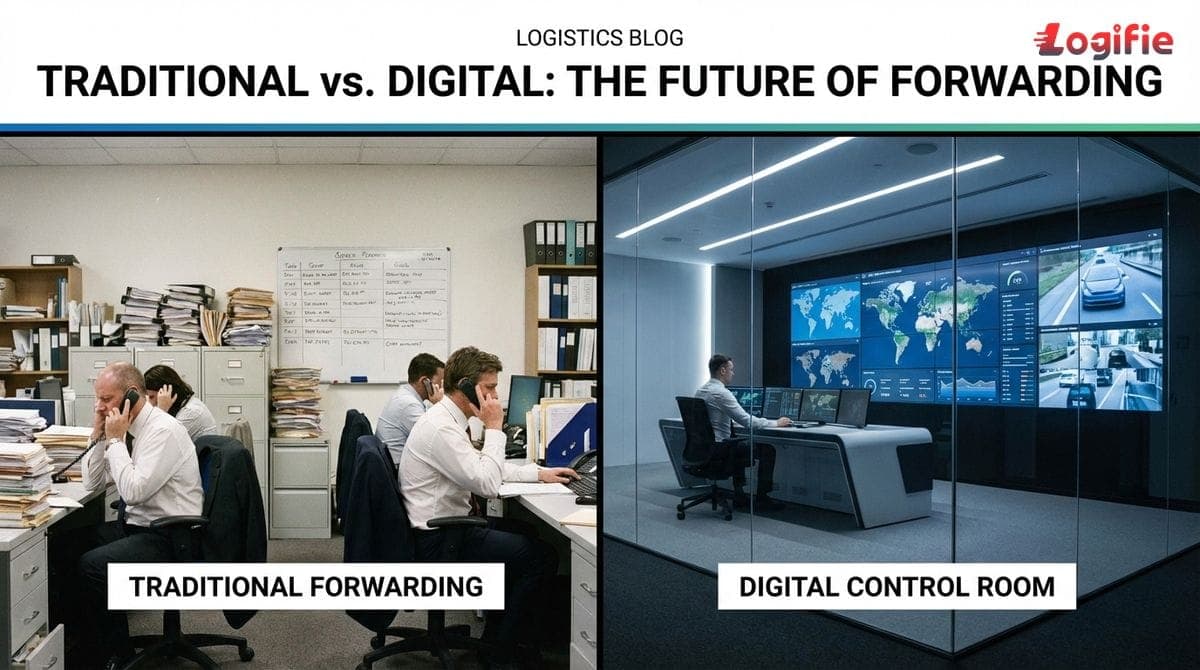
Traditional freight forwarding grew out of an era when shipping documents travelled slower than the cargo. Booking a container often meant a string of emails and phone calls to brokers, carriers and customs agents. A shipper might wait up to 100 hours to receive a quotation because forwarders had to check rates with multiple carriers and manually prepare documents. Paperwork - from bills of lading to customs declarations - was exchanged by fax or courier, leading to errors and delays.
Manual workflows not only slow down the customer experience but also raise costs. The Boston Consulting Group (BCG) estimates that automating manual processes could reduce back-office and operations costs by up to 40 %. Yet many traditional forwarders still rely on email and personal hand-offs, with only a handful offering instant quotations. Lack of integration among transport management systems (TMS), warehouse management systems (WMS) and customs brokers means shippers often have limited visibility into shipment status. When exceptions occur, customers can't take timely action to reroute goods or prevent demurrage fees.
*Caption: Split-screen illustration comparing a traditional freight forwarding office cluttered with paperwork on one side and a sleek digital control room on the other with dashboards and automated workflows.*
Digital Freight Forwarding: Platforms, APIs and Automation
Digital freight forwarders reimagine forwarding as a software-driven service. Instead of siloed processes, they build platforms that connect shippers, carriers, customs and warehouses. Core features include:
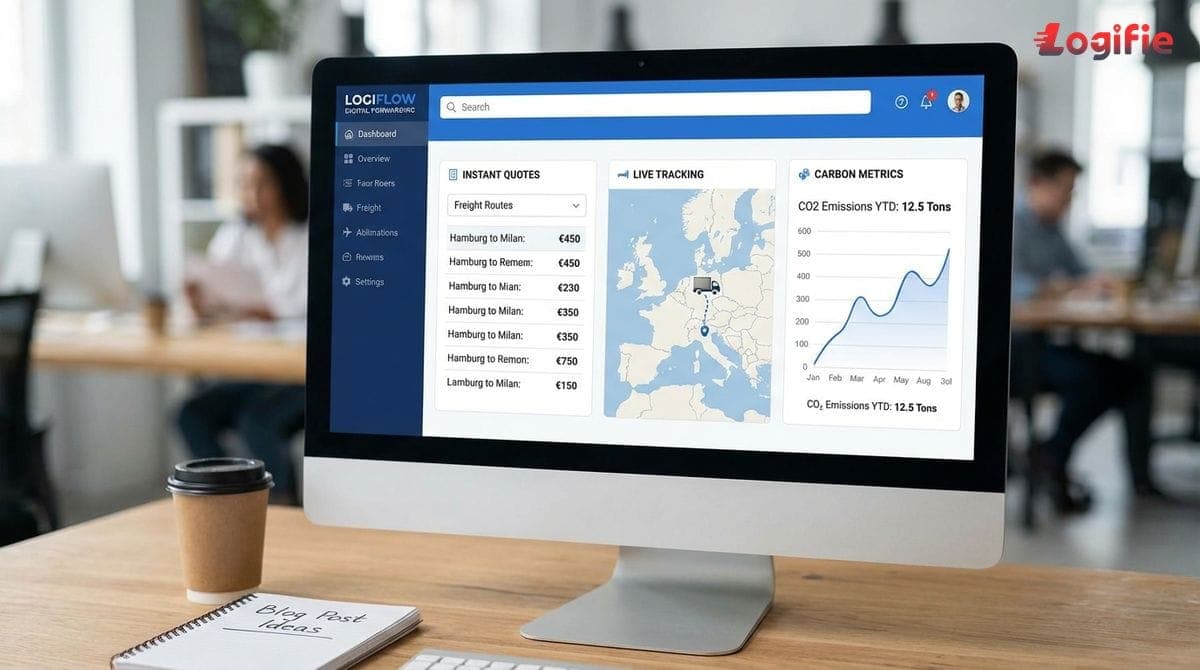
- Instant quoting and booking: Digital platforms pull live rates from carriers and compute quotations in seconds. Shippers log into a web portal, compare options and book shipments without waiting days for responses.
- Real-time shipment visibility: Internet of Things sensors and carrier integrations provide map-based tracking, ETA predictions and exception alerts. Shippers receive proactive notifications rather than calling a dispatcher for updates.
- Automated documentation and payments: Bills of lading, commercial invoices and customs forms are generated and shared electronically. Blockchain or secure document management ensures authenticity. Invoices and payments flow through the platform.
- Data centralization and analytics: All shipment data is stored in a single system. Analytics dashboards show lane performance, emissions per shipment and carrier reliability. API connections allow integration with the shipper's enterprise resource planning (ERP) or transportation management system (TMS).
A 2023 survey by Maersk notes that digital freight forwarders currently account for about 8 % of the total freight forwarding market, but their share is growing rapidly at around 23 % CAGR, compared with roughly 4 % CAGR for the overall forwarding market. Allied Market Research reports that the digital freight forwarding market was valued at USD 2.92 billion in 2020 and is expected to reach USD 22.92 billion by 2030, a compound annual growth rate of 23.1 %. Businesswire's 2025 report projects that the market will reach USD 94.8 billion by 2030 with a CAGR of 18.8 %, reflecting how quickly digital platforms are gaining traction.
Benefits of Going Digital
Digital freight forwarding isn't just about speed; it delivers tangible benefits for both shippers and forwarders. Major advantages include:
1. Visibility and Transparency
Maersk emphasizes that digitalization allows for fast data sharing among carriers, suppliers and customers, delivering unprecedented visibility and transparency. Customers today expect authentic, near real-time data to see how their products are moving, identify bottlenecks and avoid demurrage charges. Digital platforms provide map-based tracking, ETA predictions and exceptions alerts - features rarely available in traditional forwarding.
2. Speed and Efficiency
Automated processes remove paperwork and phone-tag delays. Quotes that once took days can be generated instantly. The BCG report notes that digitizing sales processes could reduce direct costs even further than back-office automation. During disruptions, digital platforms can reassign capacity or reroute shipments quickly. Maersk highlights that technology automates repetitive, time-consuming tasks such as freight tracking and quote generation, freeing human resources for strategic work.
3. Scalability and Flexibility
Digitalization levels the playing field. Smaller forwarders can operate globally by leveraging cloud-based platforms and integrations rather than building proprietary systems. Maersk notes that digital forwarders can expand service offerings and geographic reach more easily, and back-office automation allows them to do more with less. When demand surges, API-connected platforms can scale without adding staff.
4. Customer Experience
Digital tools improve customer service by allowing clients to search, book, amend and track shipments online. The Cooperative Logistics Network says that value-added services, timely delivery and immediate response are hallmarks of good freight forwarding service. Automation ensures quotes and documents are available almost immediately.
5. Decarbonization and Sustainability
Freight transport accounts for about 8 % of global GHG emissions. Digital platforms help monitor emissions and identify reductions. They integrate AI route optimization, dynamic load matching and multi-modal planning to cut fuel use. Unicargo notes that digital freight forwarding automates processes, optimizes routes based on real-time data and improves tracking, boosting efficiency and reducing emissions.
6. Data-Driven Decision-Making
Digital freight forwarders centralize data across shipments, enabling advanced analytics. Logistics managers can compare carrier performance, on-time rates and carbon intensity to select optimal partners. McKinsey's 2023 survey of 250 logistics leaders found that expanding digital logistics capabilities can improve operational performance by 10-20 % in the short term and 20-40 % within two to four years. The survey also indicates that digital tools help companies derisk their earnings by up to 60 %, boosting valuations as customers increasingly favour green, reliable service.
*Caption: Illustration showing a digital freight platform dashboard with instant quoting, real-time tracking and emissions reporting alongside automated document flows.*
What Traditional Forwarders Still Offer
Digitalisation isn't a silver bullet. Traditional forwarders offer advantages that digital-only platforms may lack:
- Local expertise and relationships: Established forwarders have long-standing relationships with carriers, customs officials and local agents. These relationships can be invaluable for unusual cargo, regulatory issues or complex project logistics.
- Value-added services: Many forwarders provide warehousing, customs brokerage, insurance, project forwarding and other services that require human expertise and physical assets. Magellan Logistics points out that human-in-the-loop systems often yield the best outcomes.
- Bespoke solutions: Traditional forwarders can tailor services to customers with unique requirements. They often handle exceptions personally, something automated platforms may not address fully.
- Hybrid models: Some forwarders blend digital tools with human expertise, offering self-service portals for routine shipments while providing personal support for complex moves. This hybrid approach combines the scalability of digital systems with bespoke problem-solving.
Choosing the Right Forwarder
When evaluating freight forwarders, consider the following criteria:
- Technology capability: Does the provider offer a modern platform with real-time tracking, API integrations and emissions reporting? Are their systems integrated with your TMS and WMS?
- Service portfolio: Beyond transport, do they offer customs brokerage, warehousing, insurance and value-added services?
- Network and scale: What is their carrier network coverage? Can they handle your key trade lanes and volumes?
- Customer support: Is there a dedicated support team for exceptions and complex shipments?
- Sustainability: Can the forwarder measure and reduce emissions? Do they participate in green initiatives or offer carbon-offset programs?
- Data ownership and security: Understand how your data is stored, who owns it and how it is secured. Ensure the provider complies with data protection regulations.
Choosing between a digital freight forwarder and a traditional one doesn't need to be an either-or decision. Many shippers adopt a hybrid strategy, using digital platforms for standard shipments and engaging traditional forwarders for specialized moves. Providers like Logifie integrate AI route optimization and real-time tracking into their operations while retaining human expertise for complex shipments.
Future Trends: What's Next for Freight Forwarding
The logistics industry continues to evolve rapidly. Several trends will shape the next decade:
- Artificial intelligence and predictive analytics: AI will become integral to demand forecasting, route optimization and dynamic pricing. Leading platforms already use machine learning for predictive ETA, capacity planning and anomaly detection.
- Blockchain and digital documentation: Secure, tamper-proof document exchange via blockchain will reduce fraud and speed up customs clearance. Smart contracts may automate payments once delivery milestones are met.
- IoT and smart containers: Connected containers and sensors will provide granular data on location, temperature, humidity and shocks, enabling proactive exception management.
- Sustainability and emissions transparency: Regulations (e.g., EU's Corporate Sustainability Reporting Directive) will require detailed emissions reporting. Freight platforms will integrate carbon calculators and allow shippers to choose lower-carbon routes.
- Platform consolidation: As digital forwarders grow, the market is likely to consolidate. Platforms that integrate sea, air, rail and road will offer "one-stop-shop" freight services.
Conclusion
Digital freight forwarding represents a major shift in how goods move across the globe. By replacing phone calls and paper with platforms, APIs and automation, digital forwarders deliver faster quotes, higher visibility and lower costs. Market data shows that digital freight forwarding is growing at double-digit rates, outpacing the overall forwarding industry and attracting significant investment. At the same time, traditional forwarders continue to provide deep expertise, value-added services and personal relationships that remain critical for complex logistics.
For shippers, the best approach is often to blend the two: leverage digital platforms for routine moves while partnering with experienced forwarders for specialized logistics challenges. Logistics companies like Logifie embrace this hybrid model, combining AI-enabled platforms with seasoned professionals. As technology and sustainability pressures intensify, choosing a partner that can adapt will be essential.
Sources
Digital Freight Forwarding Market Size, Share, Competitive Landscape and Trend Analysis Report, 2021-2030 (Allied Market Research, 2021) - Summarizes the global digital freight forwarding market, estimating it at USD 2.92 billion in 2020 and projecting it to reach USD 22.92 billion by 2030 at a 23.1% CAGR.
On the road to digitalisation in freight forwarding (A.P. Moller - Maersk, 2023) - Discusses the digitalisation of freight forwarding, stating that digital forwarders hold about 8% market share and grow at ~23% CAGR versus 4.2% for the overall market. Also highlights benefits such as visibility, speed, scalability and decarbonisation.
The Digital Imperative in Freight Forwarding (Boston Consulting Group, 2018) - Explains that automating manual processes could reduce back-office and operations costs by up to 40% and notes that shippers often wait up to 100 hours for a quotation in traditional forwarding.
Digital logistics: Technology race gathers momentum (McKinsey & Company, 2023) - Reports that digital logistics capabilities can improve operational performance by 10-20% in the short term and 20-40% within two to four years, and that digital tools help derisk earnings by up to 60%.
Digital Freight Forwarding Strategic Industry Report 2024-2030: Growing Need for Supply Chain Resilience Propels Adoption of Digital Freight Platforms (Business Wire, 2025) - Press release summarizing a ResearchAndMarkets report that values the digital freight forwarding market at USD 33.6 billion in 2024 and forecasts it to reach USD 94.8 billion by 2030, growing at an 18.8% CAGR.
Beyond Borders: Exploring Digital Freight Forwarding Trends for 2024 and Beyond (Unicargo, 2023) - Highlights that digital platforms reduce empty miles, optimize routes and enhance visibility, thereby boosting efficiency and reducing emissions.
Traditional vs Digital Freight Forwarding (Magellan Logistics, 2024) - Argues that human expertise and local relationships remain valuable and suggests combining digital tools with human guidance for optimal outcomes.