EU Road Freight Regulations 2026: Van Tachographs, Emission Zones, and AEB Mandates Explained
Van tachograph mandate, AEB for trucks, new emission zones, German wage hike — every EU road freight regulation hitting in 2026, with costs and deadlines.

Logifie Team
Logistics Technology Experts
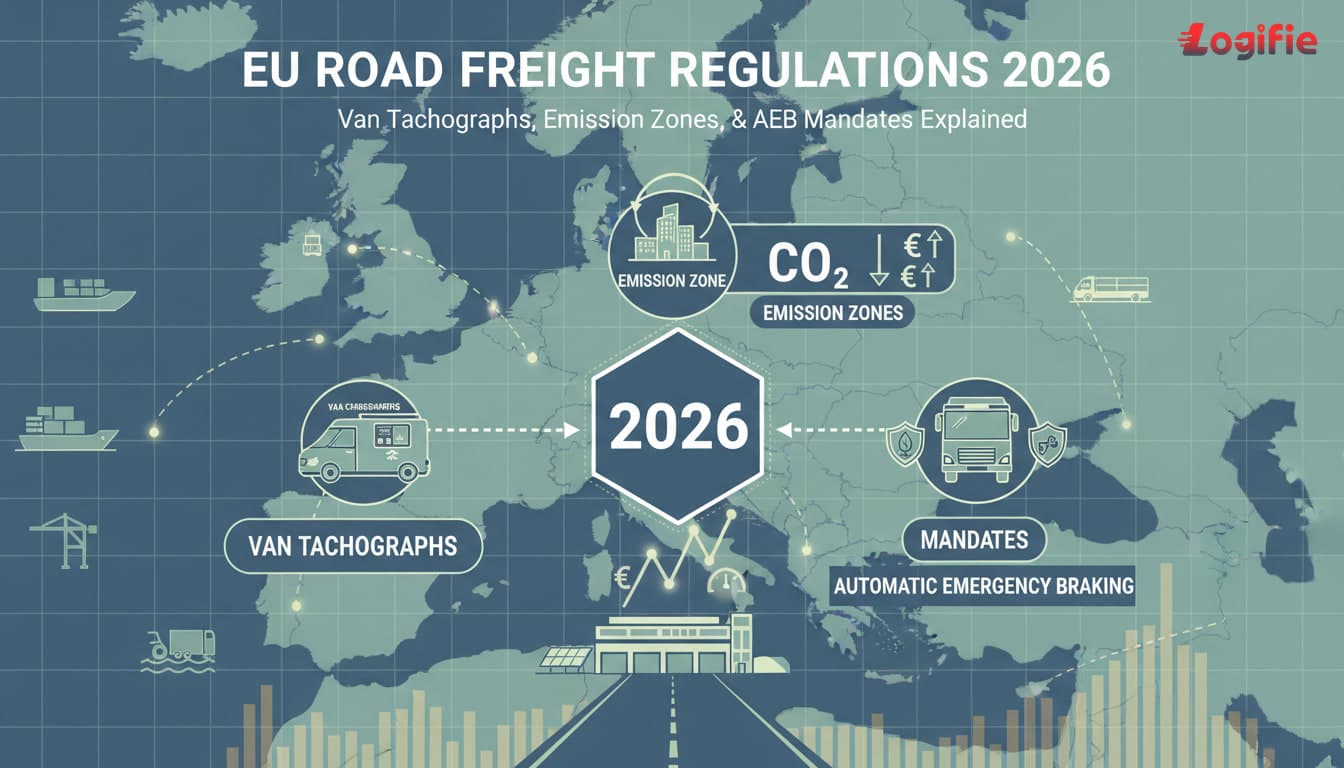
A wave of EU regulations hits road freight in 2026: van tachographs from July, truck AEB mandates, expanded emission zones, and Germany's minimum wage increase.
EU Road Freight Regulations 2026: Van Tachographs, Emission Zones, and AEB Mandates Explained
European road freight operators are facing the most concentrated wave of regulatory change in years. Within the next four months, van operators must install smart tachographs, newly manufactured trucks must include advanced emergency braking systems, new low emission zones take effect in Italy and Poland, and Germany's minimum wage increase is already pushing up labour costs on every corridor touching the country. According to the IRU , the van tachograph mandate alone affects up to 3 million vehicles across Europe.
This guide maps every major EU road freight regulation hitting in 2026, the deadlines, the costs, and what carriers and shippers need to do to stay compliant.
What EU Regulations Affect Road Freight in 2026?
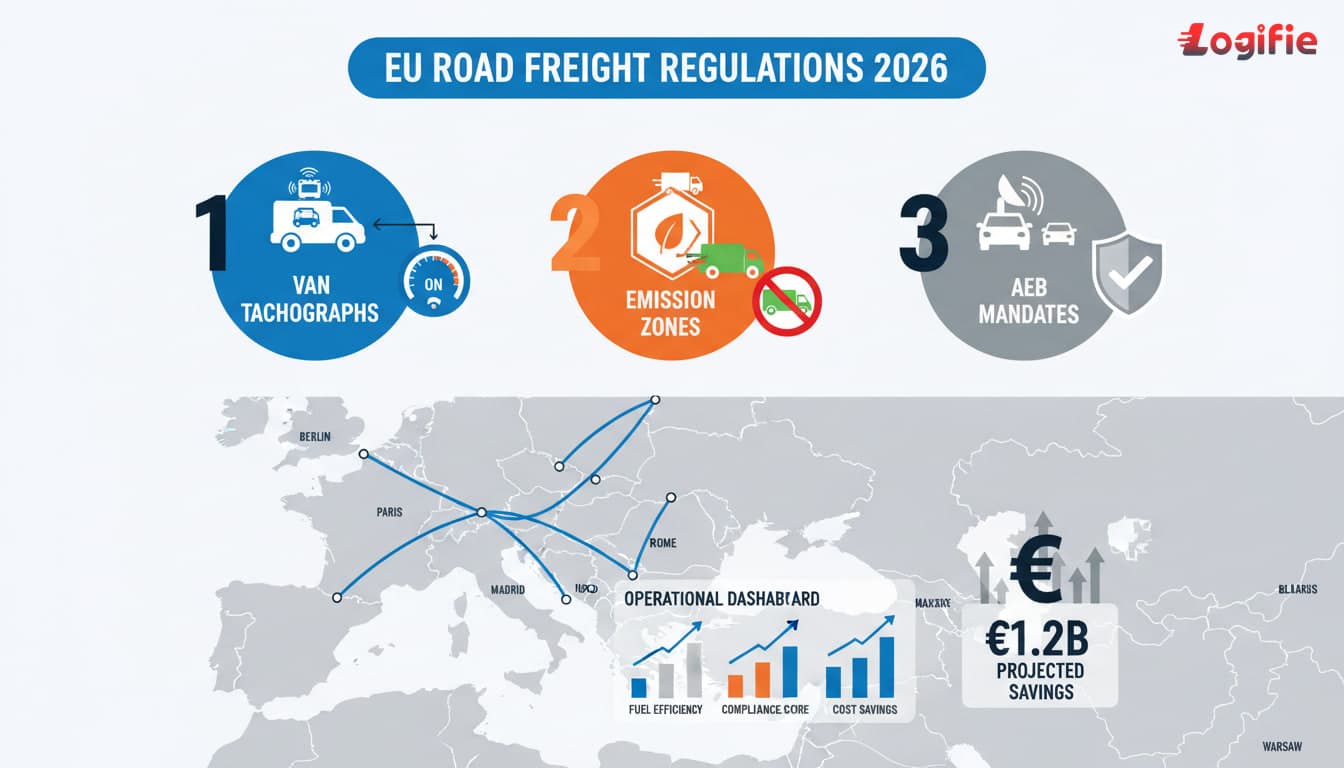
The 2026 regulatory wave spans safety, working conditions, environmental access, customs procedures, and labour costs. Here is the complete timeline:
January 1, 2026
Key figure highlighted in the regulation comparison.
January 1, 2026
Key figure highlighted in the regulation comparison.
Vehicles entering ~60% of Krakow city area
Key figure highlighted in the regulation comparison.
| Regulation | Effective date | Who is affected |
|---|---|---|
| Germany minimum wage increase to €13.90/hour | January 1, 2026 | All carriers with drivers working in/through Germany |
| Krakow Low Emission Zone (LEZ) launches | January 1, 2026 | Vehicles entering ~60% of Krakow city area |
| ELO electronic logistics envelope for EU-UK via France | January 2026 (fully operational) | All shipments between EU and UK routed through France |
| Netherlands nationwide environmental zone adjustments | January 1, 2026 | Vehicles operating in Dutch urban areas |
| Italy Euro 5 diesel ban (Piedmont, Lombardy, Emilia-Romagna, Veneto) | October 2026 (postponed) | N1–N3 vehicles in northern Italy's 4 regions |
| Van tachograph mandate (G2V2) for international freight | July 1, 2026 | Vans 2.5–3.5t performing cross-border transport |
| Advanced Emergency Braking (AEB) for new trucks | July 7, 2026 | Newly manufactured trucks |
| Event Data Recorder (EDR) for new buses/trucks | 2026 (new homologations) | Newly type-approved buses and trucks |
Source: trans.info , trans.info , Vervo
Van Tachograph Mandate 2026: The Biggest Operational Shift
What changes on July 1
From July 1, 2026, all vans weighing 2.5 to 3.5 tonnes that perform international transport of goods within the EU must be equipped with second-generation smart tachographs (G2V2) . This brings light commercial vehicles under the same driving and rest time rules that have applied to trucks for decades.
The regulation stems from the EU Mobility Package I, which aimed to level the competitive playing field between truck and van operators. Until now, van operators performing cross-border freight have been largely exempt from tachograph requirements — a gap that some operators used to undercut truck-based freight pricing while running longer hours with less regulatory oversight.
Scale and cost of the van tachograph mandate
The numbers are substantial. The IRU estimates up to 3 million vehicles across Europe are affected. The hardware cost for a G2V2 tachograph device is approximately €1,000 per unit without installation . Beyond hardware, operators must budget for driver cards and company cards (typically €50–100 per card), staff training on driving and rest time rules, procedure updates for compliance management, and software for data reading and archiving.
For a fleet of 20 vans doing international work, the tachograph compliance cost alone is roughly €25,000–€35,000 — a significant one-time hit for SME operators, many of whom have never dealt with tachograph obligations before.
Technical challenges
Few vans are factory-adapted for G2V2 tachograph installation, meaning aftermarket fitting is required for the vast majority of existing vehicles. Workshop capacity may become a bottleneck as July approaches — operators who delay until June risk being unable to secure installation slots in time.
The IRU has been pushing the European Commission for transitional support measures, including phased enforcement and simplified training requirements for van drivers unfamiliar with the tachograph system.
Truck AEB Requirement Europe: Safety Mandates from July 7
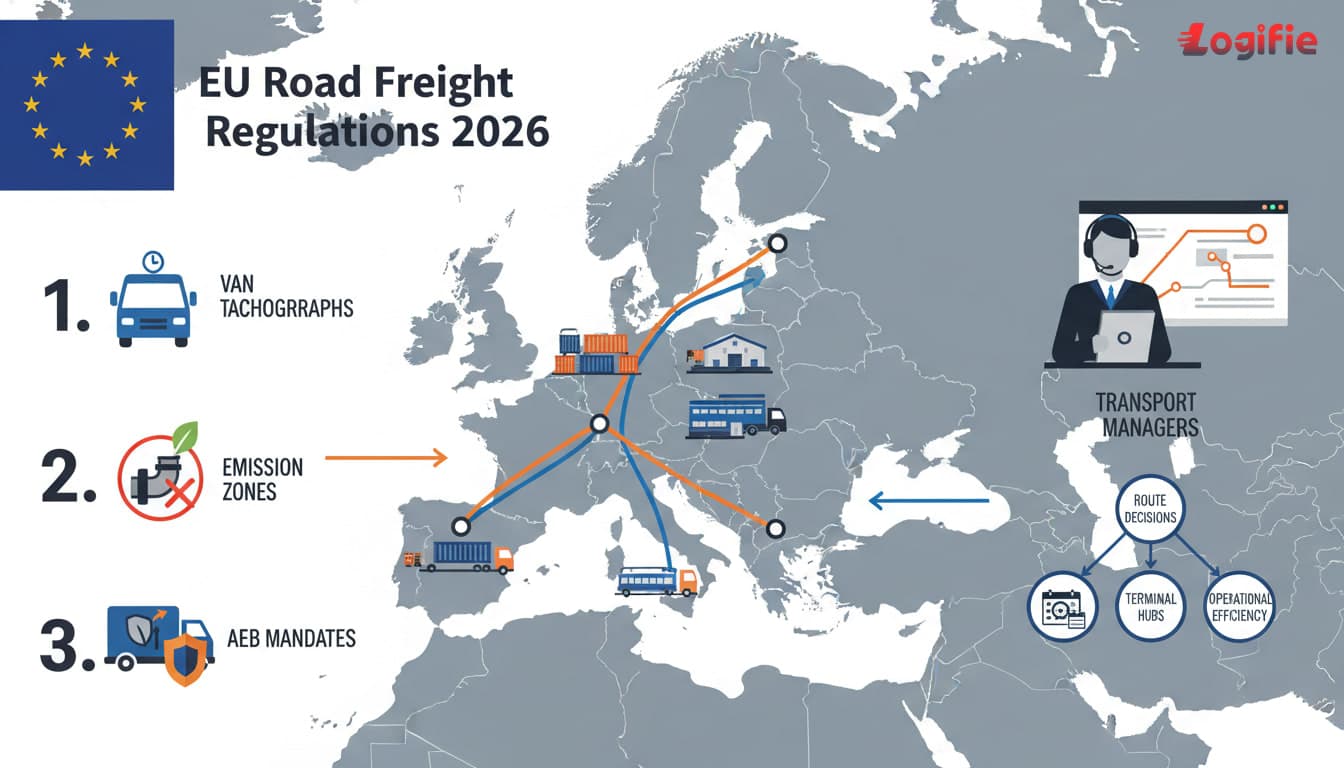
From July 7, 2026, all newly manufactured trucks must be equipped with Advanced Emergency Braking (AEB) systems that meet the latest EU General Safety Regulation standards. AEB systems automatically apply the brakes when the vehicle detects an imminent collision with a vehicle, pedestrian, or cyclist ahead.
Separately, from 2026, all newly type-approved buses and trucks will require Event Data Recorders (EDR) — essentially "black boxes" that record key vehicle data in the seconds before and during an accident. Coverage extends to all vehicles in these categories from 2029.
For carriers purchasing new vehicles, AEB and EDR add to the purchase price — though manufacturers have been progressively integrating these systems, and the incremental cost per vehicle is moderate compared to the tachograph retrofit required for vans. The operational benefit is measurable: AEB systems have been shown to reduce rear-end collisions significantly, which directly impacts fleet insurance premiums and accident-related downtime.
Emission Zones Europe 2026: Italy, Poland, and the Netherlands
There are now over 320 low emission zones across Europe , with roughly half located in Italy. The 2026 additions and changes are particularly relevant for road freight operators:
Italy: Euro 5 diesel ban in four regions
Italy has introduced a ban on Euro 5 diesel vehicles in categories N1–N3 across four northern regions: Piedmont, Lombardy, Emilia-Romagna, and Veneto. Originally planned for January 2026, the ban has been postponed to October 2026 . Fines start at €168 per violation, with repeated offences potentially resulting in a one-month vehicle ban.
This is critical for road freight flowing through the Milan–Turin–Bologna industrial triangle — one of Europe's densest logistics corridors. Carriers operating Euro 5 diesel trucks on Italian routes through these four regions must plan fleet upgrades or face operational restrictions from October onward.
Poland: Krakow's first LEZ in Central-Eastern Europe
Krakow launched its Low Emission Zone on January 1, 2026 , covering approximately 60% of the city's area. The restrictions roll out in phases: from July 2026, all vehicles entering the zone must meet at least Euro 3 for petrol and Euro 5 for diesel.
This is the first LEZ in Central and Eastern Europe — a signal that emission-based access restrictions are spreading eastward. Carriers serving Krakow's industrial and distribution hubs need to verify their fleet's compliance status.
Netherlands: nationwide zone adjustments
From January 1, 2026, the Netherlands applies nationwide exemptions and transition periods for its environmental zone framework. The changes adjust access requirements across Dutch cities, and operators should review the specific requirements for each municipality they serve.
For carriers managing complex multi-country routes, the Logifie FAQ can help clarify which documentation and compliance requirements apply to cross-border shipments.
Germany Minimum Wage and Road Freight Compliance Cost
Germany's statutory minimum wage increased to €13.90 per hour from January 1, 2026 , with a further increase to €14.60 planned for 2027. For road freight, this has a direct impact: drivers working in or transiting through Germany must be paid at least the German minimum wage for the hours spent in the country, under the EU's posted worker rules.
On freight lanes touching Germany — which includes virtually every major East-West and North-South corridor in Europe — this wage floor increases the labour cost component of freight rates. Combined with the diesel price surge currently hitting the market, German-touching lanes are facing a dual cost squeeze from both fuel and labour.
The ELO system (Enveloppe Logistique Obligatoire), fully operational since January 2026 , adds another compliance layer for EU-UK trade routed via France. Every vehicle carrying goods between the EU and UK through French territory must now have an electronic logistics envelope created for each shipment — a digital customs document that simplifies border checks but requires IT system integration.
Road Freight Compliance Cost: Cumulative Impact Assessment
CargoON's analysis asks the right question: will all these regulations have freight rates soaring? The answer depends on fleet profile:
- Tachograph hardware + installation: ~€12,000–€15,000
- Driver cards, training, software: ~€3,000–€5,000
- Total one-time compliance cost: ~€15,000–€20,000
- Van tachograph compliance: ~€25,000–€35,000
- Italy Euro 5 fleet upgrades (if applicable): €50,000–€200,000+ depending on fleet age
- German wage compliance adjustments: ongoing operating cost increase
- ELO integration for UK-via-France lanes: €5,000–€15,000 IT investment
- Total 2026 compliance investment: potentially €100,000–€250,000+
These costs will inevitably feed into freight rates. Shippers should expect carrier rate requests that reflect regulatory compliance investment, particularly on lanes affected by multiple regulations simultaneously (e.g., a van freight service running Netherlands–Germany–Italy now faces tachograph mandate + German wage floor + Italian emission zone restrictions).
For carriers looking to offset compliance costs through expanded network access, joining Logifie's carrier network provides access to cross-border freight volumes with real-time tracking built in.
EU Road Freight Regulations 2026: Compliance Readiness Checklist
- Audit your van fleet (2.5–3.5t): identify all vehicles performing international transport and schedule G2V2 tachograph installation before June to avoid workshop bottlenecks
- Order driver cards and company cards for all van drivers who will be subject to the tachograph requirement — card issuance can take 2–4 weeks
- Train van drivers on driving and rest time rules: many have never used a tachograph, and violations carry penalties
- Check truck fleet emission standards against Italy's October 2026 Euro 5 ban if you operate in Piedmont, Lombardy, Emilia-Romagna, or Veneto
- Verify Krakow LEZ compliance for any vehicles serving the city — Euro 5 diesel minimum required from July 2026
- Review Dutch environmental zone requirements for each municipality in your delivery network
- Confirm German minimum wage compliance for all drivers transiting or working in Germany — update payroll systems if needed
- Integrate ELO system for EU-UK freight via France if you have not already done so
- Update freight rate calculations to reflect new compliance costs — communicate changes to shippers transparently
- Monitor legislative updates: Italy has already postponed its Euro 5 ban once, and further adjustments to any of these deadlines are possible — check Logifie's blog for regulatory updates
- Budget for ongoing tachograph data management: data must be downloaded from driver cards every 28 days and from vehicle units every 90 days
- Review insurance implications of AEB and EDR mandates on new vehicle purchases — these safety features may qualify for premium reductions
FAQ
What are the new EU road transport rules for 2026?
The major EU road transport regulations taking effect in 2026 include: mandatory G2V2 smart tachographs for vans (2.5–3.5t) performing international freight from July 1, Advanced Emergency Braking (AEB) systems required on newly manufactured trucks from July 7, Event Data Recorders for new buses and trucks, expanded low emission zones in Italy (Euro 5 diesel ban in four northern regions from October) and Poland (Krakow LEZ from January), Germany's minimum wage increase to €13.90/hour, and the ELO electronic logistics envelope for EU-UK shipments via France.
Do vans need tachographs from July 2026?
Yes. From July 1, 2026, vans weighing 2.5 to 3.5 tonnes that perform international transport of goods within the EU must be fitted with second-generation smart tachographs (G2V2). This brings approximately 3 million vehicles across Europe into the tachograph regime for the first time. Van drivers will also be subject to driving and rest time rules similar to those for truck drivers. The hardware cost is approximately €1,000 per device, plus installation, driver cards, training, and software for data management.
How much will new EU regulations cost freight operators?
Costs vary significantly by fleet size and profile. A small van operator with 10 international vehicles faces approximately €15,000–€20,000 in one-time tachograph compliance costs. A mid-size carrier with 50 trucks and 20 vans operating cross-border could face €100,000–€250,000 or more when combining tachograph hardware, Italian fleet upgrades for emission zone compliance, IT integration for the ELO system, and ongoing German minimum wage adjustments. These costs will inevitably feed into freight rate increases across affected corridors.
Ready to move freight across Europe with real-time visibility? Get a Free Quote | Join Our Carrier Network
Sources
New EU transport rules in 2026 — trans.info
Five EU transport law changes in 2026 — trans.info
IRU takes action for EU vans — IRU
Will new regulations have road freight rates soaring? — CargoON
Transport Changes in 2026 — Vervo