European Port Congestion 2026: Hamburg Delays, Rhine Low Water and the Road Freight Surge Explained
European port congestion in 2026 is forcing cargo to road as Hamburg waits hit 2.1 days, Rhine barges lose 45% load, and Rotterdam waits reach 72 hours.

Logifie Team
Logistics Technology Experts
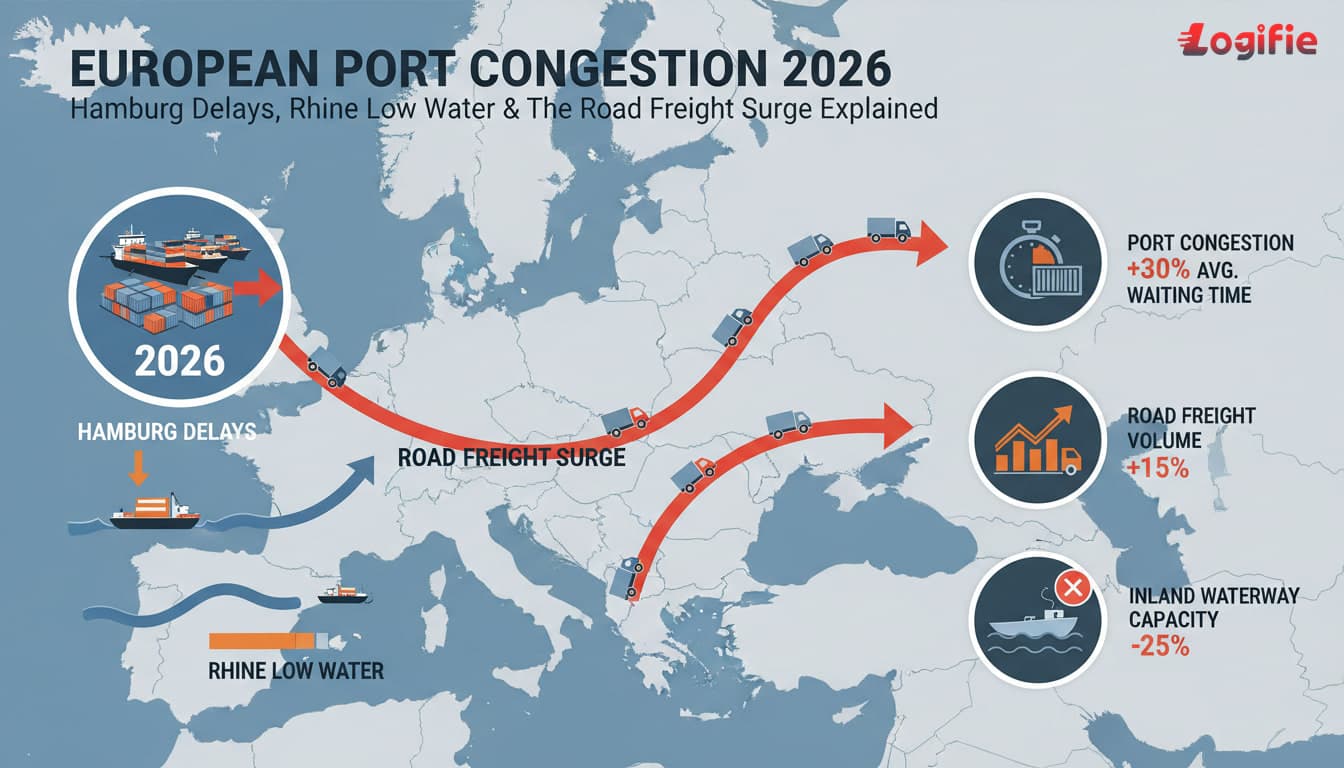
Hamburg pilot strikes push wait times to 2.14 days and CTA yard utilization to 89%, Rhine low water forces 45% barge load cuts, and Antwerp-Rotterdam barge queues hit 72–75 hours — all simultaneously in March 2026.
European Port Congestion 2026: Hamburg Delays, Rhine Low Water and the Road Freight Surge Explained
European port congestion in 2026 has reached a tipping point. Three simultaneous crises — Hamburg pilot strikes, critically low Rhine River water levels, and sky-high barge wait times at Rotterdam and Antwerp — have collided in March to create a North European logistics cascade that is forcing unprecedented volumes of cargo onto road. Hamburg's average vessel wait time hit 2.14 days in the week of March 6–13, the port's CTA yard reached 89% utilization, and Rhine barges are now hauling just 55–75% of their normal load. For logistics managers, freight operators, and shippers relying on the Hamburg-Rhine-Ruhr corridor, this is not a passing weather event: it is a structural congestion crisis that demands immediate re-routing decisions and road freight contingency plans.
What Happened: Three Crises Converging on North Europe's Freight Arteries
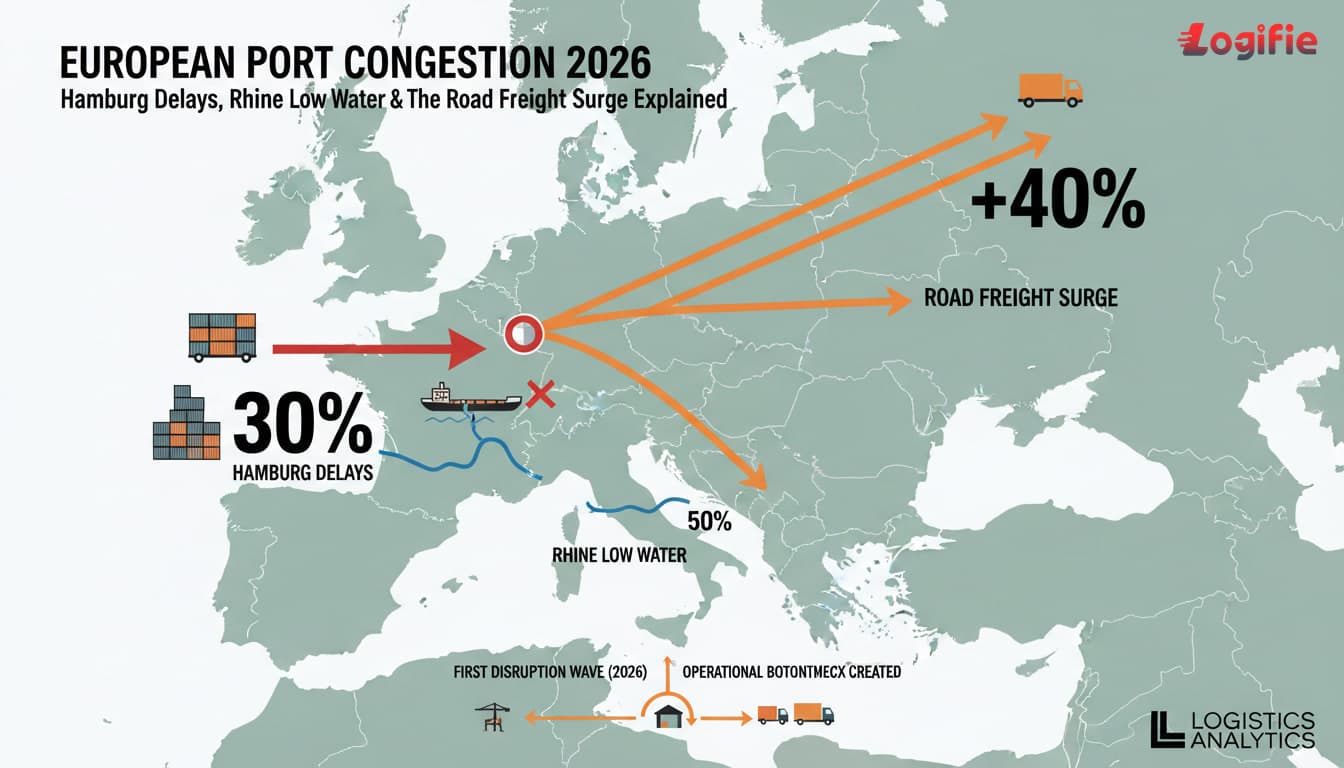
Hamburg: Pilot Strikes and Near-Critical Yard Capacity
Germany's largest container port has been under pressure throughout March 2026. Germany's ver.di union has been engaged in intermittent public sector strike action, with sea pilots participating in work stoppages that have suspended or restricted vessel movements on the Elbe.
According to the Maritime Executive , pilot action triggered a moratorium on inbound vessel movements — at its peak, no vessels requiring pilots could enter or exit Hamburg or move along the Elbe. Even in the periods between formal strike actions, the overhang of delayed arrivals and accumulated port congestion has kept wait times elevated.
Live port monitoring data from Portcast shows CTA (Container Terminal Altenwerder) yard utilization at 89% — a level that port operators consider critical. As a countermeasure, truck delivery windows for some vessels have been restricted to just 2.5 days before ETA, compressing the planning window for inland trucking and rail collection.
DredgeWire's port update for March 6–13 confirms the trend: Hamburg average vessel waiting time reached 2.14 days in that week, up from 1.37 days the prior week — a 56% increase in a single period. High import dwell times are listed as the primary structural driver.
The Rhine: Europe's Inland Motorway Hits a Wall
Running from Switzerland through Germany into the Netherlands and feeding Rotterdam, the Rhine is the single most important inland waterway for European freight. When it runs low, there is no equivalent replacement.
Everstream Analytics documents the current crisis: water levels at the critical Kaub gauge in Rhineland-Palatinate — the standard measurement point for Rhine navigability — have dropped into ranges that force barges to dramatically reduce their load or stop operations altogether. Barges that typically carry 1,500 to 3,000 tonnes are now loading under 1,000 tonnes to maintain safe draft. That represents a 25–45% load reduction, meaning operators need 30–80% more trips to move the same volume — at higher fuel cost per tonne-kilometre.
RUCA Logistics calculates the cost premium: Rhine alternatives add €200–500 per consignment compared to normal barge operations. Rail absorbs approximately 40% of diverted Rhine cargo, but rail capacity on key German corridors including Hamburg–Cologne and Hamburg–Berlin is itself running tight following service reductions through early 2026. The remainder moves to road — and that is driving a trucking demand surge across Germany, the Netherlands, Belgium, and northern France.
Rotterdam and Antwerp: Barge Queues Approaching Three Days
The port congestion is not confined to Hamburg. Logicall's market report puts barge wait times at 72 hours at Rotterdam and 75 hours at Antwerp. These are the longest sustained barge queue times seen at these ports in years.
Part of the Rotterdam congestion is structural: vessel alliance realignments in January 2026 changed calling patterns, concentrating more cargo onto fewer services with fewer departure windows per week. When vessels miss their slots — as they increasingly do in current conditions — barges that came to collect containers find themselves waiting for cargo that has not yet been discharged.
The Antwerp-Bruges port has been recovering from its own pilot and national strike earlier in March (covered separately), but the residual backlog is contributing to knock-on barge delays that affect all cargo moving into Belgium, Luxembourg, and northern France by inland waterway.
Today (March 18), it was confirmed that a planned 18–20 March dockworker strike at Le Havre has been called off after the French government showed greater receptiveness to union talks — a positive development for shippers routing through France's largest port. However, this relief for Le Havre does not materially ease the Hamburg–Rhine–Rotterdam congestion triangle that is the dominant bottleneck for North European freight flows.
European Port Congestion 2026: By the Numbers
2.14 days
Average delay for the week of March 6–13 as strike disruption and import dwell collided.
89%
Critical occupancy level compressing truck collection windows in Hamburg.
25–45%
Payload lost on inland waterway moves as low-water restrictions intensify.
| Metric | Current Level | Benchmark / Prior Period |
|---|---|---|
| Hamburg average vessel wait | 2.14 days (week of Mar 6–13) | 1.37 days (week prior) |
| Hamburg CTA yard utilization | 89% (critical) | ~75% normal operating |
| Rotterdam barge wait time | 72 hours | Typically 12–24 hours |
| Antwerp barge wait time | 75 hours | Typically 12–24 hours |
| Rhine barge load reduction | 25–45% below normal | Full load at normal gauge |
| Rhine barge load per trip | Under 1,000 tonnes | Normal 1,500–3,000 tonnes |
| Rhine cost premium (alternatives) | €200–500 per consignment | Baseline barge cost |
| Rail share of diverted Rhine cargo | 40% | — |
| Truck delivery window at Hamburg | 2.5 days before ETA | Normal 4–5 days |
How European Port Congestion 2026 Is Reshaping Freight Corridors
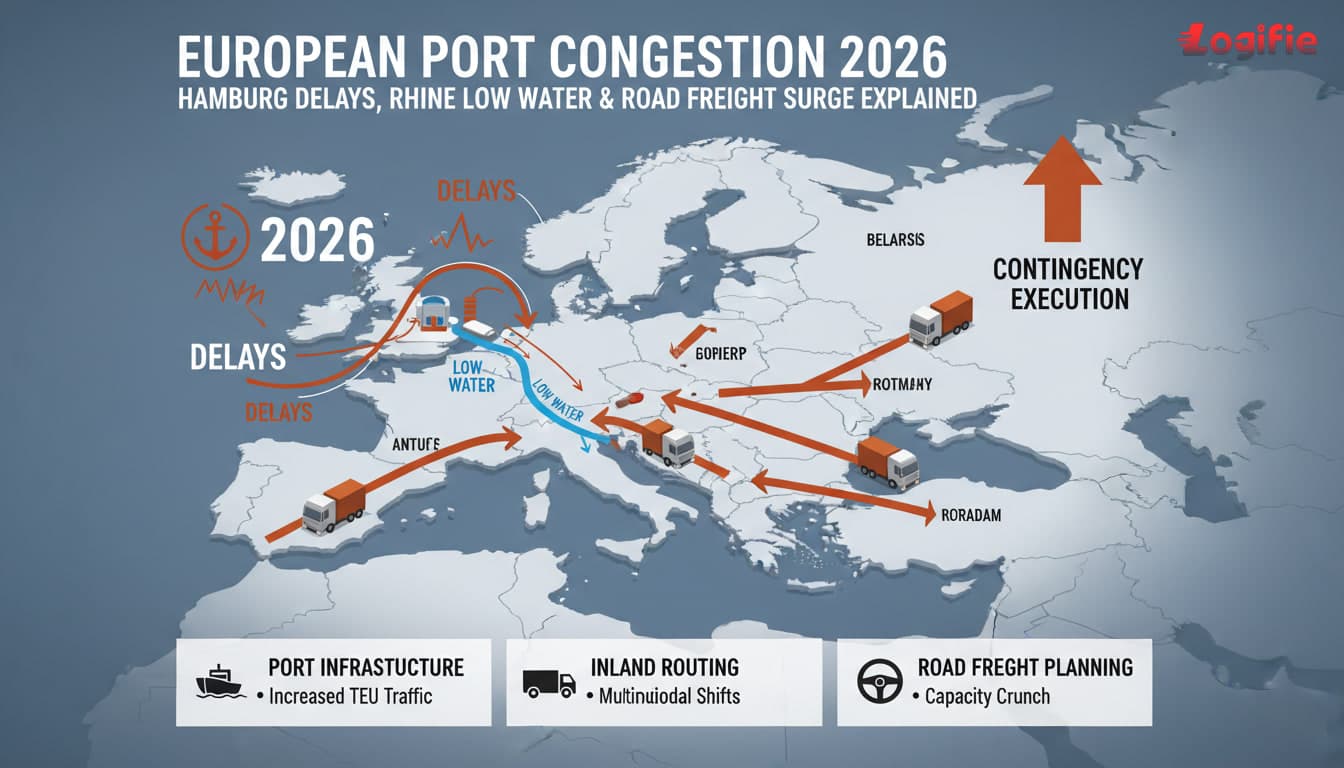
When Hamburg slows, the ripple effect moves inland and along the coast simultaneously. Carriers are reported by Metro Global to be executing port omissions at Rotterdam — Maersk has been among the services skipping Rotterdam calls to recover schedule integrity — and diverting vessels to secondary ports including Bremerhaven, Felixstowe, Zeebrugge, and Gdynia. Each diversion creates a new inland transport problem: cargo that should have arrived in Rotterdam and moved by barge to Duisburg, Cologne, or Frankfurt now needs to be trucked from an alternative port entry — longer, more expensive, and often with shorter planning horizons.
The key affected corridors for road freight include:
Hamburg → Ruhr (Germany): Normally served by Rhine barge plus short-haul truck. With barges running at half-load and wait times up 56%, road freight on this corridor is absorbing significant diverted volume, pushing rates upward for FTL loads between Hamburg, Dortmund, Essen, and Duisburg.
Rotterdam → Germany (Frankfurt, Stuttgart, Munich): The standard deep-sea container flow from Rotterdam to southern Germany moves by barge to Duisburg then truck. With 72-hour barge waits and Rhine load restrictions, shippers are requesting direct truck collections from Rotterdam — increasing demand on the Netherlands-Germany FTL corridor.
Antwerp → Belgium, Luxembourg, northern France: Similar dynamic to Rotterdam. Belgian and French importers are pulling cargo by road directly from Antwerp due to unreliable barge scheduling.
Hamburg → Poland (via Berlin-Warsaw): Eastern European shippers who rely on Hamburg inbound are facing longer wait-to-collect windows, translating to delayed FTL departures toward Poznań, Warsaw, Łódź, and Wrocław.
For carriers and shippers navigating this environment, platforms that provide real-time shipment tracking and ETA visibility — such as Logifie — are critical. When a vessel is delayed 2+ days at Hamburg, the precision of road collection timing determines whether cargo makes its promised delivery window.
Cost Implications for Shippers: What Road Freight Rate Pressure Looks Like Now
The congestion cascade has a direct cost impact on European road freight rates, particularly in spot and short-term contract markets:
Waiting for port and river conditions to self-correct leaves inland teams exposed to missed collection slots, demurrage, and premium truck buys.
- Germany-wide FTL rates are under upward pressure as demand for truck capacity from Hamburg, Bremen, and Rotterdam surges beyond normal seasonal levels.
- Cross-border LTL rates on Netherlands-Germany-Poland lanes are tightening as consolidation loads become harder to fill efficiently when cargo arrival windows are unpredictable.
- Rhine low-water surcharges are being re-applied by barge operators — for cargo that does move by barge, operators are adding €200–500 per consignment to offset partial loading economics.
- Express road freight demand — next-day or 48-hour trucking that would normally be reserved for emergency scenarios — is rising among importers trying to recover lost days caused by port delays.
Monitor Logifie's fuel prices by country alongside these developments: diesel prices in Germany, the Netherlands, and Poland are themselves elevated due to the broader Middle East energy disruption, compounding the trucking cost pressure from port congestion.
What Carriers and Shippers Should Do Right Now
- Contact your Hamburg agent today and get a confirmed ETA for any vessels due in the next 2 weeks — do not rely on liner-published schedules, which are running 1–3 days behind actual arrivals.
- Pre-book road collection capacity from Hamburg at least 3 working days ahead of vessel ETA, given the compressed 2.5-day truck delivery window now enforced at CTA.
- Check Rhine gauge levels daily via official German Waterways authority (WSA) data — the Kaub gauge is the key indicator. If levels drop below 40cm, assume full barge restrictions and plan road alternatives.
- Identify road freight providers on the Hamburg–Ruhr, Rotterdam–Frankfurt, and Antwerp–Belgium corridors who can scale volume on 24–48 hours' notice — congestion events at this scale require pre-approved emergency routing agreements.
- Negotiate detention/demurrage waivers proactively with your shipping line if vessel delays at Hamburg are causing containers to sit at port beyond free time — many carriers are granting extensions, but you must request in writing before the demurrage clock expires.
- Evaluate Gdynia and Bremerhaven as alternative gateway ports: both are operating below Hamburg's current congestion level and serve as viable entry points for cargo destined for Germany and Poland.
- Factor in national holidays: use the Logifie public holidays calendar to identify upcoming German, Dutch, and Polish public holidays that could further restrict truck availability during the congestion period.
- Communicate revised ETAs to downstream customers immediately: the cumulative delay from vessel wait + barge queue + road re-routing can add 5–10 days to total transit time — proactive communication preserves commercial relationships better than reactive updates.
- Review your freight insurance: port delays that cause cargo to remain aboard ship or sit in port storage areas increase exposure to damage and theft — ensure your policy covers extended port dwell.
- Model a 60-day scenario where Rhine remains at current low levels: climate forecasts for March–April 2026 do not guarantee a return to normal precipitation, and a sustained low-water period would keep road freight demand elevated through Q2.
- Consider intermodal alternatives for non-urgent cargo: while rail is also constrained on Hamburg-Cologne, Kombi-Verkehr and other intermodal operators still offer better economics than full spot-truck for loads that can accept 2–3 extra transit days.
- Ask your logistics partner to activate real-time ETA tracking for all road collections from affected ports — when congestion is live and dynamic, visibility is the only tool that allows proactive exception management.
FAQ
How long are vessel wait times at Hamburg in 2026? As of the week of March 6–13, 2026, the average vessel waiting time at Hamburg was 2.14 days, up from 1.37 days the prior week — a 56% increase in a single reporting period. CTA yard utilization stands at 89%, classified as critical. During acute pilot strike actions by Germany's ver.di union, the moratorium on all vessel movements means some ships have waited significantly longer. Shippers should treat any Hamburg transit time estimate as carrying at least a 2–3 day buffer in current conditions.
What is the impact of Rhine low water levels on freight? Critically low Rhine water levels — with the Kaub gauge dropping below safe navigation thresholds — force barges to cut loads by 25–45%. Barges that normally carry 1,500–3,000 tonnes now load under 1,000 tonnes, dramatically increasing the number of trips and fuel costs needed to move the same volume. The cost premium for Rhine alternatives (rail or road) runs €200–500 per consignment. Rail absorbs approximately 40% of the diverted freight; the rest moves to road, increasing trucking demand and rates across the Germany-Netherlands-Belgium corridor.
How does European port congestion push cargo to road transport? When port congestion extends vessel wait times, it compresses the inland collection window for barge and rail. At Rotterdam and Antwerp, barge wait times of 72–75 hours make just-in-time barge collection commercially unviable for time-sensitive cargo. Shippers respond by ordering direct truck collection from the port instead — a faster but more expensive option. Simultaneously, Rhine low water reduces barge capacity for cargo that does move inland, pushing further volume to road. The result is a cascading demand increase for FTL and LTL trucking on North European corridors that is currently visible in both spot rate levels and availability tightness.
Ready to move freight across Europe with real-time visibility? Get a Free Quote | Join Our Carrier Network
Sources
Port operational updates from around the world (6-13 March 2026)
Hamburg Port and Elbe Closed as Pilot Boats Join Public Sector Strike
European Ports Struggle with Congestion & Delays
Current Rhine River water levels disrupting shipping routes
Low Water Levels In Germany's Rhine River Disrupt Shipping & Increase Freight Costs
Port congestion at Hamburg — Live Delays & Vessel Wait Times
Carriers Reroute as European Ports Buckle Under Congestion