How to calculate freight cost per kilometer: European carrier's guide
Freight cost per kilometer in Europe: 1.45–1.58 EUR/km for a Euro VI truck in 2026. Formula, worked example, and how to price a profitable rate.

Logifie Team
Logistics Technology Experts
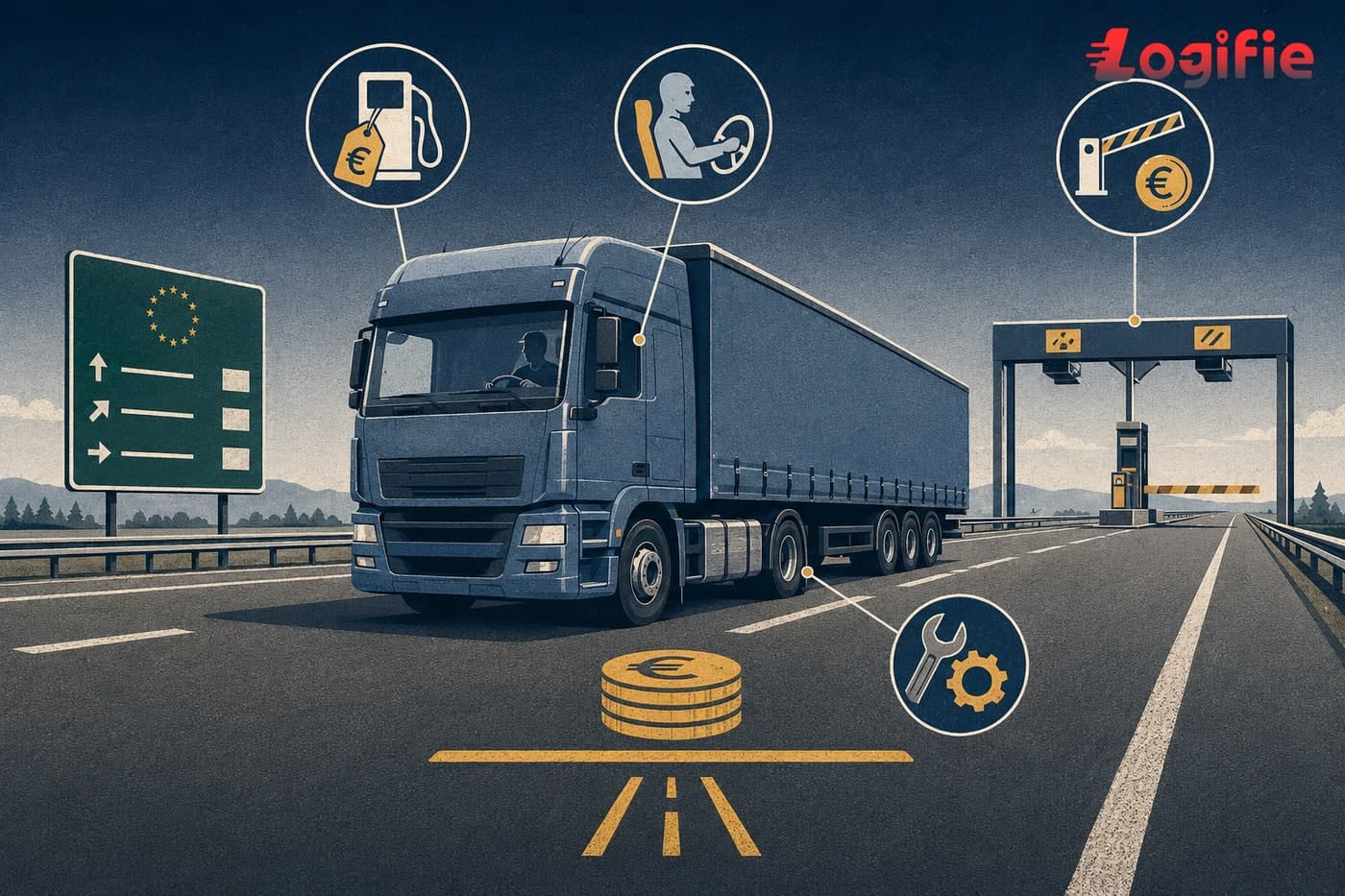
To calculate freight cost per kilometer, add together all the fixed and variable costs of running your truck over a defined period, then divide that total by the number of kilometres the truck covers in the same period. In 2026 the resulting figure for a typical articulated truck on EU roads sits at roughly 1.45 to 1.58 EUR/km to operate, according to European cost benchmarks compiled by trans.info , and the International Road Transport Union (IRU) puts the wider European range at EUR 0.50 to EUR 2.00 per kilometre depending on country, vehicle, and load profile. This guide gives you the exact formula, a worked euro-denominated example, and the step that turns a raw cost figure into a profitable quoted rate.
What does "cost per kilometer" actually mean in road freight?
Cost per kilometer is the total cost of operating a heavy goods vehicle (HGV) divided by the distance it travels. It is the single most important number a carrier can know, because it is the floor beneath every rate you quote. Quote below it and you lose money on every load; quote a margin above it and you have a sustainable business.
The figure folds in two kinds of cost. Fixed costs accrue whether the truck moves or sits idle: driver salary, vehicle depreciation or lease, insurance, and road taxes. Variable costs scale with distance driven: diesel, AdBlue, tyres, maintenance, and tolls. A common mistake among owner-operators is to track only fuel and tolls, the costs they pay at the pump and the barrier, while ignoring the fixed costs that quietly consume the rest of the margin.
There is a second, related metric that matters when you carry dense or heavy freight, and it is worth separating clearly before you start calculating.
How do you calculate cost per kilometer? The core formula and a worked example
The formula is straightforward:
Cost per km = (total fixed costs + total variable costs) over a period, divided by total kilometres driven in that period.
The discipline is in capturing every cost line honestly. Work over a full month or year so that lumpy items such as tyres and annual roadworthiness tests are spread fairly across the distance.
Here is a worked example for a five-axle Euro VI articulated truck running predominantly international routes across Western and Central Europe in 2026, assuming 11,000 loaded-and-empty kilometres per month.
Fixed costs per month
A mid-tier international driver package costs roughly 3,000 EUR per month once gross wage and tax-efficient subsistence allowances are combined, a figure consistent with see 2026 European driver salary data by country that places experienced international drivers from Poland through Germany in the 3,000 to 4,500 EUR bracket. Add a tractor-and-trailer lease of about 2,200 EUR, insurance of around 650 EUR, and road taxes plus vehicle administration of roughly 350 EUR. Fixed costs total approximately 6,200 EUR per month.
Variable costs per month
At an EU average diesel price of about 1.87 EUR/L in May 2026, per GlobalPetrolPrices data , and a realistic consumption of 30 litres per 100 km, fuel runs to roughly 6,170 EUR. Add AdBlue, tyres, and maintenance at the ICCT diesel tractor-trailer maintenance benchmark of 18.5 EUR per 100 km , which adds around 2,035 EUR, and tolls averaging roughly 3,300 EUR across a mixed German, Austrian, and French corridor. Variable costs total approximately 11,505 EUR per month.
The result
1.61 EUR/km
Total monthly cost is about 17,705 EUR over 11,000 km, giving a cost per kilometer of roughly 1.61 EUR/km. That sits just above the benchmark band, which is expected for a toll-heavy international profile, and it is the number this carrier must beat on every quoted rate.
What is cost per tonne-kilometre, and when should you use it instead?
A tonne-kilometre is the transport of one tonne of goods over one kilometre. Cost per tonne-kilometre is total cost divided by the product of tonnes carried and kilometres driven, and it is the right metric whenever weight, rather than distance alone, drives your economics.
The calculation is simple. If a load costs 2,000 EUR to move and you carry 50 tonnes over 200 km, the cost per tonne-kilometre is 2,000 divided by (50 multiplied by 200), which equals 0.20 EUR per tonne-km. AntsRoute notes that this indicator is essential for assessing the profitability of long-distance, heavy-haul transport and for negotiating rates with shippers who think in tonnage.
Use cost per kilometer for general full-truckload and partial-load planning. Switch to cost per tonne-kilometre when you haul dense bulk goods, when you compare road against rail, or when a customer prices in tonnage. For light, high-volume freight that "cubes out" before it "weighs out", neither metric alone is enough and you should price on the trailer space consumed.
Which fixed and variable costs go into your per-km figure?
Every cost line falls into one of two buckets. The table below breaks down the components for the worked example above, with each item shown as a euro amount and as a share of total monthly cost. The split is consistent with the IRU cost structure , which groups depreciation, insurance, taxes, and driver pay as fixed, and fuel, maintenance, and tolls as variable.
| Cost component | Type | EUR per month | Share of total |
|---|---|---|---|
| Driver salary and allowances | Fixed | 3,000 | 17 percent |
| Vehicle lease (tractor and trailer) | Fixed | 2,200 | 12 percent |
| Insurance | Fixed | 650 | 4 percent |
| Road tax and administration | Fixed | 350 | 2 percent |
| Diesel fuel | Variable | 6,170 | 35 percent |
| Tolls | Variable | 3,300 | 19 percent |
| Maintenance, tyres, and AdBlue | Variable | 2,035 | 11 percent |
| Total | 17,705 | 100 percent |
Fuel remains the single largest line at around 35 percent, in line with CargoON's 2026 finding that fuel represents 30 to 40 percent of operating costs. The striking shift is that tolls now rival fuel on many corridors. You can track current European diesel prices to keep the fuel line accurate, because diesel volatility in 2026 has been severe: CargoON reports EU diesel rose from about 1.56 EUR/L at the end of Q4 2025 to roughly 1.96 EUR/L by the end of Q1 2026.
What is the average cost per kilometre for a truck in Europe in 2026?
1.45–1.58 EUR/km
The 2026 benchmark for a Euro VI articulated truck is roughly 1.45 to 1.58 EUR/km, with the wider IRU range spanning EUR 0.50 to EUR 2.00 depending on country, axle count, emission class, and route. Lighter vehicles cost less per kilometre, and a light commercial vehicle (LCV) operating regionally will sit well below the articulated-truck band.
Three structural pressures defined the 2026 number. Labour costs rose, with Germany applying an 8.42 percent minimum-wage increase. Diesel spiked through Q1 2026 on geopolitical supply shocks. And tolls climbed across the network, with average inflation-linked increases of 1.5 to 2 percent from 1 January 2026 layered on top of far steeper national hikes. For context on how these costs feed through to what shippers pay, see our analysis of read how European road freight rates are set in 2026 .
How do tolls, fuel, and the empty-return leg change your real cost per km?
These three factors are where carriers most often underestimate their true cost. Each one quietly inflates the per-km figure beyond a naive fuel-only estimate.
Tolls now exceed fuel on key corridors
The headline structural change of 2026 is that per-kilometre tolls now surpass per-kilometre fuel cost in several countries. Germany's Lkw-Maut carries a CO2 surcharge of 200 EUR per tonne of CO2, pushing rates as high as 0.348 EUR/km for a five-axle Euro VI vehicle in the highest CO2 class. Austria reformed its tolls from 1 January 2026, with emission-class-1 lorries charged up to 61.27 EUR per 100 kilometres. Transporeon Market Intelligence modelling found tolls now exceed a quarter of truck transport costs in Switzerland and more than a fifth in Austria and Hungary. Country toll rates diverge sharply: Poland sits near 0.093 EUR/km on some motorways, though it raised e-TOLL rates by 40 to 42 percent in February 2026, while France averages around 0.26 EUR/km.
Fuel volatility
A consumption figure of 30 litres per 100 km is a fair planning assumption for a loaded articulated truck, but cold weather, terrain, and empty running all move it. Because diesel can swing 25 percent in a single quarter, lock your fuel assumption to a current price and revisit it monthly rather than annually.
The empty-return leg
This is the cost most often forgotten. Eurostat data shows that 21.6 percent of EU road freight vehicle-kilometres are driven empty on average , rising to 34 percent in Austria. Empty kilometres earn no revenue but still burn fuel, accrue tolls, and consume driver hours. If one in five of your kilometres is unpaid, your effective cost per revenue kilometre is materially higher than your cost per total kilometre, so always divide cost by paid kilometres when you price a one-way load. Planning round-trip loads through a load board, or checking check truck speed limits along the route to plan realistic driving times, both help shrink unproductive distance.
How do you turn cost per km into a profitable freight rate, and avoid pricing below cost?
Start from your true cost per paid kilometre, then add margin and account for empty running. If your total cost per km is 1.61 EUR but about 21.6 percent of your distance is driven empty, your cost per paid kilometre is closer to 2.05 EUR. Add a target margin of, say, 15 percent, and your minimum viable rate is around 2.36 EUR per paid kilometre.
From there, adjust for route specifics. A backhaul that fills an otherwise empty return can be priced lower because it converts a cost into revenue. A lane through high-toll Austria or Switzerland needs the toll surcharge built in explicitly. Using manage costs by lane with transport management software to track cost per lane, rather than a single blended average, is what separates carriers who quote profitably from those who discover the loss only at month-end. Shippers comparing offers can get an instant freight quote to benchmark a fair market rate against your cost-based floor.
Price on paid kilometres, not total kilometres. With 21.6 percent of EU freight km driven empty, a carrier pricing on total distance systematically undercharges on every one-way load — always divide your monthly cost by your revenue-earning kilometres before you quote.
Frequently asked questions
What is the average cost per km for a truck in Europe in 2026?
A Euro VI articulated truck costs roughly 1.45 to 1.58 EUR/km to operate in 2026, with the broader IRU range running from EUR 0.50 to EUR 2.00 per kilometre. The figure depends on the country, the vehicle's axle count and emission class, and how much of the route is tolled. Toll-heavy international corridors push the number toward and above the top of the band.
How do you calculate cost per tonne-kilometre?
Divide the total cost of a journey by the product of the tonnes carried and the kilometres driven. For a 2,000 EUR load carrying 50 tonnes over 200 km, the calculation is 2,000 divided by (50 multiplied by 200), giving 0.20 EUR per tonne-km. This metric is most useful for heavy bulk freight and for comparing road transport against rail.
Do tolls really cost more than fuel now?
On several European corridors, yes. In Austria, Hungary, and Switzerland, per-kilometre toll charges have surpassed per-kilometre fuel costs in 2026, driven by CO2-based surcharges and national rate increases. Germany's CO2 surcharge alone adds up to around 0.16 EUR/km to the toll bill for higher-emission vehicles.
What costs do carriers most often forget?
The two most commonly overlooked costs are fixed overheads that accrue while the truck is parked, such as lease payments and insurance, and the empty-return leg. With more than a fifth of EU road freight kilometres driven empty, pricing on total kilometres rather than paid kilometres systematically understates the true cost.
What is a profitable freight cost per km to quote?
There is no universal number, because your quoted rate must exceed your own cost per paid kilometre plus a margin. If your cost is 1.61 EUR/km and about 21.6 percent of your distance is driven empty, your cost per paid kilometre is around 2.05 EUR, so a profitable quote with a 15 percent margin would start near 2.36 EUR per paid kilometre on that lane.
How often should I recalculate my cost per km?
Recalculate fixed costs at least quarterly and variable costs monthly, because diesel and toll rates change frequently in 2026. EU diesel moved about 26 percent in a single quarter early in the year, and several countries raised tolls between January and February 2026, so an annual figure quickly becomes inaccurate.
Carriers on the Logifie network access transparent load boards and per-km rate benchmarks to quote with confidence — join the Logifie carrier network to put your cost-per-km calculation to work immediately.