The Hormuz Effect: How a Sea Chokepoint Drives Up Your Freight Invoice
The Hormuz effect reaches Europe through war-risk charges, rerouting and diesel repricing. Learn how a sea chokepoint shows up on your freight invoice.

Logifie Team
Logistics Technology Experts
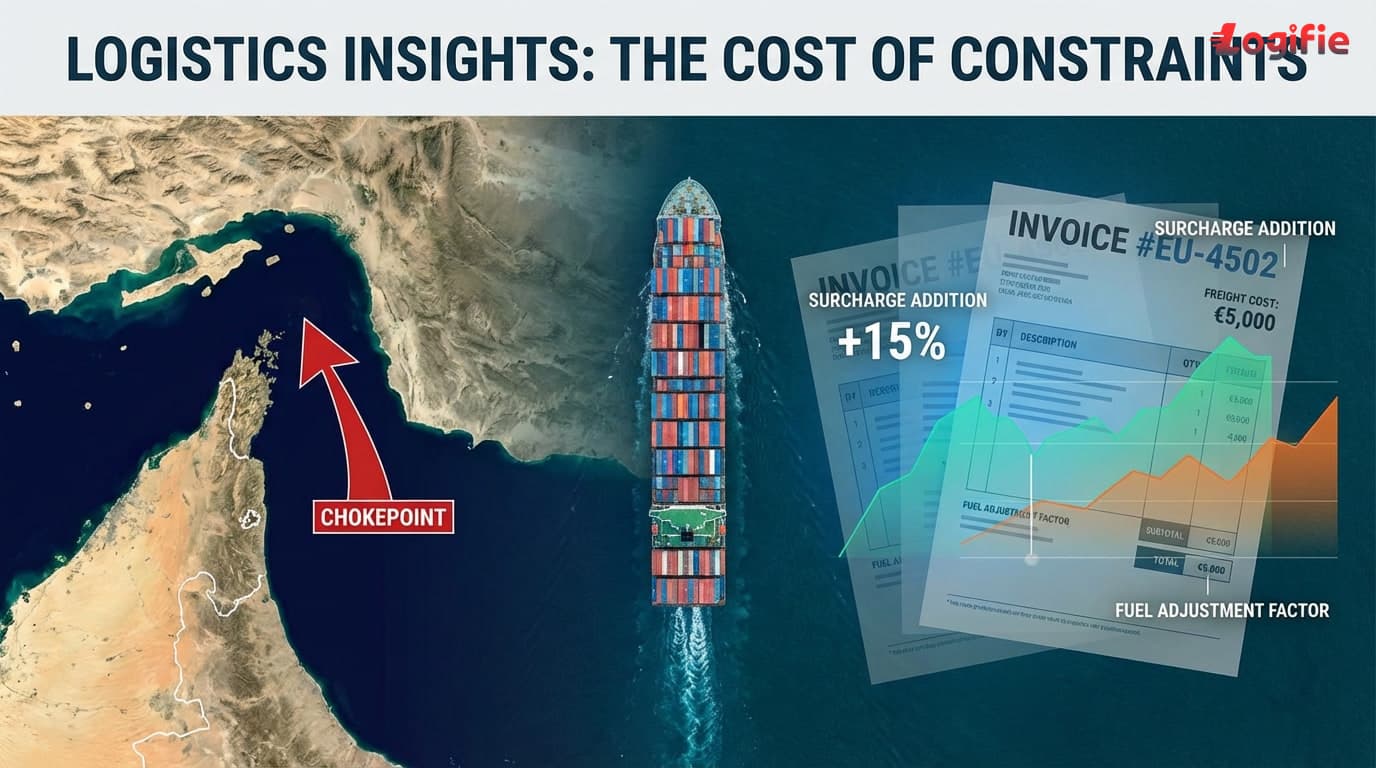
The Hormuz effect on freight costs is not abstract. Once ships are attacked, insurers reprice Gulf calls and carriers suspend or reroute services, the cost eventually lands on European buyers through fuel, risk and contingency items. If you monitor fuel prices across Europe , this is how a sea chokepoint turns into a more expensive freight invoice.
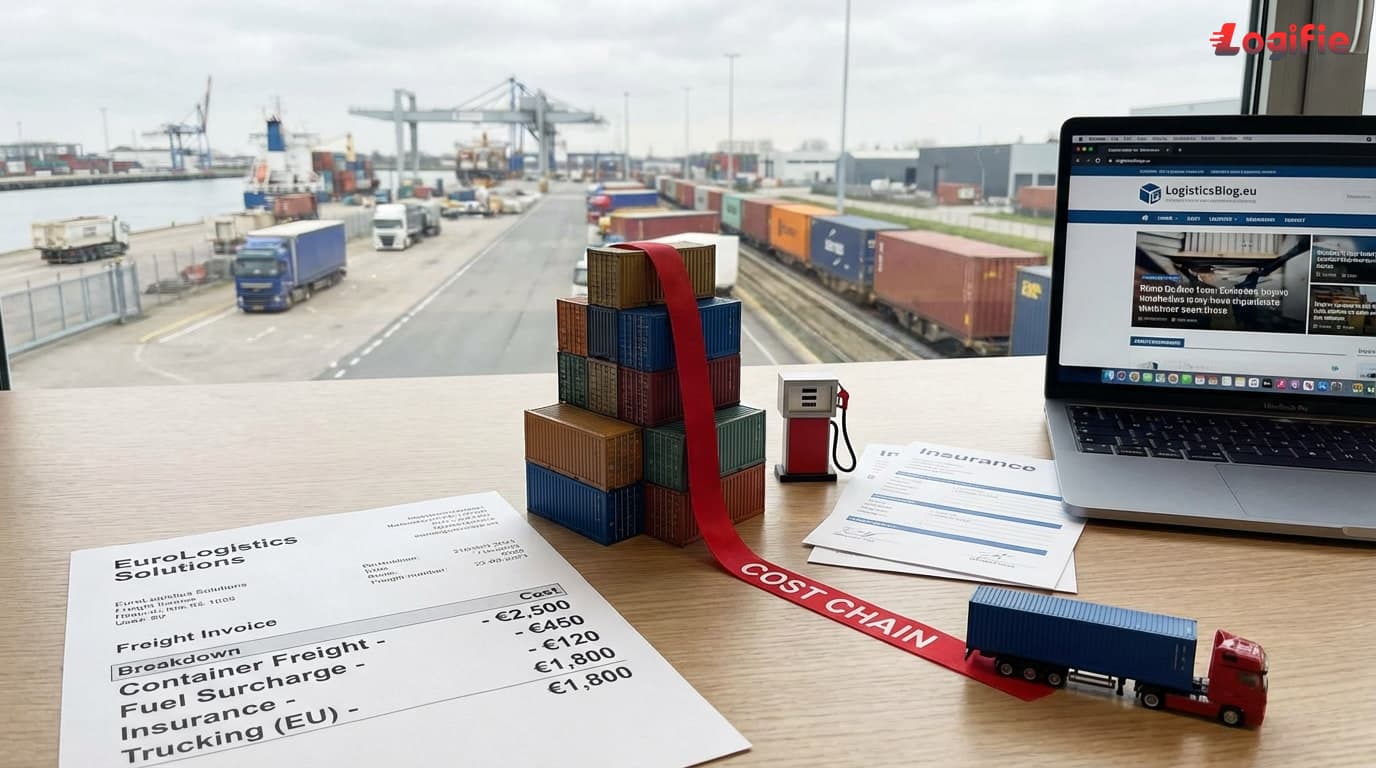
What the Hormuz effect actually means
The Strait of Hormuz is one of the world's key energy chokepoints. The EIA says 20.9 million barrels per day moved through it in 2023. That means the market reacts long before anyone proves every barrel is physically lost. Once the route looks unsafe, shipowners, insurers and cargo planners price in disruption immediately.
That is exactly what happened after the late-February escalation. Hapag-Lloyd suspended Hormuz transits, then expanded operational restrictions with booking stops for Upper Gulf cargo. For a freight buyer, the Hormuz effect means the network starts behaving like capacity has been removed, even if some cargo still moves.
Why shipping premiums show up on freight invoices
Ocean carriers pass through the costs they cannot absorb: war-risk insurance, vessel repositioning, longer routing and schedule disruption. Hapag-Lloyd's 2 March 2026 notice introduced a War Risk Surcharge of USD 1,500 per TEU for standard containers and USD 3,500 per container for reefer and special equipment on affected Gulf cargo. That is a strong signal that the cost shock is operational, not theoretical.
Even if your shipment is road-only within Europe, the invoice can still change. Imported inputs arrive with higher ocean costs, energy markets reprice diesel, and transport providers widen contingency buffers because capacity and equipment planning become less predictable. The chain reaction starts at sea but reaches inland procurement quickly.
Ocean surcharges, war-risk premiums, and road freight fuel clauses
Road freight invoices usually translate the same shock into updated fuel mechanisms rather than explicit maritime language. Logifie's fuel surcharges and tolls guide shows how this works: the benchmark moves, the formula updates, and the invoice rises without ever naming the Strait of Hormuz.
Reuters reported on 10 March 2026 that diesel markets were already upended by the Middle East conflict because distillate supply was structurally tight. That matters because diesel is the fastest way for an ocean energy shock to hit European trucking. You can end up paying more through fuel clauses, shorter validity windows and generic contingency language even when no container line item appears on your final road invoice.
What buyers should challenge in quotes and contracts
When rates move quickly, ask for transparency instead of debating headlines. Use Logifie's Get Quote page to benchmark live lanes, then challenge any supplier that cannot explain which benchmark, geography and review cycle is driving the increase.
- Ask which public diesel or fuel index is being used and what lag sits between the index date and your invoice.
- Separate ocean surcharges from inland fuel clauses so the same disruption is not recovered twice under different labels.
- Insist on shorter validity windows during volatile periods instead of leaving offers open on obsolete assumptions.
- Request evidence that rerouting, booking restrictions or war-risk measures actually affect your origin-destination chain.
- Align your own customer pass-through language early so you are not the last party absorbing the shock.
Fuel is still only one layer of freight inflation. Policy costs explained in Logifie's low-emission zones article and capacity limits explained in the EU cabotage rules guide can stack on top of a fuel shock, so buyers need a full-cost rather than single-surcharge review.
What to monitor over the next two weeks
Watch three things closely: carrier notices showing whether booking stops or rerouting are spreading, the European Commission's Weekly Oil Bulletin to confirm diesel movement, and EIA or IEA updates that show whether the supply shock is easing or being cushioned by coordinated stock releases. The goal is not to guess geopolitics. It is to know when your quote assumptions are no longer defensible.
Conclusion
The Hormuz effect reaches a European freight invoice through layered pass-throughs: maritime war-risk surcharges, disrupted network planning and faster diesel repricing. Buyers who demand benchmark transparency, isolate duplicate surcharges and recheck lanes on live market data will control the shock better than buyers treating it as someone else's ocean problem.
Sources
World Oil Transit Chokepoints (U.S. Energy Information Administration, 2024) - Explains that 20.9 million barrels per day moved through the Strait of Hormuz in 2023, establishing why disruption there changes global energy pricing.
Suspension of Strait of Hormuz transits due to security closure (Hapag-Lloyd, 2026) - Confirms that a major carrier suspended transits through the strait and warned about rerouting, delays and schedule disruption.
Shipping to and from the Upper Gulf, Arabian Gulf, and Persian Gulf? A War Risk Surcharge (WRS) is coming up (Hapag-Lloyd, 2026) - Announces a War Risk Surcharge of USD 1,500 per TEU for standard containers and USD 3,500 for reefer or special equipment on affected Gulf cargo.
Suspension of bookings to and from the Upper Gulf (Hapag-Lloyd, 2026) - Confirms that booking stops were introduced for multiple Gulf countries, reinforcing the operational nature of the disruption.
Diesel markets upended by Middle East conflict threaten global economic slowdown (Reuters, 2026) - Explains that tight distillate supply can push diesel prices higher and faster than crude, which is why the freight effect appears quickly in trucking.
Weekly Oil Bulletin (European Commission, 2026) - Provides the official EU weekly view of diesel prices that buyers can use to test whether invoice increases are aligned with live market movement.
EIA market-disruption release (U.S. Energy Information Administration, 2026) - Notes that Brent settled at USD 94 per barrel on 9 March 2026 after reduced shipments through Hormuz, showing how the security shock translated into market pricing.
IEA member countries to carry out largest ever oil stock release amid market disruptions from Middle East conflict (International Energy Agency, 2026) - Shows that governments judged the disruption severe enough to coordinate a major emergency release, which matters for short-term freight assumptions.