How AI Route Optimization Reduces CO2 in Road Freight
In road freight, time is often money - and increasingly, it's carbon. Freight vehicles crisscross continents to keep supply chains moving, yet their diesel engines emit enormous amounts of greenhouse gases (GHGs). Road...

Logifie Team
Logistics Technology Experts

In road freight, time is often money - and increasingly, it's carbon. Freight vehicles crisscross continents to keep supply chains moving, yet their diesel engines emit enormous amounts of greenhouse gases (GHGs). Road transport alone accounts for about 15 % of global CO2 emissions, and trucks moving goods produce nearly 29 % of transport emissions. Within this context, logistics providers face a dual challenge: control costs while lowering emissions. Artificial intelligence (AI)-powered route optimization offers a practical way to make road freight greener without sacrificing service levels.
Why Road Freight Needs Smarter Routing
Transportation is now responsible for roughly one-fifth of global CO2 emissions. Heavy-duty trucks - the backbone of road freight - burn large volumes of diesel, emitting carbon dioxide, nitrogen oxides and particulate matter. Inefficiencies compound the problem. In the U.S., empty miles account for about 15-20 % of trucking distances and waste an estimated 87 million tonnes of CO2e each year, with some European countries reporting more than 30 % empty vehicle kilometers. Logistics operations also waste fuel through traffic congestion, suboptimal routing, poor load matching and long idling times.
Traditional routing methods rely on static maps, driver experience and manual dispatch decisions. They often ignore dynamic factors such as live traffic, weather, delivery time windows and vehicle efficiency. This leads to unnecessary detours, late deliveries and extra fuel burn. In contrast, AI-based route optimization uses sophisticated algorithms to generate the most efficient sequence of stops for a fleet. Machine-learning models and heuristics draw on data from telematics, traffic sensors, weather services, vehicle characteristics and order constraints to minimize distance, travel time or emissions.
How AI Route Optimization Works
AI route optimization combines several technologies:
- Real-time data ingestion: Vehicle telematics and IoT sensors feed real-time location, fuel consumption and vehicle health data to the optimization engine. Traffic APIs provide live congestion information, while weather services forecast conditions that might affect driving speed and road safety.
- Optimization algorithms: Advanced algorithms (such as ant colony optimization, genetic algorithms and reinforcement learning) evaluate millions of route permutations in seconds. They consider variables like delivery windows, driver hours-of-service, vehicle capacities and charging or refueling needs.
- Dynamic re-routing: The system continuously re-optimizes routes based on new orders, road closures or unexpected delays. Drivers receive updated instructions via mobile applications or in-cab displays, ensuring the plan stays optimal throughout the day.
- Predictive analytics: Machine-learning models forecast demand, traffic patterns and vehicle performance to proactively adjust routes. Predictive maintenance algorithms can schedule service before a breakdown occurs.
These capabilities transform route planning from a static task into a dynamic optimization problem. A 2025 academic study on green logistics found that AI-enabled route optimization can produce carbon and fuel savings of up to 15 % and 30 % in specific scenarios when supported by a robust digital infrastructure.
Case Study: UPS's ORION Program
The largest commercial deployment of AI route optimization is UPS's On-Road Integrated Optimization and Navigation (ORION) system. ORION uses heuristics and machine learning to design the most efficient daily routes for drivers, integrating GPS data, package information and traffic conditions. According to UPS, ORION has eliminated about 100 million miles of unnecessary driving per year and saved 10 million gallons of fuel annually, avoiding roughly 100,000 metric tonnes of GHG emissions. UPS reports that the technology reduces each driver's mileage by six to eight miles per route, which also improves on-time delivery rates.
Other companies report similar results. Finmile's 2024 route-optimization white paper notes that algorithmic routing can cut total miles driven by 10-20 % and lower fuel usage accordingly. In particular, route planning reduces the number of routes by 30-40 % and boosts overall efficiency by 25-30 %. The authors highlight UPS ORION as a benchmark for large-scale savings.
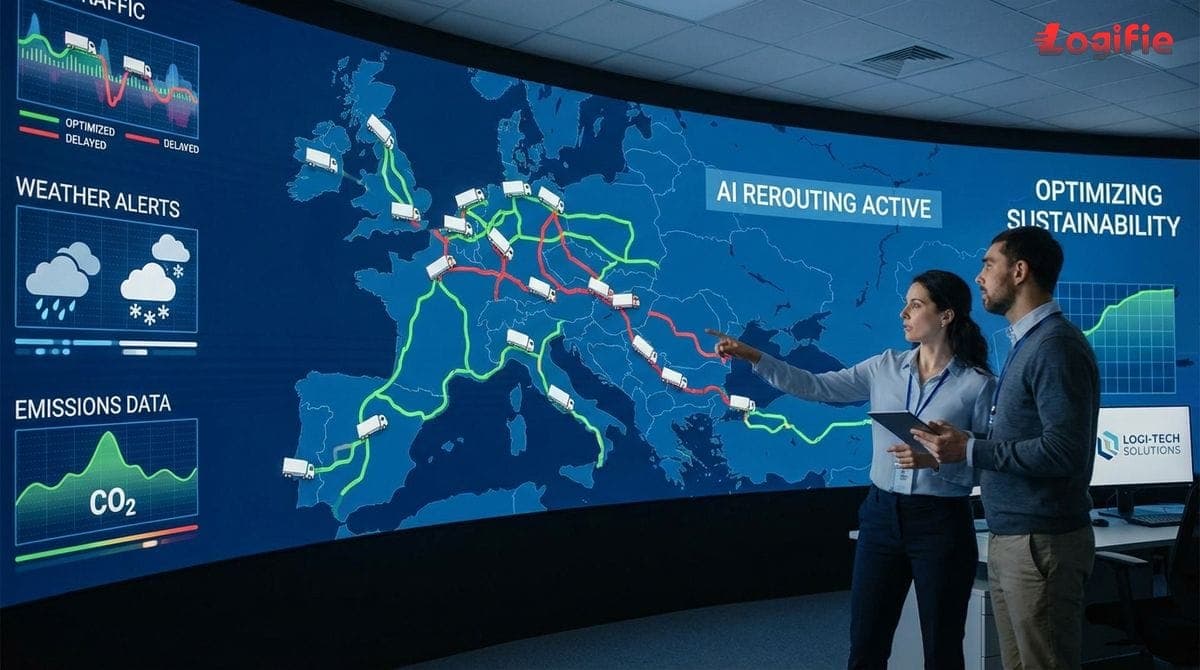
*Caption: AI-powered route optimization dashboards ingest traffic, weather and vehicle data to propose fuel-efficient routes. Illustrations should depict trucks moving along an optimized path over a digital map.*
Cutting Empty Miles and Improving Utilization
A major source of inefficiency is deadhead - the distance traveled with no cargo. Reducing empty miles boosts both productivity and sustainability. The American Transportation Research Institute (ATRI) estimates that 15-20 % of U.S. truck miles are empty and that empty trips account for tens of millions of tonnes of CO2e each year. Digital freight networks and AI routing systems match return loads to outgoing shipments, increasing load factors. The American Council for an Energy-Efficient Economy (ACEEE) notes that trucks carrying cargo operate at an average load factor of just 57 %, leaving significant unused capacity. By assigning shipments to trucks with similar origin-destination pairs and filling backhauls, digital platforms can cut emissions and reduce the number of trips.
AI systems also consider driver behavior and vehicle type. For example, by recommending eco-driving styles (gradual acceleration, reduced idling), AI can further decrease fuel consumption. Telematics data allow the system to monitor engine health and schedule maintenance, preventing inefficient operation.
Environmental Impact of AI Routing
Because freight transport contributes a large share of global emissions, the potential impact of AI route optimization is significant. The World Economic Forum estimates that freight logistics accounts for about 8 % of global GHG emissions, and its Intelligent Transport, Greener Future report suggests that AI could reduce current freight emissions by up to 15 % through optimized operations. Combined with modal shifts (e.g., shifting some freight to rail) and low-carbon fuels, AI routing is a key lever for decarbonization.
The ResearchGate study mentioned earlier adds that sustainability benefits are greatest when AI is deployed alongside policies such as green fleet management and reverse logistics. For example, using electric or hydrogen-powered trucks on optimized routes can magnify emissions reductions by pairing zero-tailpipe vehicles with fewer total miles. Dynamic routing also helps electric trucks avoid battery depletion and align with charging infrastructure.
Business Benefits Beyond Emissions
Route optimization doesn't just help the planet; it also makes financial sense. The Finmile report notes that smarter routing reduces route counts by 30-40 %, enabling fleets to serve the same volume of orders with fewer vehicles and drivers. Fewer miles driven translate directly into lower fuel and maintenance costs, while better on-time performance boosts customer satisfaction. Real-time routing also improves driver safety by avoiding traffic jams and hazardous weather.
Logistics providers adopting AI routing report improvements in profitability and productivity. UPS's ORION, for instance, delivers annual fuel savings of around $300 million (based on 10 million gallons saved) while enabling faster deliveries. Smaller fleets can access similar technology through cloud-based route-optimization platforms, which scale from a handful of vehicles to thousands.
Integrating AI Routing with Digital Freight Platforms
The full potential of AI route optimization emerges when it is integrated into a digital freight forwarding platform. Digital platforms consolidate data from transport management systems (TMS), warehouse management systems (WMS), customer orders and carrier networks. They enable:
- Instant quoting and booking: AI can generate quotes based on real-time market rates, lane capacity and service levels, replacing manual processes that take days or even 100 hours in traditional forwarding.
- Automated document management: Electronic bills of lading, customs declarations and proof-of-delivery images cut paperwork and reduce errors.
- Real-time visibility: Shippers and consignees track shipments through maps and dashboards, receiving alerts for delays or exceptions.
- Emissions monitoring: Digital platforms combine routing data with emission-factor databases to calculate CO2 per shipment, allowing shippers to choose lower-carbon options.
Logifie's platform integrates AI route optimization with a modern TMS, enabling customers to plan shipments, book carriers and monitor sustainability metrics in one place. By automating routine tasks and centralizing data, digital forwarding frees operations teams to focus on problem-solving and customer service.
Challenges and Considerations
Implementing AI route optimization requires careful planning. Key challenges include:
- Data availability and quality: Accurate routing depends on high-resolution data from vehicles, orders and infrastructure. Missing or erroneous data can lead to poor routing decisions.
- Cost and change management: Implementing AI systems involves investment in software, sensors and training. The 2025 research article notes that high implementation costs and data-privacy concerns remain barriers. Companies must also manage change among drivers and dispatchers accustomed to manual planning.
- Integration with existing systems: AI routing should plug seamlessly into TMS and WMS platforms. Logistics providers often operate legacy systems, so careful integration planning is critical.
- Regulatory and contractual constraints: Hours-of-service rules, union agreements and customer service-level agreements can limit how much routing algorithms can optimize.
Toward a Greener Logistics Future
AI-powered route optimization is a powerful tool for decarbonizing road freight. By eliminating empty miles, shortening travel distances and enabling more efficient use of vehicles, AI helps logistics providers cut costs and carbon simultaneously. Case studies from UPS and other fleets demonstrate that algorithmic routing can reduce fuel usage and emissions dramatically. When integrated with digital freight platforms, these technologies deliver real-time visibility, improved customer experience and greater operational resilience.
For shippers and carriers aiming to meet net-zero targets and remain competitive, investing in AI route optimization should be a strategic priority. Partnering with technology-driven logistics providers like Logifie allows businesses to harness AI without building the tools themselves. Start by assessing current route efficiency, identifying data gaps and piloting AI routing with a portion of your fleet. Monitor fuel consumption, emissions and service levels to quantify the benefits. Over time, expand these systems across your operations and combine them with green fleet investments and collaborative shipping.
By embracing AI route optimization today, the logistics industry can take a major step toward sustainable, cost-effective road freight.
Sources
Transport (Global Change Data Lab, 2023) - Provides statistics on global transport emissions, noting that road transport contributes about 15% of global CO2 emissions and trucks produce roughly 29% of transport emissions.
Artificial Intelligence for sustainable logistics: Reducing carbon emissions and fuel consumption through route optimization (International Journal of Science and Research Archive, 2025) - Discusses AI-based route optimization and reports that AI-enabled routing can deliver carbon and fuel savings of up to 15% and 30% in specific scenarios. Also notes high implementation costs and privacy concerns as barriers.
Route Optimization White Paper (Finmile, 2024) - Highlights how algorithmic route planning can cut total miles by 10-20%, reduce route counts by 30-40% and improve efficiency by 25-30%. Uses UPS ORION as a benchmark for fuel and emissions savings.
UPS ORION case study (BSR, 2020) - Details UPS's implementation of the ORION route optimization system, reporting savings of around 100 million miles and 10 million gallons of fuel annually, preventing about 100,000 metric tonnes of GHG emissions.
Driving sustainability: Reducing empty miles in road freight (Einride, 2023) - Cites research from the American Transportation Research Institute showing that 15-20% of U.S. truck miles are empty and notes that non-revenue miles produce an estimated 87 million tonnes of CO2e; some EU countries see more than 30% empty kilometers.
Digital Freight Networks Can Reduce Truck Emissions (ACEEE, 2024) - Explains how digital freight networks reduce emissions by matching loads to fill backhauls, noting that the average truck load factor is only 57% and increasing utilization cuts emissions.
Intelligent Transport, Greener Future: AI as a Catalyst to Decarbonize Global Logistics (World Economic Forum, 2025) - Estimates that freight logistics accounts for about 8% of global GHG emissions and suggests AI could reduce emissions by up to 15% through optimized operations and better asset utilization.