How to become a freight dispatcher in Europe (2026)
How to become a freight dispatcher in Europe — training routes in Germany, UK, Poland and Romania, salaries by country, and software tools employers expect.

Logifie Team
Logistics Technology Experts
Becoming a freight dispatcher in Europe typically takes 3 to 24 months, depending on the country and whether you enter through a formal apprenticeship or through on-the-job training in a haulage or forwarding firm. Demand is structurally strong: the IRU Global Truck Driver Shortage Report 2024 found unfilled HGV driver positions in Europe surged to 426,000 in 2024, up from 233,000 a year earlier, and the operational pressure that creates flows straight into the back office that plans and coordinates those vehicles. This guide explains what the role involves, the qualifications you need, the training routes available in Germany, Poland, Romania, and the UK, typical dispatcher salaries by country, and the software used day to day.
426,000
Unfilled HGV driver positions in Europe in 2024 (IRU), up from 233,000 a year earlier — driving strong demand for back-office dispatchers.
A quick clarification before you start. Search results for this topic are dominated by the United States model, where a "freight dispatcher" is often an independent contractor who finds loads for owner-operators on a load board. In most of Europe the equivalent role is an employed planner inside a transport company, frequently called a Disponent (German for transport planner or dispatcher). The two roles share a skill set but sit in very different commercial structures, and this guide focuses on the European employed reality.
What does a freight dispatcher do in Europe?
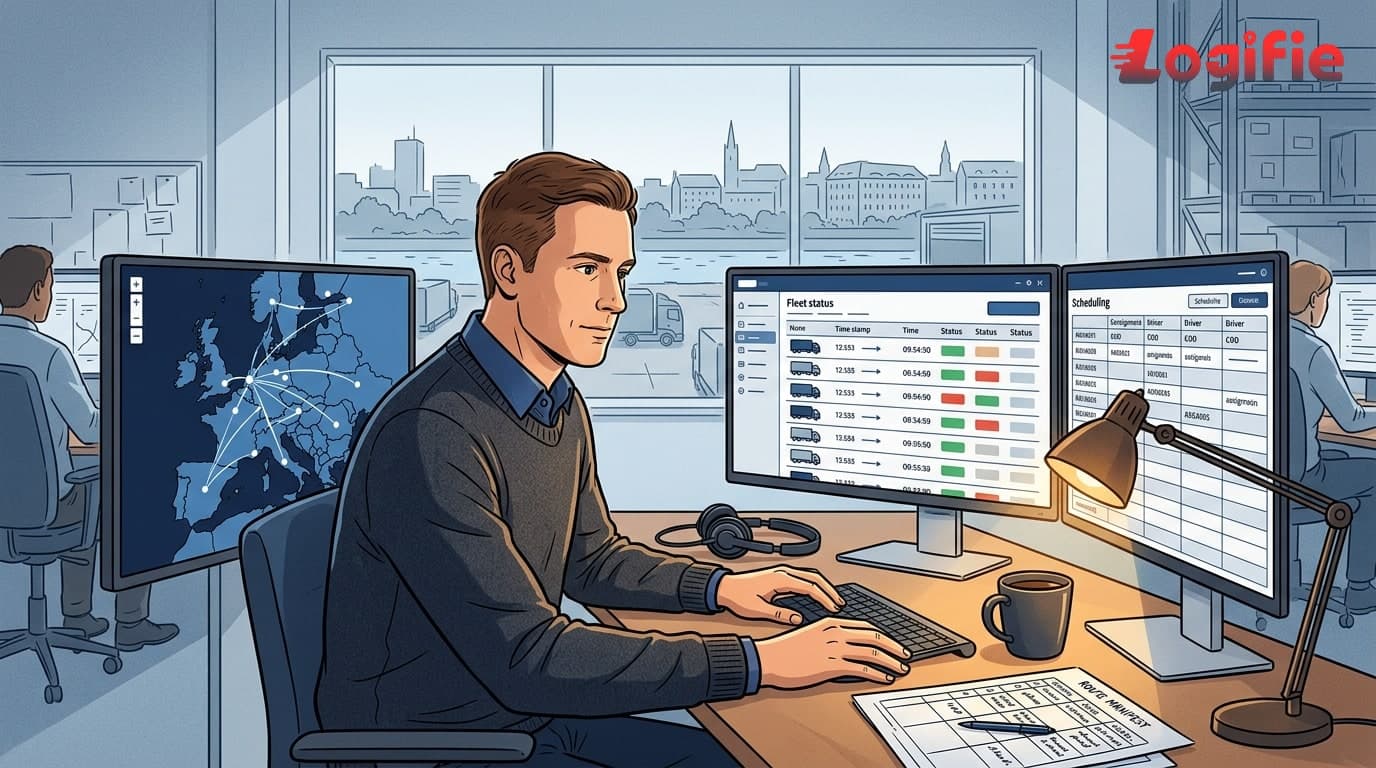
A European freight dispatcher is the operational hub between drivers, customers, and the wider supply chain. According to the ESCO occupation profile for freight transport dispatcher , maintained by the European Commission, the role covers coordinating different modes of transport, structuring routes and services, managing dispatch software, scheduling and dispatching drivers, monitoring fleet operations, and keeping accurate records.
In practice that means assigning loads to vehicles, sequencing pickups and deliveries, and re-planning in real time when a delay, breakdown, or border delay disrupts the schedule. The dispatcher is the person a driver calls when a delivery slot is missed and the person a customer calls when a shipment is late.
It is a role that rewards calm decision-making under pressure. Most of the day is spent reconciling competing constraints: driving-time limits, customer windows, vehicle availability, and cost. Understanding how this role differs from adjacent functions is the next step, because the titles are often used loosely. To see how dispatchers fit alongside the parties they coordinate, it helps to understand the difference between a freight forwarder, broker, and carrier .
Freight dispatcher vs transport planner (Disponent): what is the difference?
In most European haulage and forwarding firms, "dispatcher", "transport planner", and "Disponent" describe the same core job: planning and coordinating the daily movement of vehicles and loads. The differences are mostly regional vocabulary and seniority rather than fundamentally different work.
Where a meaningful distinction does appear, it is usually scope. A junior dispatcher tends to handle live operations: assigning loads, talking to drivers, and solving same-day problems. A transport planner or senior Disponent often owns the upstream planning, building routes and schedules a day or more ahead and managing capacity across a fleet.
The bigger divide is the US versus EU model. The American "truck dispatcher" who finds loads on a load board for a commission is an independent intermediary; the European Disponent is almost always a salaried employee inside the carrier or forwarder. If you are researching this career in Europe, prioritise the employed-planner path, because that is where the stable, structured roles and clear training routes are.
What qualifications do you need to become a freight dispatcher?
There is no single Europe-wide licence to become a freight dispatcher, which is part of why the role is accessible. What employers consistently look for is a mix of logistics literacy, communication skills, and comfort with software.
The most valued attributes are organisational ability under time pressure, clear verbal communication (often across languages and borders), basic commercial numeracy, and geographic and regulatory awareness, especially around HGV driving-time and rest rules. The ESCO profile lists managing dispatch software systems, making independent operating decisions, and managing truck drivers among the core competences, which signals that employers expect judgement, not just data entry.
Formal qualifications help but are rarely mandatory. In Germany the apprenticeship route below is the dominant pathway. In the UK and much of Central and Eastern Europe, entry is more often through on-the-job training, sometimes after a short course. Language skills are a material advantage: a dispatcher coordinating cross-border lanes who speaks English plus a second European language is materially more employable.
How do you become a freight dispatcher with no experience?
You can enter dispatching with no prior logistics experience, which is one reason it is a popular career switch. The realistic path has four steps.
First, build foundational knowledge. Learn the basics of how road freight works, including HGV and LCV (light commercial vehicle) operations, driving-time rules, and the documents that move with a shipment. Many candidates do this through a short paid course; useful background also comes from understanding the route into driving itself via the CPC qualification , because dispatchers coordinate the people doing it.
Second, apply for junior or assistant roles. Titles like "transport clerk", "operations assistant", or "junior Disponent" are common entry points where you learn the software and the lanes on the job. Third, get fluent in the core tools, especially a transport management system, which we cover below. Fourth, specialise: dispatchers who develop deep knowledge of a corridor, a vehicle type, or a customer sector progress fastest. If you are actively job-hunting, you can explore current logistics roles at Logifie to see what entry-level operations work looks like in practice.
What training courses and apprenticeships are available across Europe?
Training routes differ sharply by country, which is exactly where most online guides fall short. The clearest formal pathway is in Germany.
Germany offers the Kaufmann/-frau fuer Spedition und Logistikdienstleistung apprenticeship , a three-year dual vocational programme regulated by the IHK (Chamber of Commerce and Industry). It combines vocational-school instruction with paid on-the-job training at a forwarding or logistics firm, with an intermediate examination around the middle of the second year. Graduates are well positioned for Disponent roles and beyond. The structure is also documented by the German Federal Institute for Vocational Education and Training (BIBB) .
3 years
The Kaufmann/-frau fuer Spedition und Logistikdienstleistung dual vocational programme (IHK-regulated) — the most structured dispatcher training route in Europe.
In the UK there is no equivalent single apprenticeship for dispatch specifically, but entry runs through transport-operations and freight-forwarding roles. The National Careers Service transport planner profile describes on-the-job progression, and professional bodies such as the Chartered Institute of Logistics and Transport (CILT) and the British International Freight Association (BIFA) offer recognised qualifications. Across Poland, Romania, and the wider CEE region, entry is most often through junior operations roles inside carriers and forwarders, supplemented by short commercial courses; note that many CEE-marketed "truck dispatcher" courses target the US load-board model, so check that any paid course matches the European employed-planner role you actually want.
How much does a freight dispatcher earn by country?
Dispatcher pay varies widely across Europe, tracking local wage levels and cost of living rather than the difficulty of the job. The table below uses ERI SalaryExpert figures where a transportation-dispatcher value is available, with conservative ranges and the nearest verifiable proxy where it is not. UK figures are converted from GBP at an approximate May 2026 rate.
| Country | Average annual salary (EUR) | Entry-level | Senior-level | Notes |
|---|---|---|---|---|
| Germany | ~47,700 | ~34,000 | ~58,000 | SalaryExpert transportation dispatcher average; strong apprenticeship pipeline |
| Netherlands | ~42,000 | ~31,000 | ~55,000 | High-wage market; proxy from regional dispatcher/coordinator data, treat as indicative |
| France | ~32,700 | ~24,300 | ~42,000 | SalaryExpert dispatcher average and 1-3 year entry figure |
| UK | ~33,000 | ~24,000 | ~53,000 | From GBP ~27,900 average, GBP ~20,000 entry, GBP ~45,000 senior, approx conversion |
| Czech Republic | ~12,000 to ~32,000 | ~12,000 | ~32,000 | Wide reported logistics range; dispatcher sits mid-band |
| Poland | ~13,000–~20,000 | ~13,000 | ~22,000 | Logistics coordinator proxy; rising with cross-border demand |
| Romania | ~13,400–~16,000 | ~13,400 | ~18,000 | Nearest verifiable dispatcher proxy; fast-growing CEE dispatch hub |
€13,000 – €58,000
Annual dispatcher pay in Europe (SalaryExpert 2025 data), from entry-level roles in CEE markets to senior positions in Germany — reflecting local wage levels and experience.
Two patterns stand out. Western European markets pay roughly two to three times CEE levels in absolute EUR terms, but the gap narrows once cost of living is factored in, and CEE wages are rising fastest as cross-border dispatching demand grows. For a deeper view of how compensation moves across the region, see the companion country-by-country truck driver salary guide for 2026 .
What tools and software do European dispatchers use?
The dispatcher's primary tool is a transport management system. A transport management system (TMS) is the platform where loads are entered, vehicles are assigned, routes are planned, and the status of every shipment is tracked in one place. Fluency in a TMS is the single most important practical skill an employer looks for, and the ESCO profile explicitly lists managing dispatch software among the core competences.
Around the TMS sits a wider toolkit: telematics and tracking for live vehicle positions, route optimisation, and increasingly mobile apps that connect the office directly to the cab. A driver assistant tool of this kind lets the dispatcher push instructions, documents, and updates to drivers without endless phone calls, which is where much of a dispatcher's day used to disappear.
The day-to-day reality is that good dispatchers are not just software operators; they are decision-makers who use the software to see the whole board at once. The tooling removes friction so the dispatcher can focus on the judgement calls that keep a fleet moving profitably.
Career path and outlook for 2026 and beyond
The outlook for dispatchers is strong and structural rather than cyclical. The same IRU data that shows a record European driver shortage also points to a sector under sustained pressure to move freight efficiently, and that is precisely the work dispatchers do. Independent analysis from firms such as Transport Intelligence echoes the same demographic squeeze, with an ageing workforce and too few young entrants.
A typical progression runs from transport clerk or junior dispatcher, to dispatcher or Disponent, to senior planner or operations manager, and onward to roles such as fleet manager or transport manager. Each step adds scope: more vehicles, more lanes, and more commercial responsibility.
Two forces will shape the next few years. Automation and better software will handle more routine assignment work, raising the premium on dispatchers who bring judgement and customer relationships. And cross-border demand, especially from CEE, will keep multilingual dispatchers in short supply. For anyone entering now, the combination of accessible entry, structural demand, and clear progression makes dispatching one of the more dependable career choices in European logistics.
Frequently asked questions
How long does it take to become a freight dispatcher in Europe?
It typically takes 3 to 24 months. In Germany the formal three-year Kaufmann/-frau fuer Spedition und Logistikdienstleistung apprenticeship is the most structured route, while in the UK and CEE you can often enter a junior operations role within a few months and learn on the job. A short paid course can shorten the on-ramp but is rarely a substitute for real operational experience.
Do you need a degree to become a freight dispatcher?
No. A degree is not required for most dispatcher roles in Europe, and many people enter through apprenticeships or on-the-job training. Employers value organisational skill, clear communication, and software fluency over formal academic qualifications, although a logistics qualification can help you start at a higher level.
How much does a freight dispatcher earn in Europe?
Pay ranges widely, from roughly EUR 13,000 per year in parts of Central and Eastern Europe to around EUR 47,000 in Germany, based on SalaryExpert data. Entry-level salaries are lower and rise significantly with experience, specialisation, and language skills. Cross-border and multilingual dispatchers tend to command the strongest pay growth.
What is the difference between a freight dispatcher and a transport planner?
In most European firms they are largely the same role, with "transport planner" and "Disponent" often used interchangeably with "dispatcher". Where there is a difference, it is usually seniority and scope: junior dispatchers handle live operations, while transport planners own more of the forward scheduling and capacity management.
Can you become a freight dispatcher with no experience?
Yes. Many dispatchers start with no logistics background, entering through junior roles such as transport clerk or operations assistant. The fastest path is to learn the fundamentals of road freight, get comfortable with a transport management system, and then build corridor or sector expertise on the job.
What software do freight dispatchers use?
The core tool is a transport management system, which handles load entry, vehicle assignment, routing, and shipment tracking. Dispatchers also use telematics and tracking platforms and increasingly mobile driver apps that connect the office to the cab. Fluency in a TMS is the most sought-after practical skill for the role.
Is freight dispatching a good career in 2026?
Yes, the outlook is strong. The European driver and workforce shortage documented by the IRU points to sustained demand for the planning and coordination work dispatchers do, and the role offers a clear progression toward operations and fleet management. Multilingual dispatchers, in particular, are in short supply.
If you are exploring dispatcher roles in European road freight, view current logistics opportunities at Logifie to see where your dispatching career could take you next.