Iran, Oil, and Europe's Diesel Supply: Why This Conflict Hits Freight Harder Than Ukraine Did
Europe's diesel market can tighten quickly even without direct Iranian imports. Learn what EU reserves protect, what they do not, and how freight buyers should react.

Logifie Team
Logistics Technology Experts
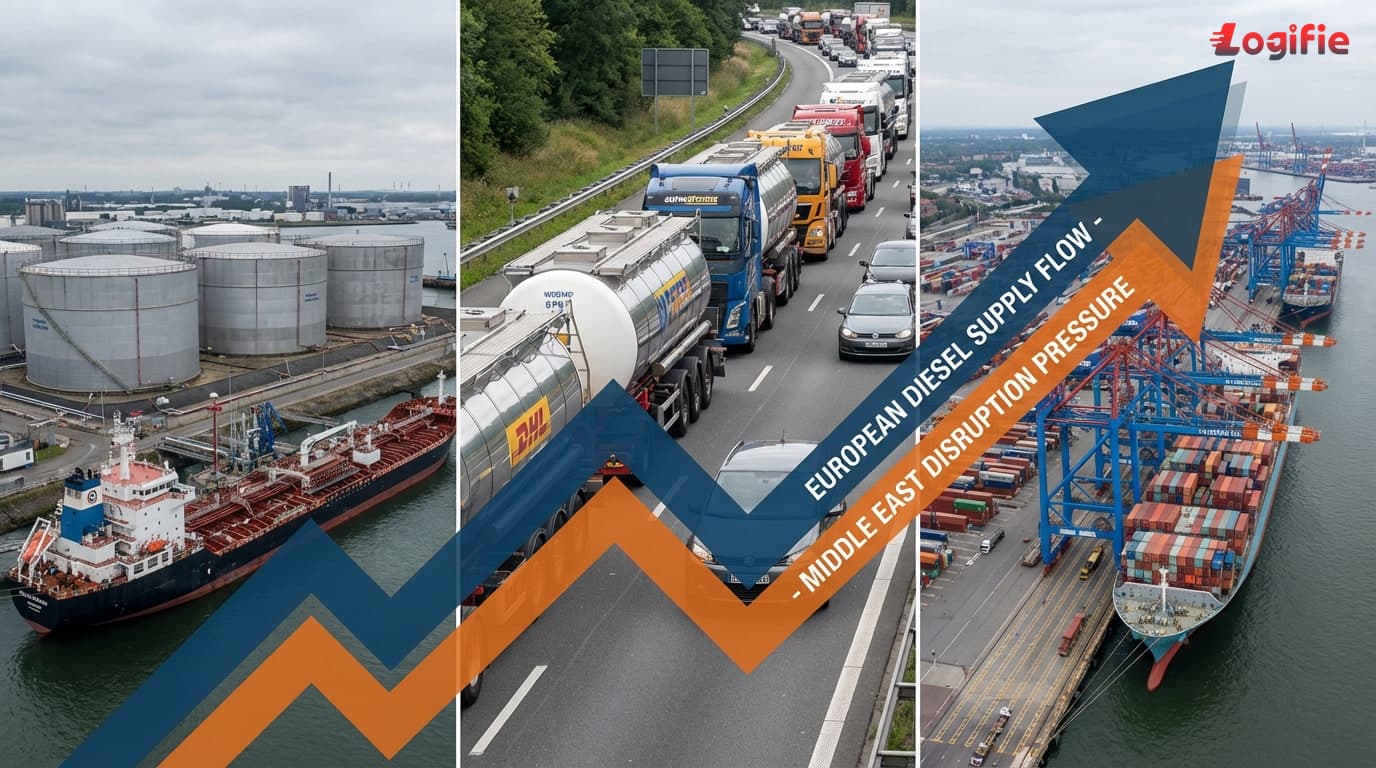
The Iran conflict diesel supply story in Europe is not about direct Iranian imports. It is about a global diesel market tightening faster than road freight contracts can adapt. If you monitor fuel prices across Europe or need a fresh lane check through Get Quote , the key question is not whether Europe runs out tomorrow. It is how fast diesel and lane pricing reprice while reserves only buy time.
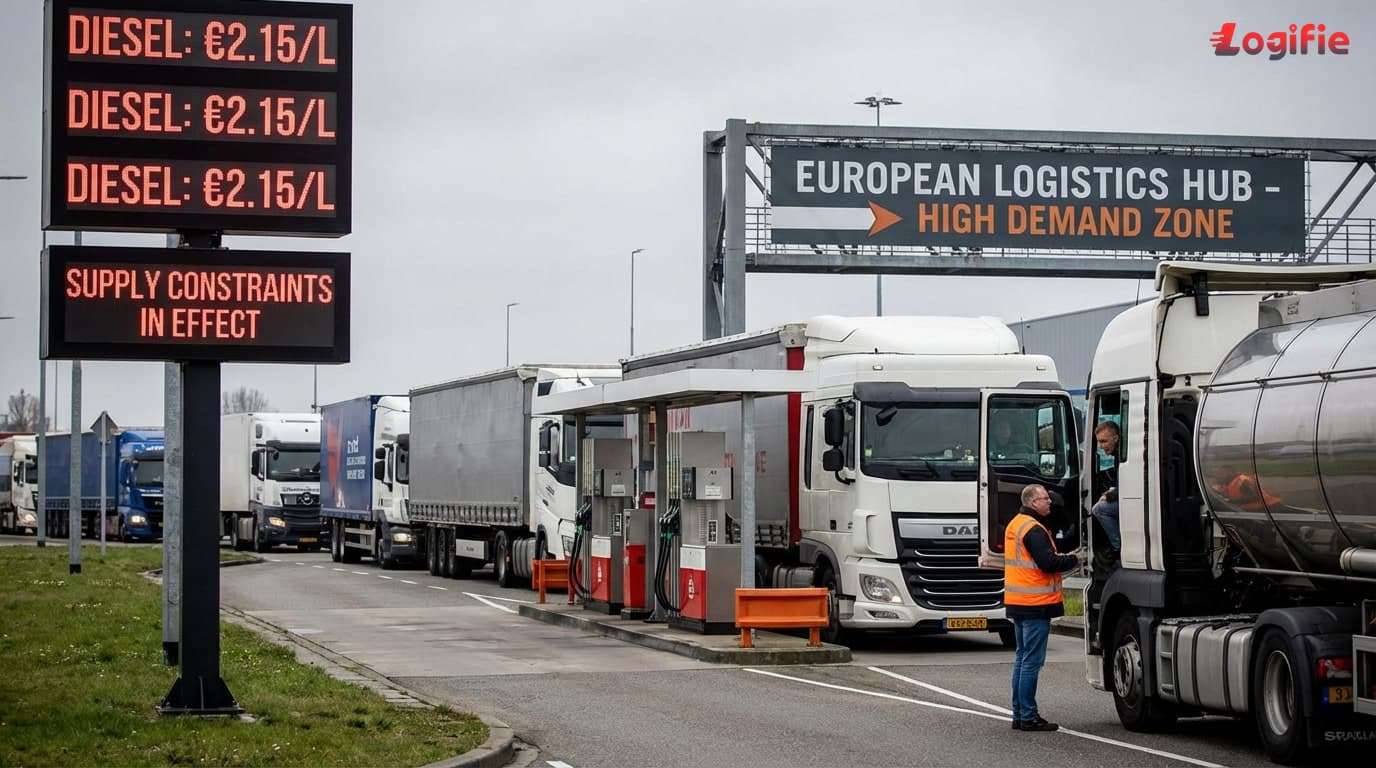
Why Europe feels this even without importing Iranian oil
The European Commission said on 4 March 2026 that member states saw no immediate oil or gas supply risk and noted that the EU does not rely directly on Iranian oil. That statement is reassuring, but it does not remove market exposure. The Strait of Hormuz still carries one of the world's largest energy flows, so a closure or security shock changes the global price Europe pays for diesel.
IRU's March 2026 market note makes the exposure more concrete: OPEC countries supply 26% of the crude oil consumed in the EU and 15% of its road diesel. Europe may not be buying Iranian barrels directly, but it still buys inside a market shaped by Gulf supply, insurance conditions and refinery economics.
Why diesel gets hit harder than crude
For freight, diesel matters more than headline crude. Reuters reported on 10 March 2026 that diesel markets were already upended because distillate supply was structurally tight. That is why Europe can feel disproportionate pain even if crude benchmarks later cool from their peak: the refined product that trucks actually burn can stay stressed for longer.
This is also why buyers should watch both pump data and wholesale indicators rather than only Brent headlines. Reuters reporting highlighted sharp movement in ARA diesel pricing during the first two weeks of the crisis, and the Commission's Weekly Oil Bulletin shows how those pressures translate into national retail diesel benchmarks that carriers use in surcharge formulas.
How this differs from the Ukraine-era energy shock
The Ukraine energy shock forced Europe to replace Russian supply over months and redesign trade flows step by step. The Hormuz crisis is different because it is a chokepoint shock. Insurance, shipping and trading behaviour can reprice almost overnight, which means freight buyers feel volatility faster even if the EU is institutionally better prepared today than it was in 2022.
That is why this conflict can hit road freight harder in practice. Strategic buffers are stronger, but trucking is still dependent on diesel and weekly market references. The lag between geopolitical escalation and invoice impact is short, especially for spot-heavy lanes or contracts with aggressive fuel-review clauses.
What EU emergency stocks do and do not protect
Directive 2009/119/EC requires EU member states to hold emergency petroleum stocks equal to at least 90 days of net imports or 61 days of inland consumption. The Commission said current stocks remain around 85 to 90 days, which is the policy reason there is no immediate shortage narrative in Europe.
But strategic stocks are a supply-security tool, not a freight-price cap. The IEA's 11 March 2026 release of 400 million barrels can reduce panic and support supply, yet it does not stop weekly diesel volatility from reaching carriers, forwarders and shippers. Buyers still need live pricing discipline while governments manage the larger energy balance.
What shippers and carriers should do now
The operational response should start with transparent fuel governance. Recheck contracts against a public diesel benchmark, and use Logifie's fuel surcharge guide when you need to review how quickly price moves should pass into linehaul rates.
- Shorten quote validity on exposed lanes and avoid carrying week-old diesel assumptions into live tenders.
- Use a public reference such as the Weekly Oil Bulletin or a national diesel benchmark for every surcharge discussion.
- Track both freight fuel and policy costs, because toll reform and emissions-related charges can amplify the same shipment.
- Secure capacity earlier on critical lanes if your carrier base is margin-sensitive or heavily exposed to spot diesel swings.
- Update internal budget assumptions weekly until the energy market and carrier notices clearly stabilise.
Freight buyers should also keep the wider cost stack in view. Policy-driven cost pressure described in Logifie's low-emission zones article and capacity-side frictions described in the EU cabotage rules guide can compound diesel stress at the exact moment the energy market is most unstable.
Conclusion
Europe is more resilient than the headlines suggest, but resilience is not the same as price stability. The Iran conflict matters because it tightens the diesel market that road freight depends on, and it does so faster than most transport budgets or contracts are built to absorb. Buyers who benchmark fuel weekly and renegotiate on evidence will navigate this better than buyers relying on the comfort of strategic stocks alone.
Sources
Council Directive 2009/119/EC (EUR-Lex) - Sets the EU legal requirement for emergency petroleum stocks equal to at least 90 days of net imports or 61 days of inland consumption.
Commission and EU countries confirm no immediate oil or gas supply concerns following the disruptions in the Middle East (European Commission, 2026) - Confirms that member states did not observe immediate supply risks and that emergency stocks remained available.
World Oil Transit Chokepoints (U.S. Energy Information Administration, 2024) - Shows why a Hormuz disruption matters to Europe by quantifying the scale of energy flows that pass through the chokepoint.
Diesel markets upended by Middle East conflict threaten global economic slowdown (Reuters, 2026) - Explains that structurally tight distillate markets caused diesel to react especially sharply, including in Europe.
More turmoil: early pump price movements seen globally (IRU, 2026) - Notes that OPEC countries supply 26% of EU crude and 15% of EU road diesel, explaining Europe's exposure even without direct Iranian imports.
EIA market-disruption release (U.S. Energy Information Administration, 2026) - Shows how reduced shipments through the Strait of Hormuz kept a clear risk premium in oil prices during early March 2026.
IEA member countries to carry out largest ever oil stock release amid market disruptions from Middle East conflict (International Energy Agency, 2026) - Announces the coordinated 400 million barrel emergency release on 11 March 2026.
Weekly Oil Bulletin (European Commission, 2026) - Provides the official national diesel benchmark data that shippers and carriers can use in contract and surcharge discussions.