Netherlands truck parking: 4,400 spaces still missing
One year after TLN's action day, Dutch truck parking remains 4,400 spaces short. EUR 43M is pledged but unspent — camper vans now occupy HGV bays.

Logifie Team
Logistics Technology Experts
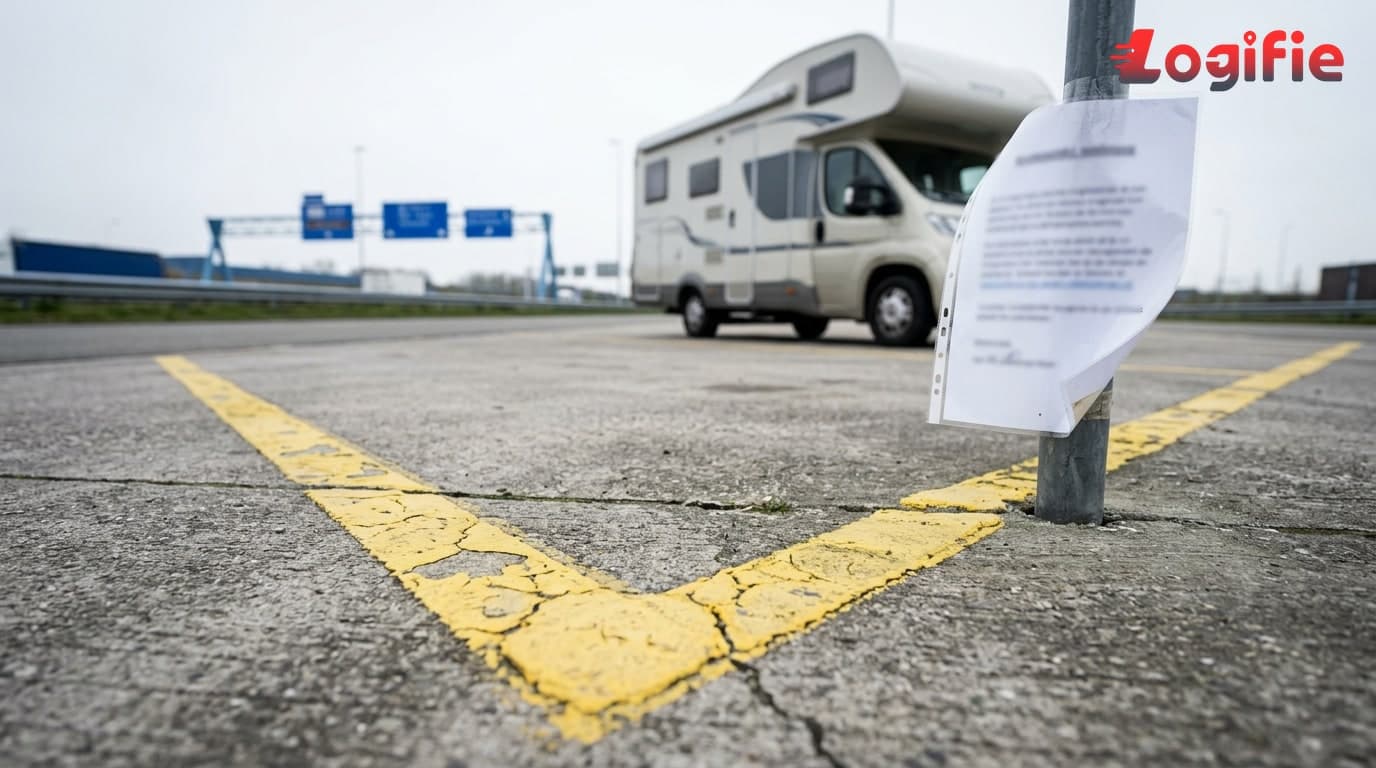
The Netherlands is 4,400 truck parking spaces short as of May 2026, leaving drivers on major freight corridors unable to find compliant rest stops. Transport association TLN, together with drivers' unions FNV and CNV, held a national action day demanding safer rest areas on 22 May 2025. One year on, the Dutch government has pledged EUR 43 million and parliament has passed supporting motions — but no new capacity has reached the ground.
Which provinces face the biggest shortfall?
The provinces of Limburg, North Brabant and Gelderland account for the largest gaps, according to a 2023 Ministry of Infrastructure and Water Management baseline report. According to Rijkswaterstaat , motorway service areas are designed for short breaks only and longer mandatory rest under EU Regulation 561/2006 should be taken at private truck parks with proper facilities — showers, food and Wi-Fi. When those parks are full or absent, drivers are pushed toward hard shoulders, secondary roads and unsuitable industrial estate corners.
The problem is not exclusive to the Netherlands. A study commissioned by the European Commission from ESPORG, presented in March 2025, estimated the EU-wide safe parking deficit at 390,000 spaces. The situation is particularly acute in France, Germany, the Benelux countries and Central Europe , according to the IRU. This is a year after the 22 May 2025 action day when Dutch industry bodies first put the 4,400-space figure on the national agenda.
EUR 43 million pledged, tarmac still pending
The Dutch government included EUR 43 million for truck parking construction and modernisation in its annual budget (Miljoenennota). Twelve months after the action day, TLN notes that motions have been adopted at parliamentary and provincial level and that location studies are underway. But money earmarked has not yet produced visible new capacity. The situation is also eroding from the margins: CNV warns that truck spaces are disappearing at filling stations, parking bans are spreading across industrial estates, and existing HGV bays are increasingly being occupied by campervans and other leisure vehicles. TLN's assessment is plain — political momentum now needs to turn into tarmac.
At EU level, the IRU has repeatedly called for member states to scale up safe truck parking networks . A recent open funding call under the Connecting Europe Facility made EUR 320 million available for safe and secure truck parking projects — it is the largest single CEF allocation for safe truck parking to date. The funding pipeline exists; the delivery on the ground has not kept pace.
What should freight operators do now?
For freight companies routing trucks through the Netherlands — one of Europe's highest-density freight corridors between Rotterdam, Schiphol and the German border — the practical implication is unchanged: plan rest stops well in advance, prioritise certified secure truck parks over standard motorway service areas, and build buffer time for drivers who cannot find a compliant rest location on schedule. Dutch enforcement authorities have previously flagged rest-time violations linked directly to parking scarcity, which means the shortage creates regulatory risk for operators as well as safety risk for drivers.
TLN says it will continue pushing for structural fixes: more spaces, facilities at every location, and better coordination between national, provincial and municipal government. The industry is not waiting for a single central solution — operators who route regularly through Limburg, North Brabant and Gelderland need to account for the current shortfall in their own planning today.
Logifie supports freight operators in planning routes and managing costs across Europe. Use our fuel price tracker for current pump prices in the Netherlands, or get a quote for your next load.