Smart Tachograph 2026: Who Needs One, When, and How Much It Costs
Smart tachograph G2V2 is mandatory for vans from July 2026. Learn who needs one, installation costs (€1,700–€4,700), fines by country, and how to comply.

Logifie Team
Logistics Technology Experts

The July 1, 2026 G2V2 van tachograph deadline is 3 months away, workshop slots are tightening, and late adopters face 40–60% higher installation costs.
Up to 3M
IRU says up to three million 2.5-3.5 tonne vehicles in Europe may need the new tachograph rules.
EUR 1,700-4,700
Western Europe averages sit lower, while full implementation in Poland can reach the upper end of the range.
+40% to +60%
Operators that wait until the final quarter before the deadline are seeing materially higher workshop pricing.
Smart Tachograph 2026: Who Needs One, When, and How Much It Costs
On July 1, 2026, the biggest regulatory shift to hit European van operators in a decade takes effect. Every light commercial vehicle weighing 2.5–3.5 tonnes that crosses an EU border for commercial freight will need a second-generation smart tachograph (G2V2) installed — and the IRU estimates up to 3 million vehicles are affected. With workshop capacity already tightening and late adopters facing 40–60% higher installation costs , this guide covers everything you need to know: who's affected, what it costs, what happens if you're not compliant, and a step-by-step action plan to get your fleet ready.
Who Needs a Smart Tachograph From July 2026?
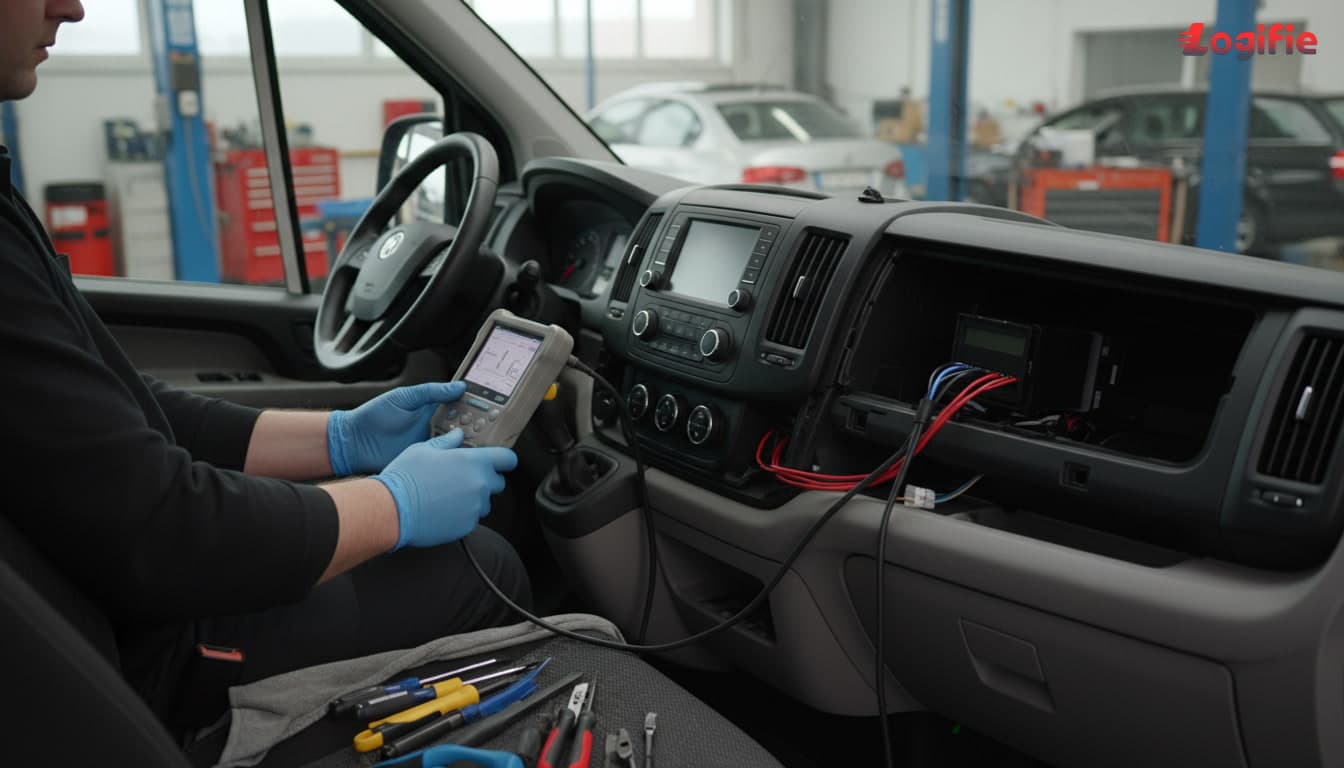
The smart tachograph 2026 mandate applies to light commercial vehicles (LCVs) that meet all three of the following criteria:
- Weight: The vehicle's gross vehicle weight, including any trailer or semi-trailer, exceeds 2.5 tonnes.
- Purpose: The vehicle is used for commercial freight transport — not private use, not passenger transport.
- Route: The vehicle performs international transport (cross-border journeys) or cabotage operations within another EU member state.
This means your Mercedes Sprinter, Iveco Daily, Ford Transit, MAN TGE, or any van in the 2.5–3.5t class that regularly crosses borders for freight delivery is in scope. The European Labour Authority (ELA) has published an official resource confirming these applicability criteria.
Who Is Exempt?
The mandate does not apply to vans used exclusively for national (domestic) transport. If your fleet operates only within Germany, or only within Poland, you are not required to install a tachograph under this rule. However, individual member states may introduce national tachograph requirements separately — so check your local regulations.
Additional exemptions, consistent with Regulation (EC) 561/2006 , include vehicles used by emergency services, breakdown recovery, agricultural/forestry operations within 100 km of the base, and vehicles with a maximum authorised speed not exceeding 40 km/h.
What Is the G2V2 Smart Tachograph and Why Does It Matter?
The G2V2 (Generation 2, Version 2) is the latest EU-approved digital tachograph. It's not just an incremental upgrade — it introduces capabilities specifically designed to close enforcement gaps that operators have exploited for years. According to VDO , the device (such as the VDO DTCO 4.1a or higher) features:
- Automatic border crossing detection using Galileo satellite OSNMA (Open Service Navigation Message Authentication), eliminating manual country entries.
- DSRC (Dedicated Short-Range Communication) module that enables remote roadside checks by enforcement authorities — without stopping the vehicle.
- Enhanced tamper detection that logs any interference attempts in a legally admissible format.
- Automatic recording of loading and unloading operations, giving authorities a complete picture of the vehicle's activities.
Crucially, only the G2V2 is permitted for newly equipped LCVs from July 1, 2026. Fitting an older-generation tachograph (whether analogue, digital, or first-generation smart) will count as non-compliant and attract the same penalties as having no tachograph at all, according to trans.info's analysis of the regulation .
How Much Does a Smart Tachograph Cost to Install?

Installation costs vary significantly depending on your location, fleet size, and how early you act. Here's what the data shows:
| Cost component | Typical range | Notes |
|---|---|---|
| G2V2 hardware unit | €800–€1,200 | VDO DTCO 4.1a or equivalent |
| Professional installation | €500–€1,000 | Must be done by certified workshop |
| Initial calibration + company lock | €200–€400 | Legally required before first use |
| Software/archiving system | €200–€500 | For mandatory data download and 12-month storage |
| Driver training | €100–€300 per driver | Operating the device, manual entries, card handling |
| Total per vehicle | €1,700–€3,400 | Western European average |
In Central and Eastern Europe — particularly Poland, which has a large international van fleet — Transport Management reports total costs reaching €3,500–€4,700 per vehicle when factoring in software licences, training, and operational changes.
The Early Bird Advantage
Companies that scheduled installations 6–9 months before the deadline (i.e., late 2025 through Q1 2026) typically secured better workshop rates and availability. Those waiting until Q2 2026 face 40–60% higher costs due to demand surge and limited workshop capacity, according to the same source. If you haven't booked your installation slots yet, the time to act is now — not in June.
Smart Tachograph Fines by Country: What You Risk
Penalties for tachograph non-compliance are set at the national level and vary dramatically across Europe. Trans.info and Stoneridge's fines map provide the following country-by-country breakdown:
| Country | Fine (operator) | Fine (driver) | Additional consequences |
|---|---|---|---|
| France | Up to €30,000 | Up to €30,000 | Up to 1 year imprisonment; vehicle impounded |
| Germany | Up to €30,000 (progressive, €750/day) | Up to €5,000 (€250/day) | Risk assessment points on operator file |
| Spain | €2,001 | — | Vehicle immobilised until tachograph installed |
| Poland | PLN 10,000 (~€2,400) | PLN 2,000 (~€480) | Registration certificate retained; 7-day permit issued |
| Italy | €1,500–€6,000 | €400–€1,600 | Both driver and company fined separately |
| Austria | €1,500–€5,000 | €150–€750 | Vehicle may be detained at roadside |
Corridor Risk: Fines Stack Up
If your van crosses multiple borders without a tachograph, fines accumulate per country. Ruptela estimates that a single trip along the Atlantic corridor (Portugal → Spain → France → Germany) could result in cumulative fines exceeding €70,000. Along the Baltic-Adriatic corridor (Poland → Czech Republic → Austria → Italy), the exposure is approximately €46,000. A single €1,700 tachograph installation looks very different against those numbers.
Driving Time Rules: Van Drivers Now Under Truck Rules

From July 1, 2026, van drivers covered by the tachograph mandate also become subject to the same EU driving time and rest period regulations that truck drivers follow. For many van operators, this is the hidden cost of compliance — it fundamentally changes how you can schedule routes and drivers.
| Rule | Limit |
|---|---|
| Maximum daily driving time | 9 hours (extendable to 10 hours, max twice per week) |
| Maximum weekly driving time | 56 hours |
| Maximum bi-weekly driving time | 90 hours over any two consecutive weeks |
| Continuous driving before break | 4.5 hours, then 45-minute break (can be split: 15 + 30 min) |
| Daily rest period | 11 hours (can be reduced to 9 hours, max three times per week) |
| Weekly rest period | 45 hours (can be reduced to 24 hours every second week, with compensation) |
These rules apply whenever the vehicle is used on in-scope international journeys. For operators who currently run van drivers on 12–14 hour days without mandatory breaks — a common practice in cross-border parcel and express freight — the productivity impact could be significant. Plan your route schedules and staffing levels accordingly.
Driver Cards: Don't Forget This Step
Every driver operating a tachograph-equipped van needs a valid driver card — a personal smart card that records their individual driving and rest times. Driver cards are issued by national authorities and are valid for 5 years.
Key points for van fleet operators new to tachographs:
- Apply early: Processing times average 10 working days in most EU countries, but can extend to 3–4 weeks during peak demand periods. With millions of van drivers potentially needing cards before July 2026, delays are likely.
- Cost: Typically €25–€40 per card depending on the country (e.g., £32 in the UK, according to DVLA/FleetGO ).
- One card per driver: A driver may only hold one valid card at a time. Lost or stolen cards must be reported and replaced.
- Company card: You'll also need a company card (separate from driver cards) to download and archive tachograph data — which you're legally required to do at least every 90 days, storing data for a minimum of 12 months.
The Compliance Timeline: What to Do in the Next 90 Days
With the July 1 deadline now less than 100 days away, here's a practical checklist for fleet operators:
- Audit your fleet immediately: Identify every vehicle in the 2.5–3.5t range that performs or may perform international transport. Don't forget vehicles with trailers that push the combination over 2.5t.
- Book workshop slots now: Certified tachograph workshops are filling up fast. Contact your nearest VDO, Stoneridge, or Continental-authorized installer and reserve dates for every affected vehicle.
- Order G2V2 hardware: Confirm availability of the specific tachograph model (e.g., VDO DTCO 4.1a) with your workshop. Supply chain delays are possible.
- Apply for driver cards: Submit applications for every driver who will operate tachograph-equipped vans. Budget 2–4 weeks for processing.
- Apply for a company card: You'll need this to download data from your tachographs. Apply through your national authority.
- Set up data management: Choose and implement tachograph data download software and archiving. Data must be stored for 12 months minimum.
- Retrain your drivers: They need to understand how to insert the card, make manual entries, handle out-of-scope mode, and comply with driving time rules.
- Revise route schedules: Model the impact of 9-hour daily driving limits and mandatory breaks on your international routes. You may need additional drivers or relay points.
- Update employment contracts: Ensure driver contracts reflect the new working time obligations and break requirements.
- Plan for enforcement: Brief your drivers on what happens during a roadside check — they must present the driver card, allow DSRC remote download, and explain any manual entries.
- Check your insurance: Confirm with your insurer that your commercial vehicle coverage is valid under tachograph-regulated operations.
- Monitor [logifie.com/holidays](https://logifie.com/holidays) for public holidays that may affect workshop availability or enforcement schedules in the countries where you operate.
European Context: How This Plays Out Across Key Markets
The impact of the smart tachograph 2026 mandate varies significantly by country, reflecting different fleet structures and enforcement cultures.
Germany has the largest LCV fleet in Europe, accounting for 23.3% of all regional registrations according to market data. German authorities apply progressive daily fines, which means a non-compliant vehicle discovered during a company audit could generate penalties that compound quickly. Germany's minimum wage increase to €13.90/hour in January 2026 (with €14.60 planned for 2027 ) also raises the cost of the additional driving hours that compliance management requires.
Poland is a critical market because Polish carriers dominate international van transport on major EU corridors. Polish logistics professionals report the highest total compliance costs at €3,500–€4,700 per vehicle. The national enforcement approach — retaining the registration certificate and issuing only a 7-day temporary permit — effectively grounds non-compliant vehicles.
France represents the harshest enforcement environment, with criminal penalties (up to one year imprisonment) alongside €30,000 fines. For any operator running vans on corridors through France — including the busy Benelux–Spain route via the A10/A63 — compliance is non-negotiable.
Spain and Italy both immobilise non-compliant vehicles, which means your cargo stops moving and your delivery timeline is destroyed.
For operators planning international routes, use logifie.com/fuel to track fuel costs by country alongside your compliance planning — because the regulatory burden comes on top of diesel prices averaging €2.10/litre across Europe .
FAQ
Do vans need a tachograph in 2026?
Yes — from July 1, 2026, vans and light commercial vehicles with a gross vehicle weight exceeding 2.5 tonnes (including trailers) must have a second-generation smart tachograph (G2V2) installed if they are used for commercial freight in international transport or cabotage within the EU. Vans used exclusively for domestic transport within a single member state are currently exempt.
How much does a smart tachograph installation cost?
The total cost typically ranges from €1,700 to €3,400 per vehicle in Western Europe, covering hardware, certified installation, calibration, and software. In Central and Eastern Europe, total costs including training and operational changes can reach €3,500–€4,700. Companies that waited until Q2 2026 to book installations are paying 40–60% more than early adopters.
What are the penalties for not having a tachograph in Europe?
Penalties vary by country but can be severe. France imposes fines up to €30,000 plus potential imprisonment. Germany applies progressive daily fines up to €30,000 for operators. Spain fines €2,001 and immobilises the vehicle. Along multi-country corridors, fines stack — a single non-compliant trip from Portugal to Germany could generate cumulative fines exceeding €70,000 .
Running international van freight across Europe? Get compliant routes with real-time tracking and ETA. Get a Free Quote | Join Our Carrier Network
Sources
IRU takes action to ease regulatory revolution for EU vans