Smart Tachograph Requirements 2026: Who Needs One and What It Costs
From July 1, 2026, vans over 2.5t in international transport must carry a G2V2 smart tachograph. See who qualifies, exact costs, fines, and how to comply.

Logifie Team
Logistics Technology Experts
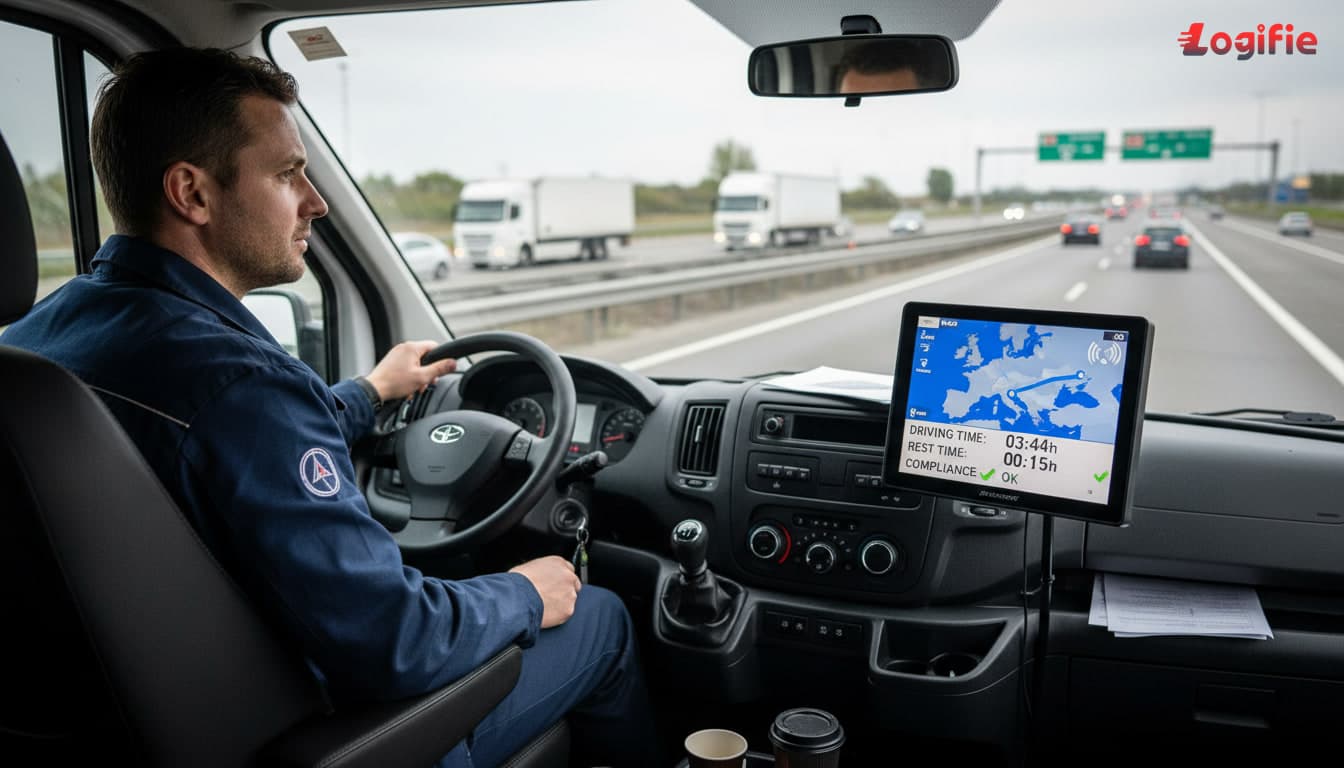
Regulatory deadline in 85 days: From July 1, 2026, vans between 2.5 and 3.5 tonnes used for international goods transport or cabotage must carry a second-generation smart tachograph (G2V2). Enforcement is already active at European border corridors — and installation workshops across Germany, Poland, and the Netherlands are warning of capacity constraints that are pushing Q2 installation costs 40–60% above what early movers paid. This is why searches for smart tachograph requirements 2026 have surged among van fleet operators across the continent.
Europe's tachograph regime just expanded. For years, smart tachograph rules applied only to trucks above 3.5 tonnes. From July 1, 2026, the net widens significantly: light commercial vehicles (LCVs) between 2.5 and 3.5 tonnes performing international goods transport must comply with the same second-generation smart tachograph (G2V2) requirement that heavy trucks have followed since August 2025. That covers a significant share of the EU's cross-border LCV operator base — van fleets, last-mile carriers, and freight forwarders running international routes below the 3.5-tonne threshold who have until now operated without any tachograph obligation.
With enforcement already active at border corridors and installation costs running 40–60% higher for operators who wait, this guide answers the questions freight professionals are asking right now: exactly who is caught by the rule, what the G2V2 device does and costs, what the fines are if you are stopped without one, and what to do between now and July 1 to comply without paying the Q2 premium.
Who Needs a Smart Tachograph in 2026?
The requirement is defined by three factors: vehicle weight, commercial purpose, and the type of transport operation. It is not enough to simply own a van — the obligation turns on how and where the vehicle is used.
You must fit a G2V2 smart tachograph if all three of the following apply:
- Your vehicle has a gross vehicle weight (GVW) exceeding 2.5 tonnes and up to 3.5 tonnes. The threshold includes the weight of any trailer or semi-trailer attached to the vehicle, so a 2.2-tonne van towing a 500-kilogram trailer falls within scope.
- The vehicle is used for the commercial carriage of goods — that is, transport for hire or reward. Own-account operators moving their own goods in their own vehicles may be exempt depending on national rules, but any operation where freight is carried as a paid service is covered.
- The transport is international — meaning the vehicle crosses at least one EU border during the course of the operation. Purely domestic transport remains outside the scope of this specific mandate, though some countries have their own national tachograph requirements for domestic operations.
- Cabotage — domestic carriage of goods by a non-resident carrier — is also included. If your van picks up a load within Germany as part of a cross-border trip, the G2V2 requirement applies.
Heavy trucks (above 3.5 tonnes) and buses in international transport have been subject to the G2V2 requirement since August 2025, following the completion of the heavy-duty retrofit phase. The July 2026 deadline is exclusively about extending the same standard to the 2.5–3.5 tonne LCV segment. Any new truck registered after August 21, 2023 was required to leave the factory already fitted with a second-generation unit.
What Is a G2V2 Smart Tachograph and What Does It Actually Do?
The second-generation smart tachograph (G2V2) is the current mandatory standard under EU Regulation 165/2014 as amended. It replaces earlier analogue and first-generation digital tachographs with a device that combines tamper-resistant data recording with real-time connectivity and satellite positioning.
The VDO DTCO 4.1a is the most widely deployed G2V2 model in Europe. Other certified units meeting the specification are also available.
Three features distinguish the G2V2 from its predecessors and explain why enforcement authorities favour it. First, it uses OSNMA — the Open Service Navigation Message Authentication protocol — delivered through the European Galileo satellite navigation system. This means the tachograph can cryptographically verify its position data and automatically detect when the vehicle crosses an international border, logging the country change without any driver input. Position manipulation that was possible on older systems is blocked at hardware level.
Second, the G2V2 includes a DSRC (Dedicated Short-Range Communication) module. This allows roadside enforcement officers to conduct remote checks without stopping the vehicle — they can read tachograph data wirelessly from a passing truck or van, enabling non-intrusive compliance monitoring on corridors across Germany, the Netherlands, France, and Poland.
Third, the device records all malfunctions and tampering attempts in a legally compliant, time-stamped log that cannot be deleted or altered.
Data management obligations that come with the device:
Once fitted, operators must download driver card data at least once every 28 days. Tachograph unit memory must be downloaded at least once every 90 days. Archived data must be stored for between 12 and 24 months depending on which enforcement authority may request it. Only certified specialist workshops are authorised to install, calibrate, and issue the initial company lock for a G2V2 unit — the company lock binds the device to your operator licence.
Smart Tachograph Costs: What to Budget for Installation
The cost varies significantly by vehicle type and — critically — by when you book the installation.
For heavy trucks already in the retrofit cycle, installation costs have settled at approximately €1,200 per vehicle, according to fleet data compiled by Snapacc. The market for truck installations is mature and workshop availability is reasonable.
For vans, the picture is different. Installing a G2V2 on a light commercial vehicle is more complex than on a purpose-built truck — the dashboard architecture, wiring harnesses, and integration requirements vary widely by van make and model. Transport Management research puts the all-in cost for van installation — unit, labour, calibration, company lock, and initial data software setup — at €3,500 to €4,700 per vehicle. For a ten-van fleet, that is €35,000 to €47,000 in compliance costs before a single kilometre is driven.
The timing penalty is severe. Operators who scheduled installations in Q3–Q4 2025 locked in workshop slots at competitive rates. Those booking in Q2 2026 — the period from now through the July 1 deadline — are facing a 40–60% premium on workshop labour as certified fitters are oversubscribed. A €4,000 installation booked in January 2026 could cost €5,600 to €6,400 if booked in May or June.
Beyond the hardware, ongoing compliance costs include: tachograph analysis software suited to your data volume and archive requirements, driver card procurement if drivers do not already have them (€40–70 per card in most EU member states), and periodic recalibration of the device every two years.
By the Numbers: Smart Tachograph Compliance at a Glance
| Item | Figure | Source |
|---|---|---|
| Deadline for vans 2.5–3.5t | July 1, 2026 | trans.info |
| Days remaining (from April 7) | 85 days | Calculated |
| Van installation cost | €3,500–€4,700 per vehicle | transportmanagement.org |
| Truck retrofit cost | ~€1,200 per vehicle | snapacc.com |
| Q2 2026 cost premium | +40–60% vs. early booking | transportmanagement.org |
| Driver card download frequency | Every 28 days (minimum) | mapon.com |
| Tachograph memory download | Every 90 days (minimum) | mapon.com |
| Czech Republic fine (no tacho) | Up to €13,932 (CZK 350,000) | ruptela.com |
| Italy fine (driver + owner) | €866–€3,464 + €831–€3,328 | trans.info |
| Spain fine + consequence | Up to €2,001 + immobilisation | trans.info |
Country-by-Country: What Enforcement Looks Like Right Now
Enforcement is not uniform across the EU, but it is coordinated. The European Labour Authority (ELA) has been running joint inspection campaigns since 2024, and the completion of the heavy-duty retrofit phase in August 2025 shifted enforcement resources toward systematic corridor checks on the major trans-European routes.
As of April 2026, Frotcom reports that roadside inspections are actively identifying and penalising non-compliant vehicles at international border corridors. The DE-PL corridor (between Germany and Poland) and the NL-DE corridor are among the highest-inspection-frequency routes in Europe.
Germany
Germany runs some of the continent's most stringent tachograph enforcement. The Bundesamt für Güterverkehr (BAG) can impose fines of up to €30,000 for serious tachograph violations and has authority to immobilise vehicles pending compliance. German enforcement officers use DSRC readers on major autobahn corridors — including the A2 (Amsterdam–Berlin), A4 (Cologne–Wrocław), and A9 (Munich–Berlin) — to conduct rolling checks without stopping vehicles.
Poland
Poland is a critical corridor country for European freight and has historically been among the most active enforcement jurisdictions. Polish ITD (Road Transport Inspectorate) officers operate across the major eastern EU corridors and have increasingly coordinated their actions with German BAG through ELA frameworks.
Czech Republic
Czech Republic carries the steepest headline fine in the EU at up to CZK 350,000 (approximately €13,932) for operating without a required tachograph. Czech enforcement is concentrated on the D1 (Prague–Brno) and D5 (Prague–Plzeň–German border) motorways.
France and Spain
France and Spain both use tachograph data as part of broader compliance checks on the posting of workers, cabotage, and driving time. Spain's July 2026 diesel VAT relief for commercial transport (cut from 21% to 10%) does not affect tachograph enforcement — operators on the FR-ES corridor via the Pyrenean crossings should expect continued scrutiny. Track diesel prices for Spain at logifie.com/fuel/es .
Romania and the Netherlands
Romania and the Netherlands are both active enforcement markets. The Netherlands, which is also introducing distance-based truck tolling from July 1, 2026, has aligned its van regulation enforcement timeline with the tachograph deadline — meaning July 2026 is a dual-compliance month for Dutch and trans-Netherlands operators. Track Dutch freight market conditions at logifie.com/fuel/nl .
For holiday-period planning — when enforcement activity often increases due to cross-border traffic surges — operators can check national public holiday calendars for Germany at logifie.com/holidays/de/2026 and for Poland at logifie.com/holidays/pl/2026 .
10-Step Smart Tachograph Compliance Checklist
Work through this list in order. Every step that remains open after June 1, 2026 is a fine risk.
- Audit your fleet weight by weight class. Pull GVW from V5/registration documents for every van in your fleet. Flag all vehicles above 2.5t GVW. Include GVW of any regularly towed trailer when assessing threshold.
- Confirm which vehicles cross international borders. Cross-reference your flagged vehicles against route records. Only international transport triggers the July 2026 mandate — document this for each vehicle so you have an audit trail.
- Identify your certified installation workshop. Only workshops with EU-issued certification can legally install and calibrate a G2V2 unit and issue the company lock. Use the VDO or Continental dealer locator, or ask your fleet leasing provider for their approved partner network.
- Book installation slots immediately. Do not wait. Workshops in Germany, Poland, the Netherlands, and Belgium are reporting June availability is limited. Email or call this week and get written confirmation of your booking. Expect an all-in price of €3,500–€4,700 per van.
- Confirm which model to install. The VDO DTCO 4.1a meets G2V2 specification. So does the Continental VDO DTCO 4.1b and the Stoneridge SE5000 G2V2. Verify compatibility with your van make and model before ordering hardware.
- Ensure every affected driver has a valid tachograph driver card. Driver cards are issued by national licensing authorities (e.g., DVLA in the UK, KBA in Germany, GITD in Poland). Processing time varies by country — allow at least four weeks from application to receipt, and apply now. Cost: €40–70 depending on country.
- Set up data download procedures. Establish a 28-day calendar reminder for driver card downloads and a 90-day reminder for tachograph unit memory downloads. Designate a responsible person in your operations team. Choose a compliant tachograph analysis software — options include Optac4, TachoMaster, DLK Pro, and others.
- Review your working time rules for affected drivers. From July 1, van drivers covered by the mandate must comply with EU driving time and rest period rules: maximum 9 hours driving per day (extendable to 10 hours twice a week), 45-minute break after 4.5 hours, 11 hours daily rest. Drivers who previously operated without these constraints will need training.
- Update your contracts and rates if needed. If you are a carrier and the compliance cost shifts your operating economics on international van lanes, review rate agreements with shippers. The cost is real and documented — it is a legitimate basis for a surcharge discussion. Many shippers already anticipate an uplift.
- Build a non-compliance risk register. Identify which corridors carry the highest enforcement probability (DE, PL, CZ, FR). Brief drivers on what to do if stopped — they must be able to produce the driver card, demonstrate the tachograph is functioning, and provide the last 28 days of driving data. A vehicle immobilised at a border costs far more than the installation fee.
Frequently Asked Questions
What is a smart tachograph and how does it work?
A smart tachograph is a tamper-resistant electronic recording device fitted to a commercial vehicle that automatically logs driving time, rest periods, speeds, and distances. The second-generation version (G2V2) uses the European Galileo satellite system with OSNMA authentication to verify position data and automatically detect international border crossings without driver input. It also includes a DSRC wireless module that allows roadside enforcement officers to conduct remote compliance checks without stopping the vehicle. Data is stored on a chip in the device and on the driver's personal tachograph card, and both must be downloaded regularly by the operator.
Do vans need a tachograph for international transport?
From July 1, 2026, yes — if the van has a gross vehicle weight above 2.5 tonnes and is used for the commercial carriage of goods across an EU border, it must be fitted with a second-generation smart tachograph (G2V2). This applies equally to cabotage operations. Vans used solely for domestic transport or for own-account non-commercial purposes may be exempt, but any cross-border paid freight operation in a 2.5–3.5t van is in scope from the July deadline.
How much does it cost to install a smart tachograph?
For vans (2.5–3.5t), the all-in cost — hardware unit, certified installation, initial calibration, and company lock — ranges from €3,500 to €4,700 per vehicle, according to fleet industry data. For heavy trucks, the settled market rate is approximately €1,200 per vehicle as the truck retrofit cycle is now mature. Operators booking installation in Q2 2026 should expect to pay 40–60% more than those who booked in the second half of 2025, due to workshop capacity constraints as the July deadline approaches.
What are the fines for not having a smart tachograph in Europe?
Fines vary significantly by country. The Czech Republic imposes the highest headline fine in the EU at up to CZK 350,000 (approximately €13,932), for operating without a required tachograph device. In Italy, drivers face fines of €866 to €3,464, with vehicle owners or operators liable for an additional €831 to €3,328. Spain can fine operators up to €2,001 and immobilise the vehicle. Germany's Bundesamt für Güterverkehr can impose fines up to €30,000 for serious tachograph violations. Beyond monetary penalties, non-compliance can trigger a review of an operator's "good repute" — the licence condition that permits EU cross-border transport — making it a business-threatening risk, not just a fine.
trans.info — Tachograph for vans from 1 July 2026: rules and penalties
transportmanagement.org — The €4,700 Van Fleet Challenge: G2V2 implementation strategies before July 2026
European Commission — Stronger and more unified enforcement as smart tachograph retrofit phase concludes
Frotcom — Smart Tachograph Fines in International Transport, April 2026
mapon.com — EU Tachograph Regulations: 2.5t+ LCV Update 2026
Ruptela — New EU tachograph regulations: Penalties and preparation for logistics companies
Need reliable pan-European freight with real-time tracking and smart route analytics? Get a Free Quote or Join Our Carrier Network.