What is a TMS? The European carrier's guide to transport management systems
A TMS (transport management system) handles dispatch, compliance, and cost for road freight carriers. What European SME operators need to know in 2026.

Logifie Team
Logistics Technology Experts
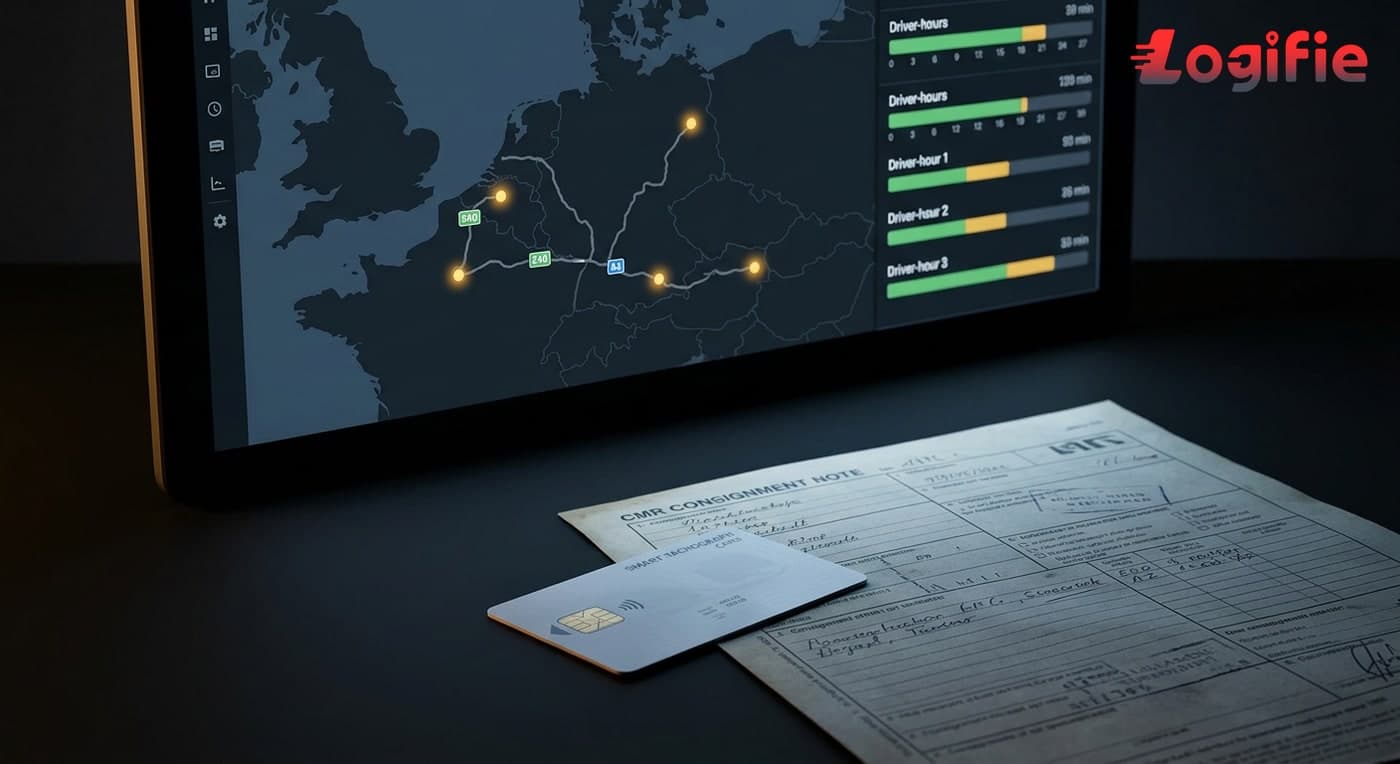
A TMS (transport management system) is the software layer a road freight carrier uses to plan loads, dispatch trucks, track shipments, settle invoices, and prove regulatory compliance from one screen instead of a wall of spreadsheets and paper. For a European operator running 5 to 50 trucks across borders, it is the system that ties dispatch to the tachograph, the consignment note, and the cabotage clock. According to a 2024 survey of transport leaders cited by ShipperGuide , buyers reach positive return on investment on a new TMS in about 14 months on average, and the same analysis finds a TMS can cut transport spend by 2 to 5 percent a year through better visibility and automation.
14 months
2–5%
From 1 July 2026, EU rules extend tachograph obligations to light commercial vehicles (LCVs, vans between 2.5 and 3.5 tonnes) used in international road transport, as confirmed by the European Commission . Tens of thousands of van fleets that have never touched a tachograph download will suddenly need software that can handle driver-hours data and cross-border compliance logging.
A TMS is no longer a large-fleet luxury. For any carrier crossing a border, it is becoming basic infrastructure, and this guide is written for the SME road carrier the enterprise vendors tend to ignore. If you are mapping out your wider digital stack, our overview of logistics software for fleets sets the scene.
What does TMS stand for, and why do European carriers confuse it with ERP?
TMS stands for transport management system. It is the part of the logistics technology stack that plans and executes the physical movement of goods: which load goes on which truck, which route, which driver, at what rate, and with which documents. The confusion with ERP (enterprise resource planning, the company-wide system that runs finance, payroll, and inventory) is common because the two overlap at the edges and some ERP suites bundle a transport module.
The distinction is practical. As vendor-neutral comparisons such as Cargofive explain, an ERP is built for enterprise planning, finance, and forecasting, while a TMS is purpose-built for real-time transport execution: vehicle tracking, routing, dispatch, and regulatory compliance. An ERP alone cannot manage a live cabotage clock or a tachograph download. For most SME carriers the right answer is a dedicated TMS that exchanges data with whatever accounting tool they already use, rather than an oversized ERP that does transport badly.
What core functions does a TMS cover for a road freight operator?
For a carrier that owns or subcontracts trucks, a TMS is the daily control room. The core functions, drawn from category breakdowns by AltexSoft and others, fall into a handful of buckets:
- Dispatch and load assignment. The system matches each load to the best available truck and driver based on location, capacity, and hours remaining, replacing the dispatcher's mental map and whiteboard.
- Route planning and optimisation. It factors in traffic, road closures, driving bans, and fuel to build efficient routes and cut empty running.
- Real-time tracking and visibility. GPS positions and driver mobile updates give the office and the customer live shipment status. Logifie's own real-time shipment tracking is one example of this layer.
- Billing, settlement, and freight audit. The TMS verifies charges, raises invoices, and reconciles subcontractor payments, syncing to accounting and reducing manual errors.
- Compliance and documentation. Increasingly the system stores the consignment note, logs cabotage operations, and ingests tachograph data so the audit trail is ready for a roadside check.
- Performance analytics. Dashboards track cost per kilometre, on-time delivery, fuel use, and driver behaviour so the operator can see where margin leaks.
How is a carrier-side TMS different from a shipper or 3PL platform?
This is where most of the advice online goes wrong for a road carrier. The bulk of TMS guides, and many of the best-known European platforms, are built for shippers. Cargoson , for instance, openly describes its product as a transport management system for European manufacturers, wholesalers, and retailers, designed to compare carrier rates and book shipments, not to run a fleet.
A carrier-side TMS solves a different problem. A shipper platform asks "which carrier should move this box and what will it cost." A carrier platform asks "which of my trucks and drivers moves this load, is the driver legal to drive it, am I within my cabotage allowance, and did I get paid." The features that matter to a carrier, such as digital tachograph integration, driver-hours monitoring, subcontractor settlement, and cabotage tracking, are usually absent from shipper tools. When you evaluate options, confirm the system is genuinely carrier-side. Logifie's transport management system for carriers sits firmly on the carrier side of that line.
How does a TMS connect with digital tachographs, eCMR, and the EU Mobility Package?
For a European carrier, compliance is not a side feature. It is half the reason to buy a TMS at all, and the 2026 regulatory calendar makes the case sharper.
Tachograph integration
From 2026-07-01, vans over 2.5 tonnes in international transport must carry a second-version smart tachograph, which the European Commission notes automatically records border crossings and loading or unloading events. A TMS that ingests tachograph downloads turns that raw data into driver-hours reports and infringement alerts. Our smart tachograph requirements guide for 2026 covers the hardware side; the TMS is what makes the data usable. Driver-facing tools such as a driver assistant app close the loop by pushing compliance reminders to the cab.
Cabotage and posting
Under the EU Mobility Package, cabotage (carrying goods for hire inside a country where the carrier is not established) is capped at three operations in seven days, after which the vehicle must leave for four days. The carrier must also file a posting declaration for cabotage and cross-trade work. A TMS that tracks these clocks per vehicle stops the operator drifting into a fine.
eCMR and eFTI
The eCMR is the digital version of the CMR consignment note (CMR being the convention governing international carriage of goods by road). Adoption is still tiny: the IRU reports eCMR is used in under 1 percent of operations, with roughly 99 percent of documents still on paper. That changes with the EU eFTI framework, shaped by the Commission's Digital Transport and Logistics Forum; under Implementing Regulation (EU) 2025/2243 authorities will be required to accept electronic freight information from 2027-07-09. A TMS with eCMR support positions a carrier ahead of that deadline.
What does a TMS cost, and when does it pay for itself?
Pricing is the question every fleet manager asks first. Most TMS products for SME carriers run on a software-as-a-service subscription, so the headline number is a monthly fee rather than a capital purchase.
| Item | Typical SME range | Notes |
|---|---|---|
| Monthly subscription | 350 to 1,000 EUR | Small-to-mid carriers; basic plans from around 20 EUR |
| Per-truck pricing | 5 to 15 EUR per truck per month | Varies with module set |
| Implementation (one-off) | 500 to 3,000 EUR | Higher with custom integrations |
| Data migration (one-off) | 1,000 to 5,000 EUR | Depends on legacy data quality |
| Training (one-off) | 500 to 3,000 EUR | Per the ShipperGuide cost breakdown |
Those figures are indicative ranges converted from market pricing data and will vary by vendor and country. The return comes from three places: the 2 to 5 percent cut in transport spend that better planning delivers, the hours saved on manual invoicing and compliance paperwork, and the fines avoided at the roadside. With an average payback of around 14 months and cloud subscriptions that scale by truck, even a 10-truck operator can build a credible business case. To get a tailored figure for your fleet, you can request a quote for your operation .
Which European TMS options should an SME carrier shortlist in 2026?
The European market splits into three rough tiers. Enterprise platforms such as the larger ERP-linked suites are overkill and overpriced for a sub-50-truck fleet. At the other end sit shipper-focused multi-carrier tools like Cargoson and contract-and-spot platforms such as Alpega, which are excellent for buyers of transport but not built to run a carrier's own trucks. In the middle sit carrier-side systems, including AI-driven cloud products from vendors such as Trimble and regional players, plus operator-focused tools like Logifie.
Carrier-side systems in the middle tier are the appropriate fit for most SME fleets because they are built around dispatcher and driver workflows rather than a shipper's rate-shopping interface. The core value for a sub-50-truck operation is automated dispatch suggestion, native tachograph integration that ingests driver card data without manual uploads, and a mobile driver app that replaces paper manifests. Enterprise platforms can carry equivalent features in theory, but licensing structures assume larger fleets and integration costs can outweigh the benefit. Pricing and module depth vary significantly within the mid-tier, so request a free trial or a structured demo before committing.
For an SME carrier the shortlist criteria matter more than the brand. Prioritise a cloud (browser-based, no on-site server) deployment for fast rollout, native digital tachograph and eCMR support, cabotage and posting tracking, subcontractor settlement, and a driver mobile app. Confirm the vendor supports the languages and the national posting systems of the countries you actually run in.
How do you implement a TMS without disrupting day-to-day operations?
The good news for small fleets is that cloud TMS rollouts are fast. Cargoson notes cloud implementation typically takes one to four weeks, against six to 18 months for old on-premise systems, and most SME deployments reach go-live in two to six weeks. The single biggest driver of how long it takes, and how much it costs, is the number of integrations you connect on day one.
A low-disruption approach is to phase it. Start with dispatch and tracking, run them alongside your existing process for a fortnight, then layer in billing, tachograph ingestion, and compliance once the core is stable. Clean your data before migration, nominate one internal champion, and train dispatchers first because they live in the system all day. Treat the first month as a parallel run rather than a hard switch, and the operational risk stays low.
There are EU-specific risks worth checking before go-live. Not every TMS vendor covers every national posting declaration system: confirm the vendor supports the specific countries you operate in, not just the major five. Tachograph integration varies in depth — some platforms read DDD files from any approved card reader while others require proprietary hardware; verify the vendor handles the driver card format in use across your fleet. Finally, check that the vendor's eCMR module meets the eFTI technical standards that take effect from 2027-07-09, when authorities are required to accept electronic freight information under Implementing Regulation (EU) 2025/2243 .
1–4 weeks
Frequently asked questions
What does TMS stand for in logistics?
TMS stands for transport management system. It is software that plans, executes, and optimises the movement of goods, covering dispatch, routing, tracking, freight billing, and compliance documentation for a carrier or shipper.
Do small carriers really need a TMS?
Yes. Even a five-truck operation gains from a single digital hub for dispatch, invoicing, and compliance. Adoption among small fleets has historically lagged, but the 2026 tachograph and eCMR changes make manual paperwork far harder to sustain across borders.
What is the difference between a TMS and an ERP?
A TMS handles real-time transport execution: routing, tracking, dispatch, and regulatory compliance. An ERP runs the whole company, including finance, inventory, and forecasting. They complement each other, and most carriers connect a dedicated TMS to their existing accounting or ERP tool rather than relying on one system for both.
How much does TMS software cost for a small carrier?
Most SME carriers pay roughly 350 to 1,000 EUR a month on a subscription, often priced per truck, plus one-off costs for implementation, data migration, and training. Basic plans can start near 20 EUR a month for very small fleets.
How long does it take to implement a TMS?
A cloud TMS for an SME carrier usually goes live in two to six weeks, sometimes as little as one to four weeks for a simple setup. Legacy on-premise systems took six to 18 months. The number of integrations is the main factor that lengthens the timeline.
Can a TMS handle tachograph and cabotage compliance?
A carrier-side TMS can ingest digital tachograph downloads, generate driver-hours reports, and track cabotage operations and posting declarations against EU Mobility Package limits. This is exactly the capability the 2026-07-01 LCV tachograph mandate makes essential for cross-border operators.
Is a TMS the same as fleet management software?
They overlap but are not identical. Fleet management focuses on the vehicles themselves, including maintenance, fuel, and telematics. A TMS focuses on the movement of freight, including loads, routing, documents, and settlement. Many modern carrier platforms combine both.
To see how a carrier-side platform handles dispatch, tachograph data, and cross-border compliance in one place, explore Logifie's transport management system built for European road carriers and benchmark it against the 2026 regulatory checklist your fleet now faces.