EU–US-tullit ja maantiekuljetukset 2026: miten KUOP:n ratkaisu ja kauppasodan kaaos muokkaavat eurooppalaista tieliikennettä
EU–US-tullit maantiekuljetuksissa 2026: KUOP kumosi IEEPA-tullit, Trump otti 15 %:n maksut ja EU:n viennit nousivat 22,4 %. Mitä tämä tarkoittaa eurooppalaiselle maantiekuljetukselle.

Logifie Team
Logistics Technology Experts
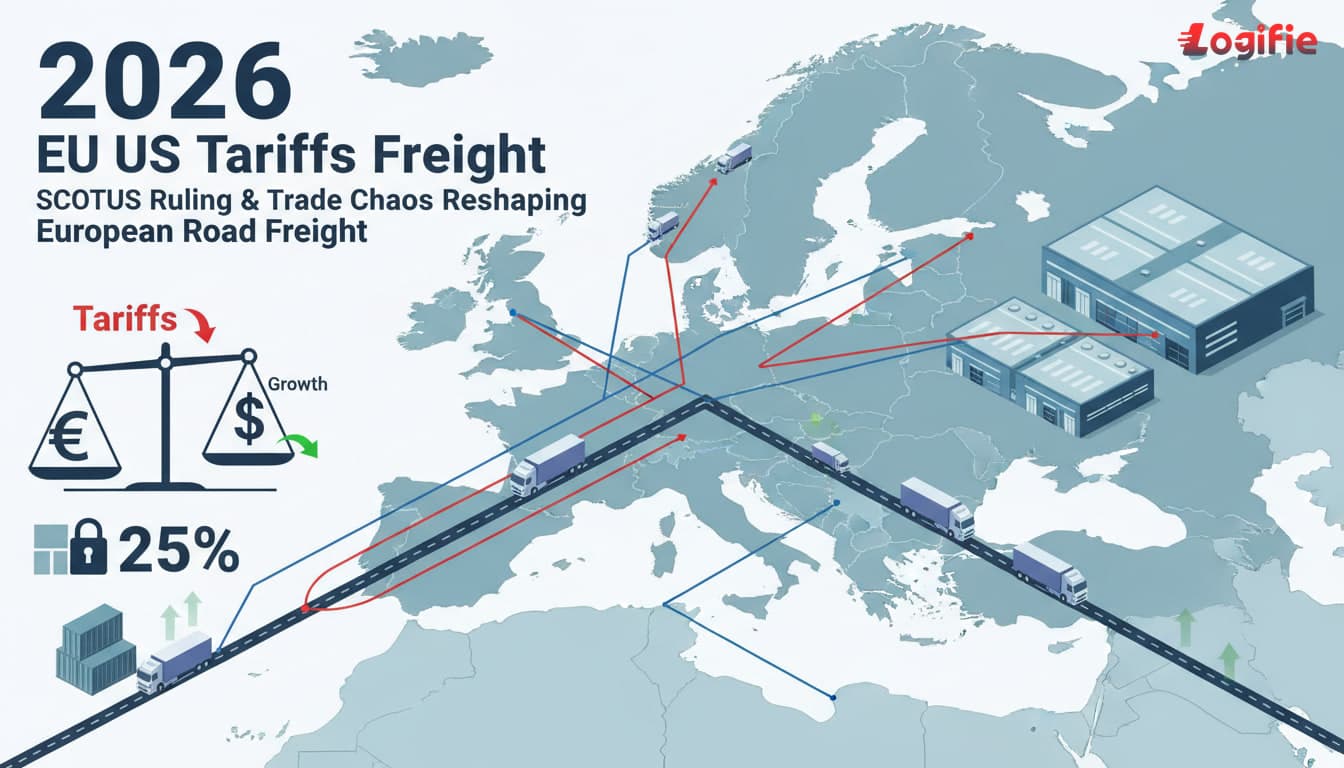
The US Supreme Court struck down IEEPA tariffs on Feb 20, Trump immediately imposed new 15% global tariffs, and EU exports to the US surged 22.4% as shippers frontloaded cargo.
EU US Tariffs Freight 2026: How the Trade War and SCOTUS Ruling Are Reshaping European Road Freight
European exports to the United States surged 22.4% year-on-year in February 2026. That number is not a sign of healthy trade growth — it is the sound of shippers scrambling to get cargo across the Atlantic before the next round of tariff escalation hits. The EU US tariffs freight 2026 situation has become the most chaotic trade policy environment in a generation: the Supreme Court struck down the IEEPA tariffs on February 20 in a landmark 6-3 ruling, Trump responded within hours by imposing new 10–15% global levies, the EU-US trade deal vote in the European Parliament has been delayed repeatedly, and an estimated 57% of Europe's top shippers have expedited inland hauls to clear export inventories ahead of higher duties. For European road freight operators, the result is a volatile demand environment that is simultaneously surging and uncertain. Here is what is happening, what the numbers reveal, and what you should be doing now.
What Happened: From the SCOTUS Ruling to 15% Global Tariffs
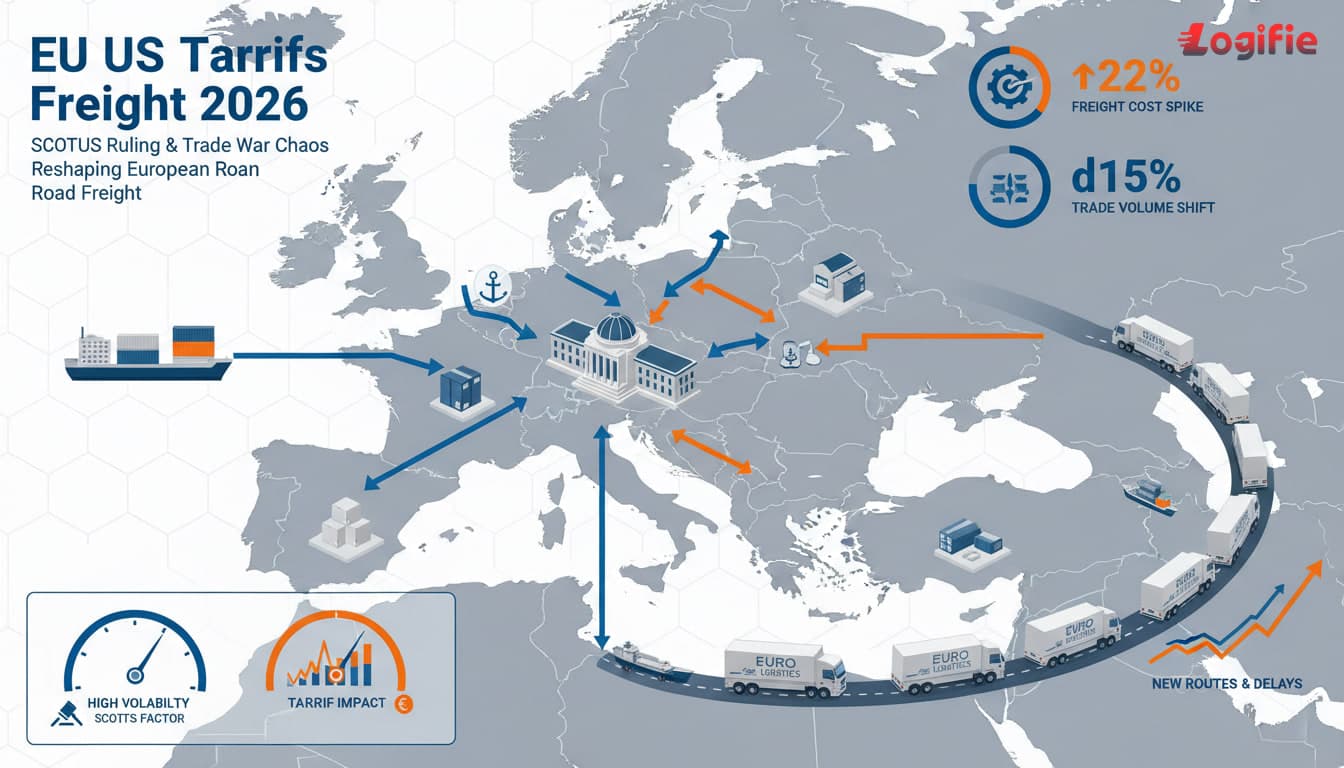
The current chaos began on February 20, 2026, when the US Supreme Court issued a 6-3 ruling that the International Emergency Economic Powers Act (IEEPA) does not authorize the President to impose tariffs. The decision invalidated the sweeping "Liberation Day" reciprocal tariffs — including rates as high as 145% on Chinese imports and 25% fentanyl-related tariffs on Canada and Mexico — that had been in effect since April 2025.
The ruling was expected to bring relief. Instead, within hours, Trump attacked the Court and signed an executive order imposing a new 10% tariff on all countries under Section 122 authority. By February 21, the rate was raised to 15%. US Customs stopped collecting the unlawful IEEPA tariffs on February 24 , but the new global levy immediately replaced them.
For the EU specifically, the situation is further complicated by the ongoing trade deal negotiations. The European Parliament's International Trade Committee (INTA) is set to vote on the EU-US trade deal on March 19 , but around 7% of European goods already face tariffs above the 15% ceiling that was agreed last summer, with products like cheese hit by duties as high as 30%. Bloomberg reported that the EU has kept the trade deal frozen over this tariff uncertainty.
Meanwhile, the EU has prepared €21 billion in retaliatory tariffs targeting US goods including jeans, motorbikes, bourbon, and machinery at rates of 10–25%.
By the Numbers: The Tariff Freight Demand Surge
The trade policy turmoil is generating hard numbers that directly affect logistics planning:
+22.4%
Key figure highlighted in the metric comparison.
57% of top shippers
Key figure highlighted in the metric comparison.
Key figure highlighted in the metric comparison.
| Metric | Figure | Source |
|---|---|---|
| EU export surge to US (Feb 2026 YoY) | +22.4% | [Scangl](https://www.scangl.com/news/trade-wars-reloaded-logistics-in-the-crossfire-of-us-tariff-fallout/) |
| European shippers expediting inland hauls | 57% of top shippers | [Scangl/AlixPartners](https://www.alixpartners.com/insights/102katp/the-quiet-before-the-trade-storm-tariff-impact-on-europe-eu-freight-and-import/) |
| EU exports threatened by US tariffs | €380 billion (~70% of EU-US trade) | [AlixPartners](https://www.alixpartners.com/insights/102katp/the-quiet-before-the-trade-storm-tariff-impact-on-europe-eu-freight-and-import/) |
| Potential duty increase | From €7B to €80B+ | [AlixPartners](https://www.alixpartners.com/insights/102katp/the-quiet-before-the-trade-storm-tariff-impact-on-europe-eu-freight-and-import/) |
| IEEPA tariffs collected before SCOTUS ruling | $160–175 billion | [Yale Budget Lab](https://budgetlab.yale.edu/research/state-us-tariffs-scotus-ruling-update) |
| New global tariff rate (post-SCOTUS) | 15% | [CNBC](https://www.cnbc.com/2026/02/23/what-supreme-court-tariff-ruling-means-for-global-trade-us-economy.html) |
| IRU European road freight contract index | 128.9 (up 2.8 pts) | [Upply/IRU](https://market-insights.upply.com/en/customs-tariffs-the-european-unions-response-options) |
| EU retaliatory tariffs prepared | €21 billion | [European Parliament](https://www.europarl.europa.eu/topics/en/article/20250210STO26801/eu-us-trade-how-tariffs-could-impact-europe) |
The 22.4% surge in EU exports to the US and the fact that 57% of top shippers are expediting hauls signal that the frontloading wave is real and it is happening now.
US Tariffs European Road Freight: Which Corridors Are Most Affected
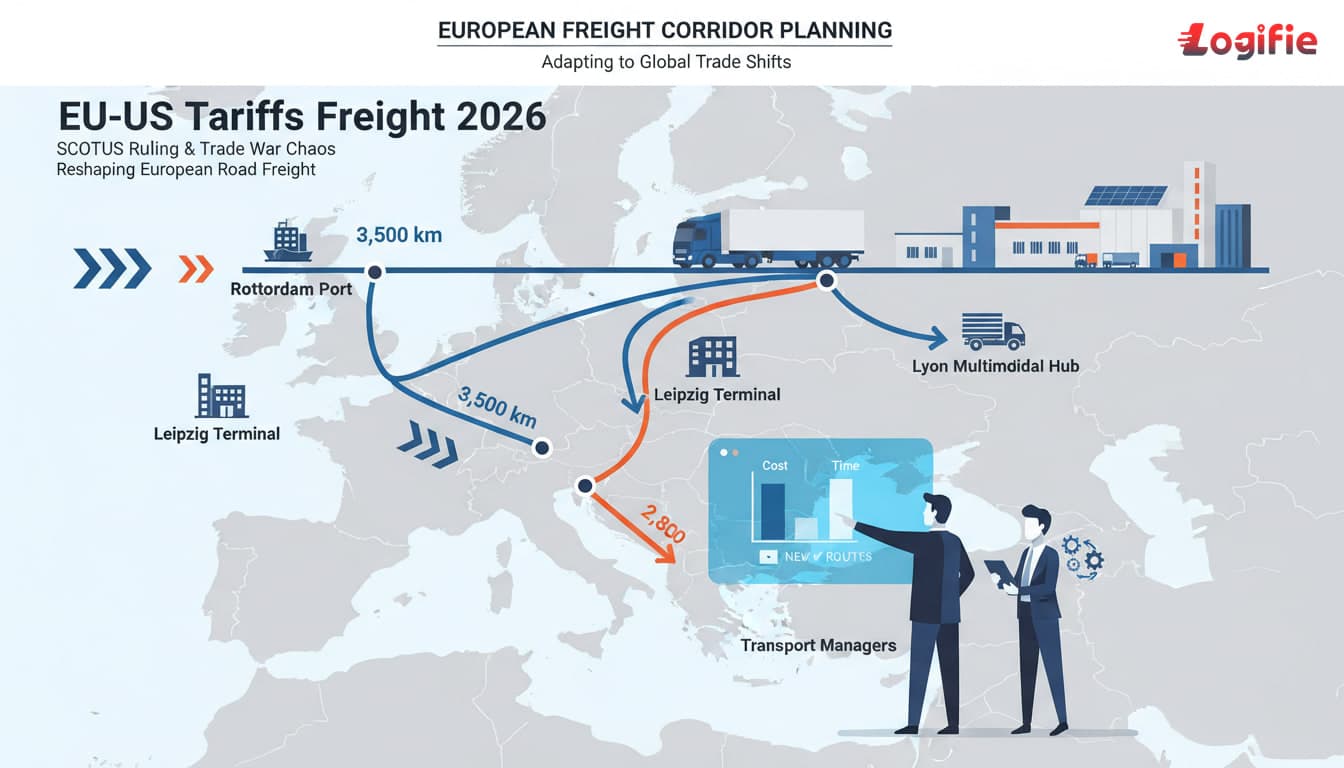
The frontloading rush is not spread evenly across Europe. It concentrates on the corridors that connect manufacturing centres to major export ports, creating localised demand surges that road freight operators need to understand.
Germany–Hamburg/Bremerhaven corridor is the most heavily impacted. Germany is the EU's largest exporter to the United States, and the automotive, machinery, and chemical sectors — all tariff-sensitive categories — generate massive road freight volumes feeding into North Sea ports. Carriers on the A1/A7 corridor into Hamburg and the A27 into Bremerhaven are reporting elevated booking demand as manufacturers rush to get shipments to port before the next tariff escalation.
Netherlands–Rotterdam corridor serves as the gateway for a significant share of EU-US trade. With the port also dealing with congestion from the lasher strike and broader capacity constraints , the combination of tariff-driven frontloading and port delays is creating both demand pressure and inefficiency simultaneously.
France–Le Havre corridor is seeing increased activity in wine, aerospace components, and luxury goods — all categories where exporters want cargo on the water before potential retaliatory or additional tariffs hit. The Benelux–France route via Lille is experiencing knock-on effects.
Italy–Genoa/Trieste corridor is affected for fashion, food, and machinery exports. Italian cheese, which faces tariffs as high as 30% — well above the 15% ceiling — is a particularly urgent category driving road freight demand to Mediterranean ports.
The IRU's road freight index shows contract rates already climbing — up 2.8 points to 128.9 — despite softening ocean freight rates. This divergence reflects the inland logistics bottleneck: even as ocean shipping rates ease, road transport demand is being driven up by tariff-related urgency and port-access constraints.
The SCOTUS Tariff Ruling and Its Logistics Aftermath
The SCOTUS tariff ruling on February 20 was supposed to simplify things. Instead, it created a three-way uncertainty that is paralysing supply chain planning.
Uncertainty 1: Refunds. Approximately $160–175 billion in IEEPA tariffs were collected before the ruling. The Court did not address refunds, and Flexport's analysis notes that timing, eligibility, and process remain entirely unresolved. For European exporters who paid elevated duties throughout 2025, the potential for refunds — or the lack thereof — affects cash flow projections and pricing strategy.
Uncertainty 2: The new 15% tariff's legal basis. Trump's immediate reimposition of tariffs under Section 122 is already being challenged legally . If this authority is also struck down, the trade environment could shift again dramatically — making long-term logistics planning nearly impossible.
Uncertainty 3: The EU-US trade deal. The European Parliament's vote has been delayed multiple times . If the deal is ratified by end of March, it provides a framework — including a sunset clause expiring March 2028 and a suspension clause if either side violates terms. If it fails, the trade war escalates, and EU retaliatory tariffs worth €21 billion could be activated, reshaping transatlantic freight flows entirely.
EU Trade War Freight Impact: What Happens Next
The freight implications depend on which of three scenarios plays out over the coming weeks:
Scenario A — Deal ratified, tariffs stabilise. If the EU-US trade deal passes the European Parliament by end of March and the 15% tariff holds, the current frontloading surge subsides, and road freight demand normalises — but at a structurally higher baseline due to the new tariff regime. Carriers see a demand dip in Q2 after the frontloading wave passes.
Scenario B — Deal delayed or rejected, uncertainty continues. If the vote is delayed again, the 57% of shippers currently frontloading continue to do so, sustaining elevated road freight demand through Q2 but at the cost of inventory imbalances and potential over-stocking. Rate volatility increases as shippers oscillate between urgency and paralysis.
Scenario C — Tariff escalation, retaliatory cycle. If the US raises tariffs beyond 15% or the EU activates its €21 billion retaliatory package, transatlantic trade volumes could contract significantly . Road freight demand on export corridors drops sharply, but intra-European restructuring activity increases as supply chains diversify away from US dependence.
For road freight operators, the actionable takeaway is to plan capacity for elevated demand now, while building flexibility for a potential correction in Q2.
What European Logistics Operators Should Do Now
The tariff chaos demands both immediate tactical adjustments and medium-term strategic positioning:
- Review all transatlantic supply chain contracts for tariff-related clauses — understand which party bears the duty cost under different scenarios
- Prioritise export corridor capacity on Germany–Hamburg, Netherlands–Rotterdam, France–Le Havre, and Italy–Genoa routes through March, as frontloading demand peaks
- Monitor the EU Parliament INTA committee vote on March 19 — the outcome will directly influence Q2 freight demand on transatlantic corridors
- Build flexible capacity agreements with carriers that allow scaling up or down as tariff policy shifts — avoid locking in rigid volumes
- Pre-position containers at inland depots closer to manufacturing sites to reduce port-access lead times during congestion
- Track [fuel costs by country](https://logifie.com/fuel) — tariff-driven demand spikes combined with elevated diesel prices compound cost pressure
- Assess tariff refund exposure — if your business paid IEEPA tariffs, document all payments for potential refund claims once the process is clarified
- Diversify port routing — avoid over-reliance on any single export gateway given simultaneous port congestion and tariff uncertainty
- Communicate tariff cost impacts to customers transparently using published data rather than absorbing costs silently
- Review [holiday schedules](https://logifie.com/holidays) across operating countries — Easter closures in April combined with tariff-driven demand make Q1/Q2 planning critical
- Consider joining a [carrier network](https://logifie.com/carrier) for access to pan-European load visibility across multiple export corridors
FAQ
How are US tariffs affecting European road freight demand?
The tariff turbulence is creating a demand surge on European road freight corridors that serve major export ports. EU exports to the US rose 22.4% year-on-year in February 2026 , and an estimated 57% of top European shippers have expedited inland hauls to clear inventories ahead of higher duties. The Germany–Hamburg, Netherlands–Rotterdam, France–Le Havre, and Italy–Genoa corridors are most affected. The IRU's European road freight contract index has risen 2.8 points to 128.9, reflecting this demand pressure even as ocean freight rates have softened.
What does the SCOTUS tariff ruling mean for EU-US trade?
The Supreme Court's 6-3 ruling on February 20, 2026 found that IEEPA does not authorize presidential tariffs, invalidating the sweeping duties in place since April 2025. However, Trump immediately imposed new 10–15% global tariffs under different legal authority. For EU-US trade, this means the tariff environment has shifted but not improved — the new 15% baseline plus product-specific rates above that level continue to affect export volumes and logistics planning. Approximately $160–175 billion in IEEPA tariffs were collected, but refund processes remain unresolved.
How should European logistics operators prepare for tariff uncertainty?
Operators should build flexibility into every element of their supply chain: use short-term capacity agreements rather than rigid contracts, diversify port routing across multiple gateways, and monitor the EU Parliament trade deal vote on March 19 as a key decision point. Tactically, prioritise export corridor capacity through March to capture frontloading demand, track fuel costs by country to manage combined tariff-and-fuel cost pressure, and document any IEEPA tariff payments for potential future refund claims. The most resilient operators will be those who can scale capacity up or down rapidly as trade policy shifts.
Ready to move freight across Europe with real-time visibility? Get a Free Quote | Join Our Carrier Network
Sources
What the IEEPA SCOTUS Ruling Means for American Freight
European Parliament ready to vote on EU-US trade deal by March
Supreme Court ruling throws Trump tariff strategy into flux
EU Keeps US Trade Deal on Hold as Tariff Uncertainty Persists
Trade wars reloaded: Logistics in the crossfire of US tariff fallout
The quiet before the trade storm: Tariff impact on EU freight
State of U.S. Tariffs: SCOTUS Ruling Update
Customs tariffs: the EU's response options