Germany: EU rest rules block electric trucks at chargers
Germany was formally asked in 2026 to amend EU rest rules that force electric trucks to hold public charging bays even after the battery is full.

Logifie Team
Logistics Technology Experts
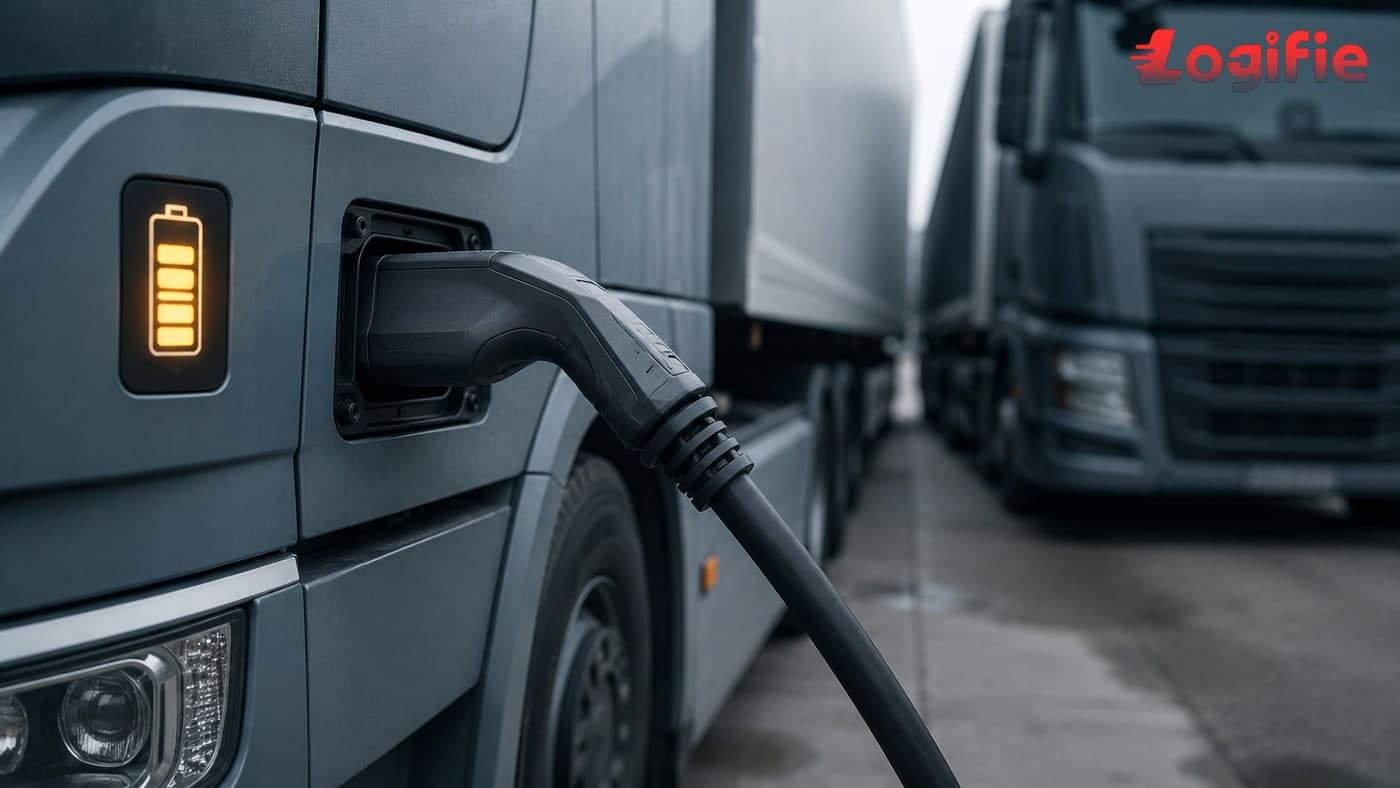
Under EU Regulation (EC) No 561/2006, an electric truck driver who moves a fully charged vehicle from a public charging bay to a parking space interrupts the mandatory 11-hour rest period and must restart the clock from zero — a legal gap Germany's transport ministry is now being formally asked to fix. An open letter from driver Tobias Wagner to Transport Minister Patrick Schnieder, submitted on 2026-04-23, has put this compliance gap in EU drivers'-hours law onto the policy agenda. The issue risks turning public charging infrastructure into a compliance bottleneck as long-haul electric freight scales up.
Why do EU rest rules trap electric trucks at public chargers?
Under Regulation (EC) No 561/2006, a driver's daily rest of at least 11 hours must remain uninterrupted. European road transport enforcement confederation CORTE has confirmed that charging counts as rest if the driver is free from work and not required to supervise the process. That interpretation gives operators flexibility to top up batteries during overnight stops.
The difficulty begins when the battery is full. Moving a charged truck from a public bay to a nearby parking space is a driving act. Under the current enforcement interpretation, it interrupts rest and forces a restart from zero. Removing the tachograph card is not a workaround: the device records the movement as driving without a card, which is a separate infringement. The result is that operators either leave a fully charged vehicle occupying a fast charger until the rest period ends, or accept a compliance risk by freeing the bay.
For diesel trucks the issue does not arise. Refuelling takes minutes and happens during working time. Electric trucks often finish charging well before a mandatory rest period ends, as reported by trans.info , leaving a vehicle tethered to infrastructure other operators need. The gap is a structural mismatch between diesel-era rules and battery operations. EU electrically-chargeable truck registrations rose 40.1% in Q1 2026 to 4.4% market share, up from 3.5% a year earlier, according to ACEA — making the charging-rest compliance gap a growing operational concern.
What drivers and industry are asking Berlin to do
Long-haul driver Tobias Wagner submitted an open letter to Federal Transport Minister Schnieder at Germany's BMDV co-signed by logistics companies and charging-point operators. Wagner requests a narrow interim measure modelled on the existing derogation that allows drivers to split rest when travelling on ferries and trains, under Article 9 of Regulation 561/2006.
The proposed fix is specifically limited: allow a driver to move a fully charged vehicle a short distance to free the charger, add the time to the rest period, and record the movement by tachograph. No relaxation of fatigue rules is sought. The German road transport association BGL notes that the issue is largely hidden today, because most electric trucks serve urban routes and charge on private depot infrastructure. As long-haul electric freight grows and megawatt charging hubs expand, the conflict between charging availability and rest compliance will become harder to ignore.
How EU law may need to change
A German enforcement guidance notice could be issued quickly but would give limited legal certainty for international operators subject to enforcement across EU member states. European Commission guidance on brief post-charge repositioning could serve as a short-term bridge, though legal experts caution that guidance cannot override the regulation's wording if challenged.
A narrow amendment to Regulation 561/2006, adding a derogation for post-charge repositioning similar in structure to the ferry exception, would provide the clearest EU-wide legal certainty. That path requires a full legislative process and would take longer to deliver. Industry groups favour early Commission guidance as an interim measure while the legislative route is pursued.
Germany's shortage of secure truck parking adds further pressure: if electric trucks cannot leave charging bays after reaching full charge, charger congestion and parking availability become a single compliance problem rather than two separate infrastructure issues.
Operators running electric vehicles on cross-border EU routes should review their rest-period and charging schedules before public charging volumes grow and enforcement attention follows. Logifie helps freight operators plan European routes with full visibility of compliance requirements along each corridor.