Europe's truck makers and workers warn EU of competitiveness crisis over CO2 targets
On 27 May 2026, Europe's truck makers and workers told the EU that CO2 targets outpace charging infrastructure, threatening the commercial vehicle sector.

Logifie Team
Logistics Technology Experts
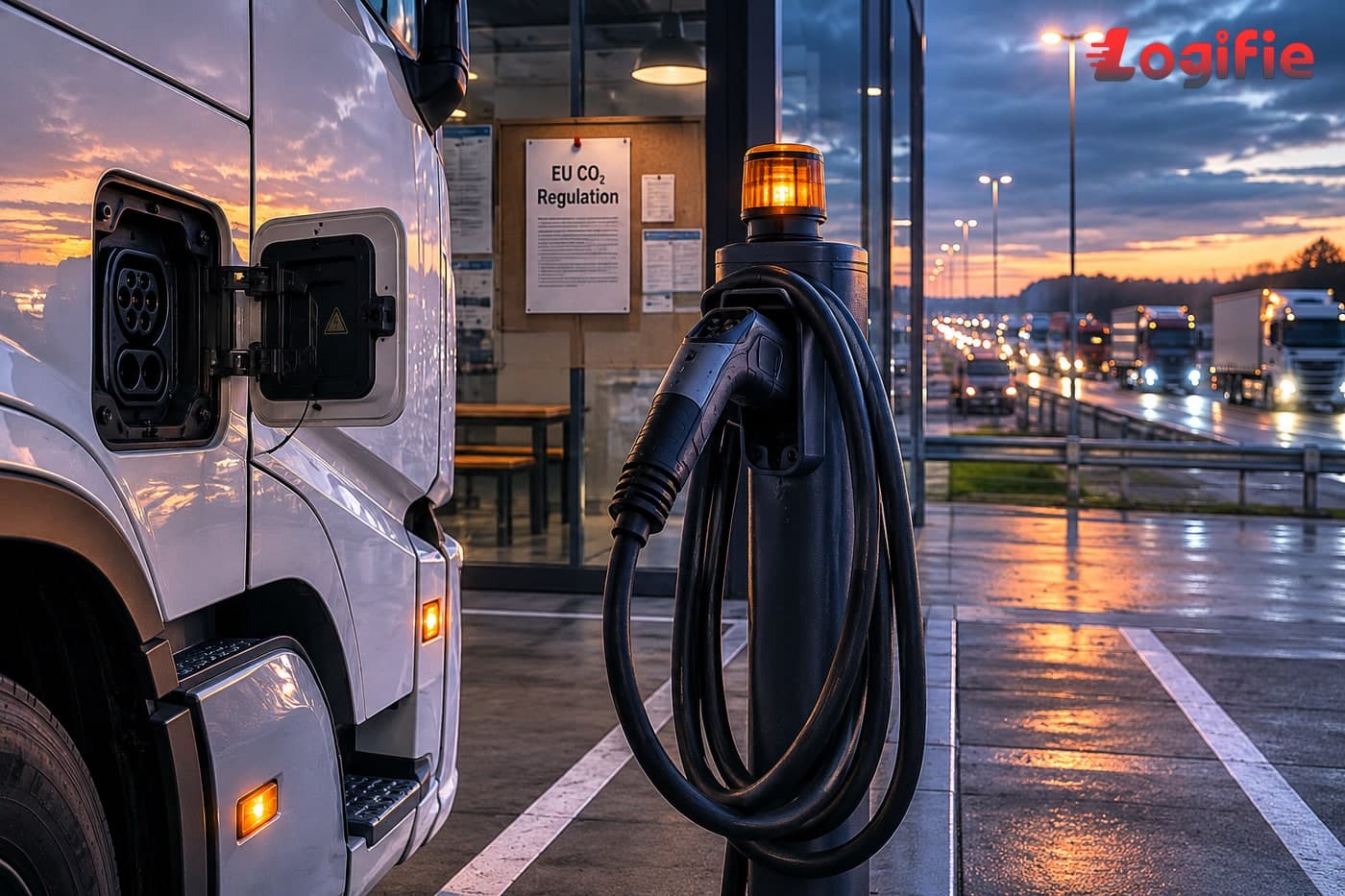
On 27 May 2026, every major European truck and bus manufacturer and their workers jointly demanded that the European Commission review CO2 targets for heavy-duty vehicles (HGV) and mandate binding motorway charging infrastructure milestones. The group of chief executives and workers' council representatives — including DAF, Daimler Truck, Ford Trucks, IVECO Group, MAN Truck and Bus, Scania Group, and Volvo Group — formally wrote to the European Commission ahead of the EU Competitiveness Council meeting on 28 and 29 May 2026, warning that current targets outpace available infrastructure and put Europe's global leadership in commercial vehicle manufacturing at risk.
What the letter asks the Commission to do
The manufacturers and their workers' representatives make three specific demands. First, they call for an early review of the EU CO2 regulation for heavy-duty vehicles, arguing that the 45 percent reduction target from 2030 is incompatible with the current pace of charging and hydrogen infrastructure deployment. The EU Council granted manufacturers targeted credit flexibility in March 2026, but the letter makes clear that industry and workers regard this as a temporary measure , not a structural fix.
Second, the signatories call for binding motorway deployment milestones under the forthcoming revision of the Alternative Fuels Infrastructure Regulation (AFIR). The existing AFIR sets indicative targets; the manufacturers and workers want legally enforceable ones, so that infrastructure operators have an obligation — not merely an invitation — to build dedicated HGV charging points and hydrogen refuelling stations along European motorways.
Third, the letter asks for a coherent EU industrial strategy for the commercial road transport sector. The signatories describe the challenge in direct terms: "Intensifying competition from regions operating under different cost structures, regulatory frameworks, and coordinated industrial strategies is placing unprecedented pressure on manufacturers, suppliers, and workers."
Where the electric truck transition stands
ACEA (European Automobile Manufacturers' Association) data for Q1 2026 shows the EU truck market recovering — registrations rose 10.7 percent year on year to 81,766 units in the first quarter, recovering from a 6.2 percent decline across the whole of 2025. Electric trucks grew 40.1 percent in Q1 2026 and reached a 4.4 percent EU market share, up from 3.5 percent a year earlier. France and Germany are leading, with electric truck registrations rising 66.3 percent and 58.9 percent respectively.
The problem is scale. Even at 40 percent growth, electric trucks hold only 4.4 percent of the EU market — a fraction of what is needed to meet the 2030 CO2 targets. The bottleneck is not product availability; major manufacturers already offer zero-emission heavy-duty trucks across weight classes. The bottleneck is infrastructure: dedicated HGV charging points and hydrogen stations remain insufficient along most European motorways.
ING THINK's January 2026 analysis of Europe's electric truck market confirms that Q1 2026 truck market recovery reflects pent-up fleet replacement demand after two years of contraction, not a structural upturn in freight volumes. Without a viable charging network, replacement buyers will default to diesel — closing the total cost of ownership gap for electric trucks depends directly on infrastructure density.
What operators should watch before the summer recess
The Commission's response to the letter — if it comes before the parliamentary summer recess — will indicate whether AFIR binding milestones are likely to feature in the next legislative package. Electric truck operators already benefit from Eurovignette toll exemptions until 2031 — extended by EU regulation in the member states that apply them, giving early adopters a partial operating cost offset. Read the country-by-country toll breakdown at logifie.com/blog/eu-road-tolls-trucks-country-guide-2026 to see where exemptions apply on your routes.
Fleet and operations managers running mixed diesel and zero-emission fleets will want to track the AFIR revision calendar. If the Commission accepts binding HGV charging milestones, the route-planning and charging logistics for electric heavy-duty trucks could change materially within 18 months. For a broader overview of fleet technology regulations affecting European operators in 2026, visit logifie.com/blog .