Netherlands truck toll 1 July 2026: OBU contracts due 31 May
The Netherlands launches a per-kilometre truck toll on 1 July 2026, replacing the Eurovignette and requiring every N2 and N3 truck to carry an OBU.

Logifie Team
Logistics Technology Experts
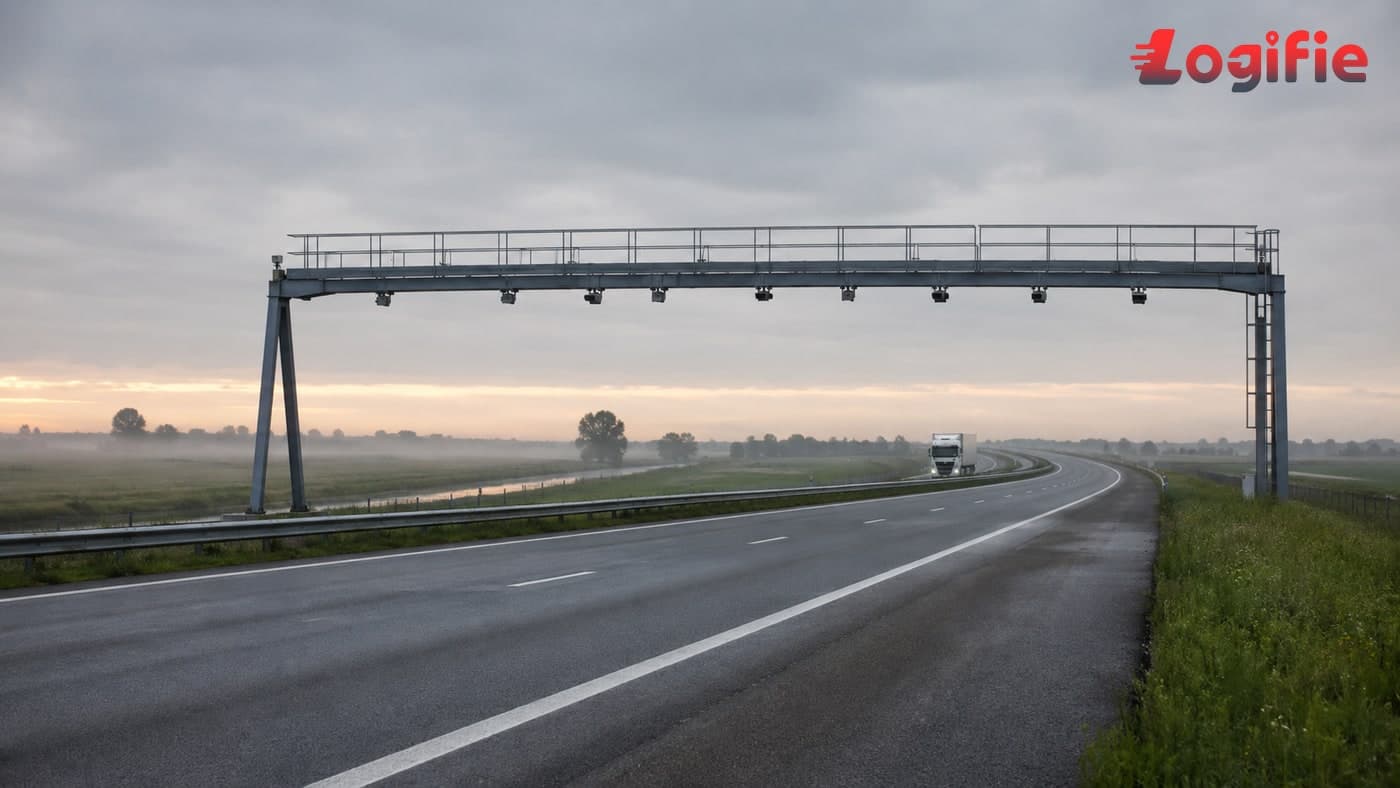
The Netherlands launches a per-kilometre truck toll on 1 July 2026 , replacing the flat Eurovignette and requiring every N2 and N3 truck to carry a working on-board unit (OBU) the moment it crosses the Dutch border. The RDW, the Dutch vehicle authority running the scheme, asks operators to sign an OBU contract by 31 May 2026 so devices can be received and fitted in time. About 725,000 unique foreign trucks use Dutch roads each year, and every one of them needs an active OBU on day one or risks a fine.
Which trucks need an OBU on Dutch roads?
The Dutch truck toll applies to vehicle categories N2 and N3 with a technical maximum mass above 3,500 kg, both Dutch and foreign. There is no light commercial vehicle (LCV) exemption above that threshold and no foreign-operator exemption. The toll covers almost all Dutch highways and a smaller set of provincial and municipal roads where freight traffic is concentrated. The current Eurovignette ends on the same day for the Netherlands, so operators do not pay both, because the new charge is a replacement, not a top-up. The OBU itself must remain active across the entire journey on Dutch territory, including any segments on toll-free roads, because the device also serves as the enforcement signal.
How operators arrange an OBU before 31 May 2026
Two provider types are recognised. EETS providers offer multi-country OBUs that already work in Germany, Belgium, Austria and other European tolling regimes, and most foreign hauliers will extend an existing fuel-card or toll-service contract to add the Netherlands to its service area. NedLinq is the single-country alternative, useful for operators whose Dutch exposure is limited and who do not need cross-border coverage. The detail that catches non-Dutch fleets off guard is that the Toll Collect device used in Germany and the Satellic device used in Belgium do not work in the Netherlands , so operators carrying only one of those need a new contract regardless of how clean their German or Belgian compliance is today. The IRU coordinated an international webinar with the RDW and the Dutch trade association TLN earlier in 2026 to brief foreign hauliers on exactly this gap, which is a clear signal European trade bodies expect significant readiness shortfalls among non-Dutch operators in the final weeks before launch.
What happens if a truck arrives without a working OBU?
RDW enforcement starts on 1 July 2026, using fixed gantries above Dutch roads and roadside mobile equipment. Suspected breaches go through a review step before a fine is sent by post to the vehicle owner. The penalty schedule is set out on Vrachtwagenheffing.nl and is halved for the first six months. A missing service-provider contract costs EUR 800 (EUR 400 until 1 January 2027), and driving with an OBU registered to a different truck costs EUR 500 (EUR 250 until that date). A vehicle can only receive one fine per 24 hours, with the highest amount applying when more than one offence is detected.
What does a typical Euro VI run cost per kilometre?
The per-kilometre rate is built from three inputs: maximum authorised mass, Euro emission class and CO2 emission class. The official RDW rate table sets a Euro VI tractor above 32,000 kg in CO2 emission class 1 at EUR 0.201 per kilometre, and the same vehicle in the cleaner Euro VI+ class at EUR 0.197 per kilometre. Rates drop sharply for cleaner CO2 classes, reaching EUR 0.038 per kilometre at CO2 class 5 in the heaviest band, and rise to EUR 0.487 per kilometre for a Euro 0 vehicle above 32,000 kg in CO2 class 1. Operators recalculating Dutch lane costs should overlay those rates against the lanes they actually run and re-quote any Dutch leg signed under the flat-fee Eurovignette assumption.
Logifie helps operators compare Dutch toll exposure across alternative routings and request a compliance-aware freight quote tuned to the new per-kilometre regime. Operators reviewing their full corridor cost base ahead of 1 July 2026 can also consult the pan-European road-toll guide before the launch date.