Electric truck total cost of ownership vs diesel in Europe
MY2026 electric trucks run 10.1% cheaper on TCO than diesel in Europe — here is the per-km breakdown, break-even guide, and country toll comparison.

Logifie Team
Logistics Technology Experts
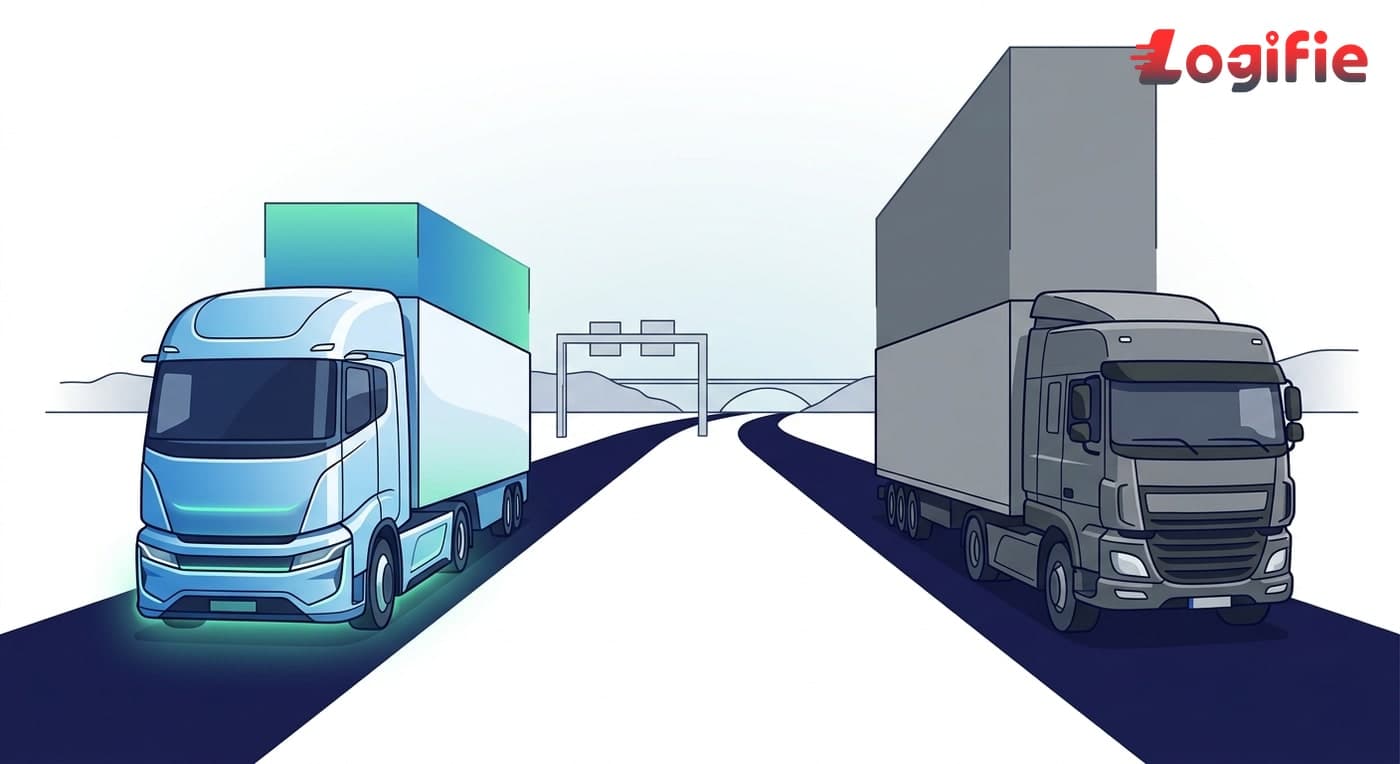
A model-year-2026 battery-electric HGV now runs cheaper over its life than an equivalent diesel for many European fleets, not despite the higher sticker price but because of lower energy, maintenance and toll costs. In April 2026 the International Council on Clean Transportation (ICCT) found that, under current German policy, MY2026 battery-electric trucks already carry a total cost of ownership (TCO) that is 10.1% lower for regional work and 11.4% lower for long-haul than diesel, with running costs of roughly EUR 36.60 per 100 km against about EUR 60 for diesel ( ICCT, 2026-04 ). This guide explains what drives that gap, when an electric truck breaks even, how tolls and CO2 charges move the maths country by country, and how to decide whether your fleet should electrify now or wait.
−10.1%
MY2026 battery-electric HGVs cost 10.1% less than diesel over their lifetime for regional duty cycles under current German policy, per ICCT April 2026.
−11.4%
The electric TCO advantage widens to 11.4% for long-haul operations in Germany, driven by toll exemptions and lower energy costs.
What goes into the total cost of ownership of a truck, and why does purchase price mislead?
Total cost of ownership is the full lifetime cost of operating a vehicle, not the price on the invoice. For a long-haul HGV running 100,000 km or more per year, the purchase price is a minority of the total spend over a typical five-to-seven-year hold. Energy is the single largest line, followed by tolls, maintenance, insurance, driver wages and the residual value recovered at resale.
This is why purchase price misleads. A battery-electric truck costs substantially more to buy than a comparable diesel tractor, often by EUR 100,000 or more before subsidies, because of the battery. But it consumes cheaper energy per kilometre, needs less servicing, and in several countries pays no road toll at all. The right question is not "what does it cost to buy" but "what does it cost to run, per kilometre, across its working life". Fleets that manage a mixed diesel and electric fleet inside a transport management system (TMS) find the per-kilometre cost gap far easier to see once tolls, energy and maintenance are tracked together rather than as separate invoices. You can model a mixed fleet's true running costs in a transport management system rather than reasoning from the sticker.
How much does an electric truck cost vs a diesel truck per kilometre in 2026?
On energy alone, the gap is large. A diesel HGV incurs operating costs of around EUR 60 per 100 km, while an electric equivalent costs approximately EUR 36.60 per 100 km on public charging, and as little as EUR 16 per 100 km where the operator charges from its own depot supply ( trans.info, 2026 ). The exact diesel figure swings with the pump price, which is why a per-kilometre comparison must be re-run against current fuel costs. You can compare live diesel prices by country and check the latest German diesel price before fixing your own baseline, because a 10-cent move in diesel shifts the break-even by months.
EUR 16/100 km
Fleets charging from their own depot supply pay as little as EUR 16 per 100 km — less than a third of the diesel equivalent — making depot charging the single biggest TCO lever.
A real-world fleet example from German logistics operator Dachser, cited in the same comparison, put a Mercedes eActros 600 at EUR 521.40 per operating day against EUR 649.50 for a diesel Actros, a saving of more than EUR 3,225 per month and over EUR 38,700 per year per truck. The table below summarises where the money moves across the main TCO components.
| TCO component | Diesel HGV (MY2026) | Battery-electric HGV (MY2026) | Net effect |
|---|---|---|---|
| Purchase price | Lower (baseline) | Higher, often EUR 100,000+ more before subsidy | Favours diesel |
| Energy per 100 km | ~EUR 60 | ~EUR 36.60 public, ~EUR 16 depot charging | Strongly favours electric |
| Maintenance | Higher (engine, exhaust, fluids) | Lower (fewer moving parts, regen braking) | Favours electric |
| Road tolls (Germany) | Full toll plus CO2 surcharge | Zero until 2031-06-30 | Strongly favours electric |
| Residual value | Established resale market | Less mature, battery health uncertainty | Favours diesel today |
The headline TCO outcome from the ICCT is that, with Germany's toll exemption and CO2-based diesel charges in force, MY2026 battery-electric trucks already sit 10.1% below diesel for regional duty and 11.4% below for long-haul ( ICCT, 2026-04 ).
When does an electric truck break even against diesel?
Break-even is the point at which cumulative running-cost savings have repaid the higher purchase price. In high-utilisation regional and long-haul work under favourable tolling, that point now arrives within roughly three to four years, and faster still in the most intensive duty cycles. MAN and the Chinese manufacturer SANY both quote payback as short as two and a half years for high-mileage operations with reliable depot charging ( Motor Transport, 2026 ).
Two variables dominate the break-even timeline. Annual mileage: the more kilometres a truck covers, the faster the per-kilometre energy and toll savings repay the premium — which is why long-haul, despite a larger battery and higher purchase price, can break even sooner than light regional work. Charging cost: a fleet charging from its own depot supply at off-peak rates reaches break-even far earlier than one reliant on public fast charging.
Driving style and route planning also matter at the margin, because regenerative braking and steady speeds extend range and cut energy draw. Tools that optimise routes and driver efficiency shorten the payback by trimming kWh per kilometre on every trip.
How do toll exemptions and CO2 mileage charges change the maths in Germany, France and beyond?
Tolls are decisive because they fall on diesel and, in several countries, spare electric entirely. Since 2025-01-01 Germany has charged a CO2-based surcharge on the LKW-Maut, lifting diesel costs sharply, while every zero-emission HGV over 7.5 tonnes pays no toll at all. That exemption was due to lapse at the end of 2025, but the European Commission proposed extending it and Germany has now confirmed full exemption through 2031-06-30 ( electrive, 2025-11 ). On a long-haul German route the avoided toll plus the CO2 surcharge on diesel is the largest single contributor to the electric truck's TCO advantage.
The EU framework behind this is the Eurovignette Directive, which lets member states grant toll exemptions or reductions to zero-emission HGVs. The Commission's April 2026 work shows that full toll exemptions alone are enough to bring MY2026 regional electric trucks to TCO parity with diesel in France, Germany and Sweden, and to narrow the gap to 9% in Italy, 7% in Poland and 5% in Spain; by 2030 toll exemptions alone deliver parity across all six markets ( ICCT, 2026-04 ). France matters as well as Germany because its concession-based motorway tolls run at EUR 0.20 to 0.40 per km, so an exemption there is worth a great deal, and concession countries can negotiate exemptions without waiting for contracts to expire.
The lesson for an operator is that the same truck has a different TCO in every country it runs through, because tolls, CO2 charges and energy prices all vary at the border. Mapping the per-country operating-cost factors, including the truck speed limits and toll rules that apply per country , is part of building an honest cross-border cost model rather than a single-market one.
Do electric trucks lose payload, and how far can they really go in 2026?
Range anxiety and payload loss were the two classic objections, and both have narrowed sharply. The Mercedes eActros 600, a representative MY2026 long-haul tractor, offers around 500 km on a single charge from its 600-plus kWh battery, enough to cover a daily driving shift before the mandatory rest break, during which it can recharge ( Daimler Truck, 2026 ). For regional distribution, where daily distances are shorter and the vehicle returns to a depot, range is rarely the binding constraint.
~500 km
The Mercedes eActros 600 covers around 500 km on a single charge — enough for a full HGV driving shift before the mandatory rest break in 2026.
On payload, EU law grants zero-emission HGVs an additional weight allowance to offset the battery mass, and with a standard semitrailer the eActros 600 carries around 22 tonnes of payload, close to a comparable diesel for the great majority of loads that "cube out" on volume before they "weigh out" on mass. For dense bulk freight at the legal weight limit, a small payload penalty can remain, which is a genuine factor for tankers and aggregates but irrelevant for most general and palletised freight.
Is the charging infrastructure there yet for cross-border haulage?
This is the real remaining gap, and it is closing on a fixed legal timetable rather than on hope. The Alternative Fuels Infrastructure Regulation (AFIR) requires HGV-capable fast charging along the Trans-European Transport Network (TEN-T), the EU's core road corridors. By 2027-12-31 charging pools delivering at least 350 kW per point must sit every 60 km along the core TEN-T network, rising to greater capacity and full coverage by 2030 ( AFIR Regulation (EU) 2023/1804, European Commission ). Megawatt charging systems that can refill a long-haul battery inside a driver's rest break are moving from prototype to production over the same window.
For now the practical position is that depot and regional charging is largely solved, while uninterrupted cross-border long-haul on public chargers alone is still patchy outside the busiest corridors. A fleet electrifying in 2026 should plan its first electric duty cycles around routes where it controls the charging, then extend onto the public network as AFIR builds out the corridors.
Which costs are still higher for electric, and how do you de-risk them?
Three costs still favour diesel today. The purchase price is the obvious one, partly offset by national subsidies and the fast payback above. The second is residual value: the second-hand market for electric HGVs is immature and battery state-of-health is hard for a buyer to verify, so resale assumptions should be conservative until the used market matures. The third is charging-related capital, because a depot fast charger and the grid connection behind it are real upfront costs that belong in the TCO model, not outside it.
De-risking these is mostly about contract structure and data. Battery warranties and state-of-health guarantees from the original equipment manufacturer (OEM) transfer residual-value risk off the operator. Leasing and battery-as-a-service arrangements convert the purchase premium into a predictable monthly cost. And accurate energy, toll and maintenance data, tracked per vehicle from day one, is what lets a fleet prove the TCO case to its own finance function rather than argue it on faith.
Should your fleet electrify now or wait? An electric truck TCO checklist by haul type
The honest answer is that it depends on duty cycle, and 2026 is the first year the numbers favour acting for a clear set of cases. Battery-electric trucks crossed 3% of new EU, EFTA and UK registrations in 2025, up from 1.5% the year before — a trend tracked in the IEA Global EV Outlook 2025 — and ING expects the share to pass 5% in 2026 as CO2 rules, mileage charging and incentives bite ( ING THINK, 2026 ). Use this checklist:
- Regional and return-to-base distribution under 400 km per day: electrify now. Range is a non-issue, depot charging is cheapest, and the TCO is already favourable in Germany and parity-or-better elsewhere with toll exemptions.
- High-mileage domestic long-haul in Germany or France: electrify now or pilot immediately. The toll exemption plus CO2 surcharge on diesel makes the TCO case strongest here, with payback inside three to four years.
- Cross-border long-haul across multiple toll regimes: pilot now on the busiest corridors, scale as AFIR charging fills in through 2027. Build the per-country cost model first.
- Weight-critical bulk freight at the legal limit: wait or run a single trial. The residual payload penalty and patchier heavy charging make the case weaker until batteries get denser.
Frequently asked questions
Is an electric truck cheaper than diesel in 2026?
On total cost of ownership, yes for many European fleets. The ICCT found MY2026 battery-electric trucks run 10.1% cheaper than diesel for regional work and 11.4% cheaper for long-haul under current German policy, driven by lower energy costs of about EUR 36.60 per 100 km against roughly EUR 60 for diesel, plus the German toll exemption.
How much does an electric truck cost per kilometre compared with diesel?
On energy, an electric HGV costs around EUR 36.60 per 100 km on public charging and as little as EUR 16 per 100 km on depot power, against about EUR 60 per 100 km for diesel. The full per-kilometre cost also depends on tolls, which are zero for zero-emission HGVs in Germany, and on the current diesel price, which should be checked live before fixing a baseline.
When does an electric truck break even against diesel?
In high-utilisation regional and long-haul work under favourable tolling, break-even now arrives in roughly three to four years, and as little as two and a half years in the most intensive duty cycles with reliable depot charging. Lower-mileage or public-charging-dependent operations take longer.
Are electric trucks exempt from tolls in Germany?
Yes. Every zero-emission HGV over 7.5 tonnes pays no LKW-Maut in Germany, and the exemption has been confirmed through 2031-06-30. Diesel trucks additionally pay a CO2-based toll surcharge introduced in 2025, which widens the electric advantage further.
Do electric trucks carry less payload than diesel?
Slightly, but EU law grants zero-emission HGVs an extra weight allowance to offset the battery, so a long-haul tractor such as the eActros 600 carries around 22 tonnes with a standard semitrailer. For most palletised and general freight that fills the trailer by volume before weight, there is no practical penalty; only dense bulk loads at the legal limit are affected.
How far can an electric truck drive on one charge in 2026?
A current long-haul battery-electric tractor covers around 500 km on a single charge, enough for a full driving shift before the mandatory rest break, during which it can recharge. Regional vehicles returning to a depot rarely approach their range limit.
Is there enough charging infrastructure for cross-border haulage?
Not yet everywhere, but it is being built on a legal deadline. AFIR requires HGV fast charging of at least 350 kW per point every 60 km along the EU's core TEN-T corridors by the end of 2027. Depot and regional charging is largely solved today; uninterrupted public long-haul charging is still patchy outside the busiest routes.
If your fleet is weighing diesel against electric on specific lanes and wants the numbers run against real costs, request a tailored transport quote from Logifie and compare the options before your next vehicle order. For related reading, see our guide to the 2026 smart tachograph requirements and our analysis of Chinese electric trucks entering the European freight market .