How to calculate a freight rate for a truck load in 2027: formula and worked example
To calculate a freight rate for a truck load, add loaded km, empty km, tolls and extras, then divide by one minus your margin.

Logifie Team
Logistics Technology Experts

To calculate a freight rate for one truck load, add the cost of the loaded km, the cost of any empty km, the tolls and the extras for the job, then divide that total by one minus your margin. The Ti, Upply and IRU benchmark for Q2 2026 (published 2026-08-11) put the European contract rate index at 148.0, up 15.2% year on year , so a price built from last year's numbers needs a fresh check. This guide gives the formula, the break-even per loaded km formula and a worked 1,300 km example through Germany and France, including tolls, empty km, waiting time and a test of a client offer.
How do you calculate a freight rate for a truck load?
You calculate it in four steps: price the loaded km, price the empty km, add tolls and extras, then divide the total by one minus your margin. Written as one line:
Freight rate = (loaded km x cost per loaded km + empty km x cost per empty km + tolls + extras) / (1 - margin)
Loaded km are the km driven with the cargo on board. Empty km are the km you drive to reach the pickup or to come back without a paying load. Extras are anything specific to the job: ferries, tunnels, waiting time and extra stops.
The last step deserves attention. Dividing by (1 - margin) treats the margin as a share of the price you charge. A 10% margin of price on a job that costs EUR 2,208.70 gives 2,208.70 / 0.90 = EUR 2,454.11. A 10% markup on cost would give only EUR 2,429.57 on the same job, because the markup is a share of cost and not of price. Logifie's freight calculator offers both modes, and its default is a margin of 10% of price. It rounds the recommended price up to the next EUR 10, which makes the example EUR 2,460.
Every cost input in this guide is an example from the calculator's default 40 t profile. Your own driver pay, leasing, insurance and diesel price will differ, so enter your numbers in Logifie's freight calculator before you quote. The monthly cost behind those inputs comes from a yearly budget, so build that budget with the 2027 truck cost per km budget template .
How do you work out your break-even cost per loaded km?
Your break-even cost per loaded km is your monthly cost before tolls divided by the km you drive loaded in a month, because only loaded km earn revenue.
Break-even per loaded km = (total monthly cost excluding tolls) / loaded km per month
Empty km still burn fuel and wear tyres, so their cost has to be recovered by the loaded km. That is why a fleet that drives 10,000 km a month with 20% empty has 8,000 paid km to spread its costs over, not 10,000.
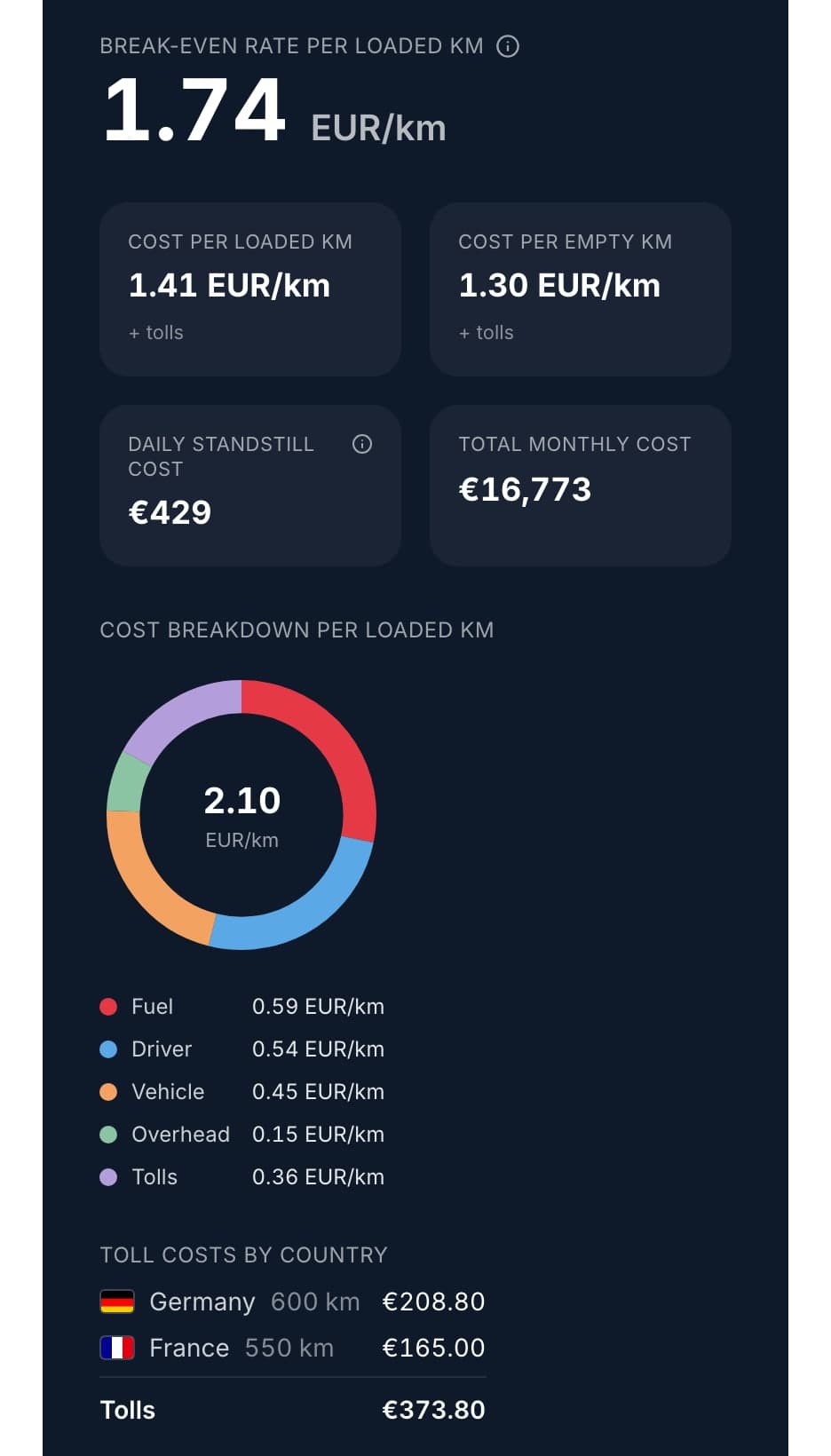
The default 40 t profile in Logifie's freight calculator shows how this plays out. Fixed costs per km are the monthly fixed costs divided by monthly km. Adding fuel gives a cost of 1.41 EUR per loaded km (32 L/100 km) and 1.30 EUR per empty km (25 L/100 km), both before tolls. The break-even per loaded km then weights the two by the empty share:
(1.41 x 0.80 + 1.30 x 0.20) / 0.80 = 1.735, shown as 1.74 EUR per loaded km before tolls.
Add the fleet-average toll cost of 0.36 EUR per loaded km and the total reaches 2.10 EUR per loaded km. Fuel is 0.59 of that, the driver 0.54, the vehicle 0.45 and overhead 0.15.
Diesel is the input that moves most often, so use the net price you actually pay per litre. As a reference point, the EU weighted average diesel price was EUR 2.154 per litre including taxes in the week of 2026-11-02 , based on the European Commission Weekly Oil Bulletin. The calculator default of EUR 1.55 per litre is a net-of-VAT example and is not a market quote. The ETS2 carbon price on road fuel becomes fully operational in 2028 (European Commission page updated 2026-09-02), so it does not belong in a 2027 diesel input. For a fuller treatment of the method, work through the cost per km calculation guide for Europe .
How do you add tolls to a freight rate?
Add tolls after the per-km cost, country by country, using the km you actually drive on tolled roads. Averaging tolls into the per-km figure hides the difference between a 600 km German leg and a route that avoids the Autobahn, so a single load is better priced from its own route.
Germany is the clearest case. The Toll Collect tariff for Euro VI vehicles over 18 t with 5 or more axles in CO2 class 1 is 34.8 ct per km , in force since 2024-07-01. No 2027 change had been announced as of 2026-11-07. The calculator uses that rate as 0.348 EUR per km, and applies 0.30 EUR per km for France. Toll values in the calculator are net of VAT, for Euro VI, converted at ECB rates of 2026-09-25. Check the current tariff for your own vehicle class before you rely on them.
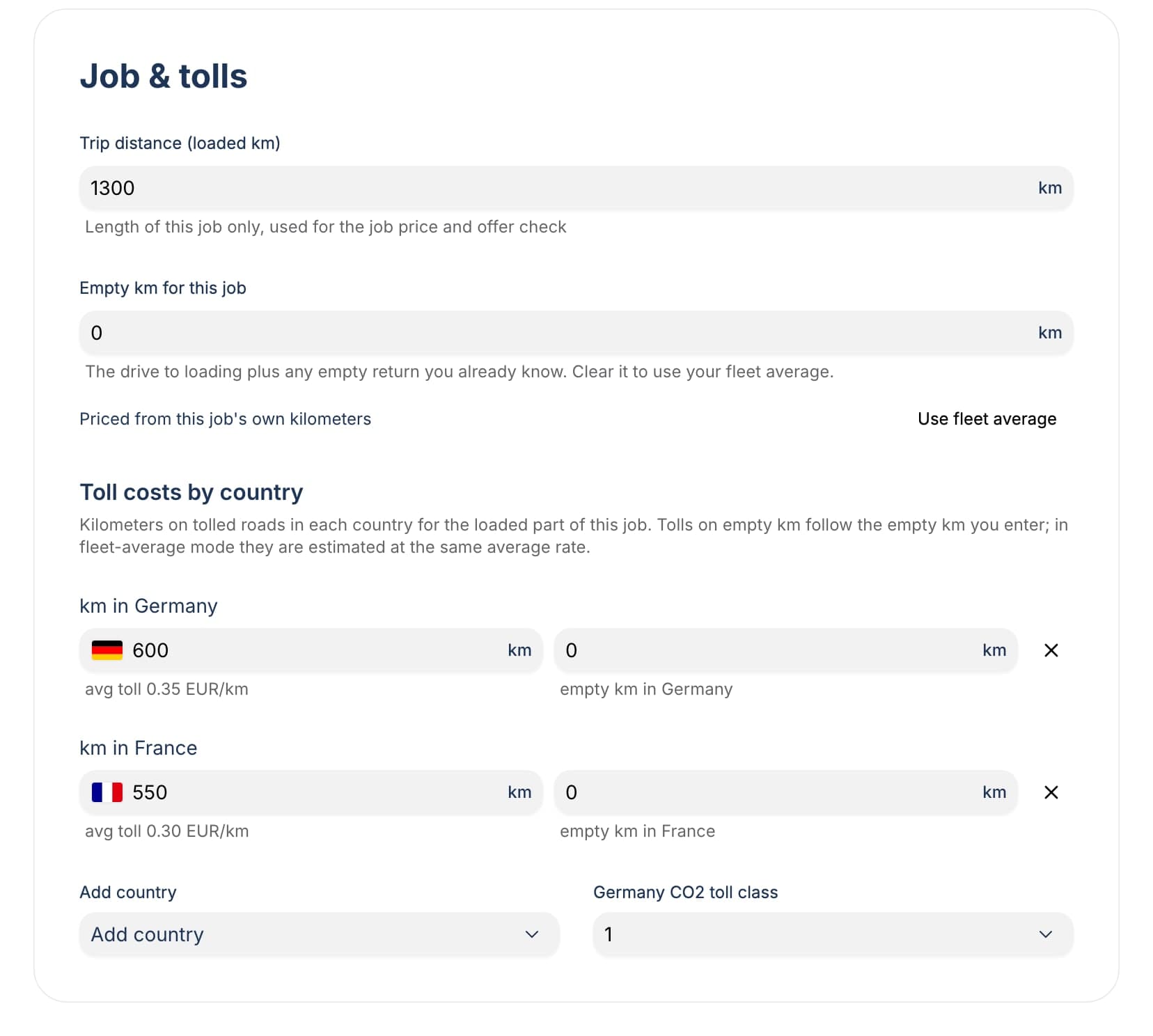
In the example, the job card holds the whole route: 1,300 loaded km, 0 empty km, 600 km tolled in Germany, 550 km tolled in France and CO2 class 1.
What should you charge for a 1,300 km load through Germany and France?
For the example job, the break-even price is EUR 2,209 and the recommended price is EUR 2,460, both net of VAT. The table below follows the formula line by line, using Logifie's freight calculator at default 40 t settings.
| Line item | Calculation | Amount (EUR) |
|---|---|---|
| Loaded km cost | 1,300 km at 1.4115 EUR per km (shown as 1.41) | 1,834.90 |
| Empty km cost | 0 empty km entered | 0.00 |
| Tolls, Germany | 600 km at 0.348 EUR per km | 208.80 |
| Tolls, France | 550 km at 0.30 EUR per km | 165.00 |
| Job cost (break-even) | Sum of the lines above | 2,208.70 |
| Minimum price | Job cost rounded up to the next EUR 1 | 2,209 |
| Recommended price | 2,208.70 / 0.90, rounded up to the next EUR 10 | 2,460 |
The minimum price works out at 1.70 EUR per loaded km, or EUR 994 a day. The recommended price is 1.89 EUR per loaded km, or EUR 1,107 a day. The job takes about 2.22 days: 1,300 km at 65 km/h is 20 hours of driving, and the model allows 9 hours of driving a day.
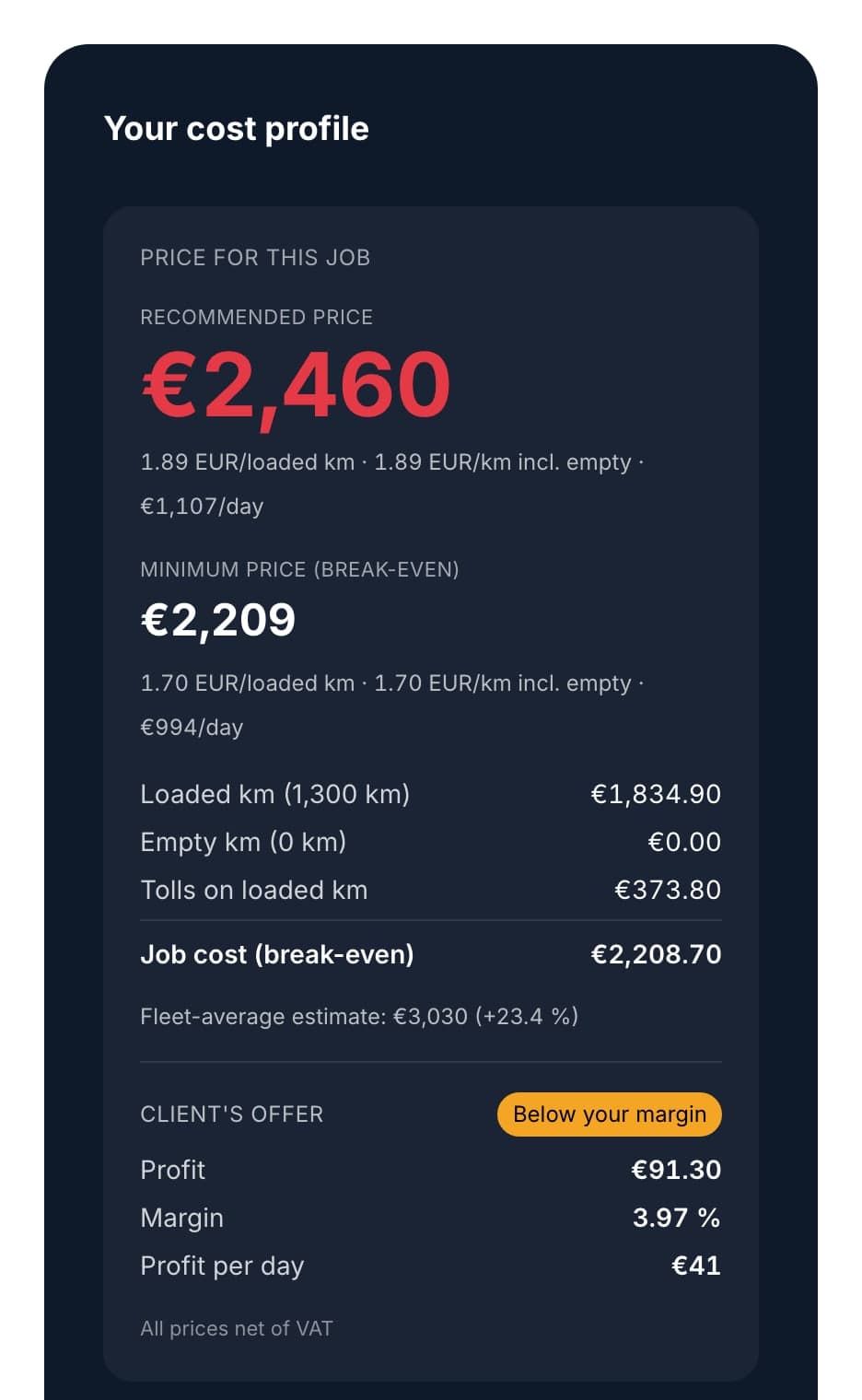
Two points explain the numbers. First, break-even and recommended price answer different questions. The break-even price covers the cost of the job and leaves nothing for the business. The recommended price adds your margin, so it is the number to quote when you have room to negotiate.
Second, this example enters 0 empty km, so it is a route-only price. The calculator also shows a fleet-average estimate of EUR 3,030, which is 23.4% above the job-only price. That estimate prices in the share of empty running that a fleet normally carries. If the truck will come back empty from the unloading point, the route-only figure understates what the load really costs.
How do empty km, waiting time and stops change the price?
Each of the three adds cost that the loaded km alone does not cover, and each belongs in the extras line of the formula. Empty km cost 1.30 EUR per km in the default profile before tolls, nearly as much as a loaded km.
Empty running is common. Eurostat reported that around one fifth of EU road freight vehicle-km were driven empty in 2020 (news release 2021-12-10), with Cyprus the highest at 44% and Belgium the lowest at 6%. The Spanish transport ministry observatory shows the same pattern in cost: Q1 2026 unit costs were 1.79 EUR per laden km and 1.52 EUR per empty km , as reported on 2026-06-29. An empty km is cheaper than a loaded one, but not by much.
Waiting time and stops cost money because the truck and driver cost the same whether the wheels turn or not. The default profile has a daily standstill cost of EUR 429. It is made of time-based costs only (fuel and AdBlue accrue only while driving): about EUR 205 for the driver, EUR 165 for the vehicle and EUR 59 for overhead. Every extra hour at a loading dock uses a share of that day.
Price this in the quote or in the contract terms. To set the terms, see how carriers set included waiting time and hourly charges .
How much should you charge per km for a 40 t truck in Europe?
Charge at least your own break-even per loaded km plus margin, then compare that with a market band. Logifie's freight calculator shows a market band of 1.10 to 1.90 EUR per km for 40 t full loads, built from IRU, CO3 and industry indices. The example job sits inside it: break-even at 1.70 EUR per loaded km and the recommended price at 1.89.
Treat the band as a reference and not a promise. The Ti, Upply and IRU benchmark for Q2 2026 gives index values (contract 148.0, spot 146.8, with spot up 13.9% on the year) and an average EU diesel price of EUR 1.94 per litre, but no EUR per km lane rates. The Spanish observatory figure of 1.79 EUR per laden km in Q1 2026 is a cost, not a price; the same report shows operating costs up 15.1% on Q1 2025. Nobody can give a reliable 2027 rate per km today, and this guide does not try.
If your break-even sits above the band, the load needs a higher rate, a better backhaul or a different lane. To see the market side in more detail, compare your rate with the road freight rate per km guide .
How do you check whether a client's offer is profitable?
Subtract the job cost from the offer to get profit, then divide profit by the offer to get the margin. For the client's EUR 2,300 offer on the example job, profit is 2,300 - 2,208.70 = EUR 91.30. The margin is 91.30 / 2,300 = 3.97%.
Spread over the 2.22 days the job takes, that is about EUR 41 of profit a day. Logifie's freight calculator flags the offer as Below your margin, because the default margin is 10% of price and the offer delivers 3.97%. The gap to the recommended price is EUR 160.
A low margin is a decision and not an automatic rejection. A load that fills a day that would otherwise stand still, at a cost of EUR 429, may be worth taking at a thin margin. A load that adds empty km on the way back probably is not. Run the offer through the numbers first, then choose.
Frequently asked questions
What is the simplest formula for a freight rate on one truck load?
Freight rate = (loaded km x cost per loaded km + empty km x cost per empty km + tolls + extras) / (1 - margin). Use your own cost per km from your monthly costs. The result is a net price before VAT.
What is the difference between break-even price and recommended price?
The break-even price equals the job cost, so profit is zero. The recommended price adds your margin on top. In the example, break-even is EUR 2,209 and the recommended price at a 10% margin of price is EUR 2,460.
Should I price empty km into a load?
Yes, if the truck will drive empty because of this job. The example enters 0 empty km, which gives a route-only price of EUR 2,209 at break-even. Pricing in the fleet-average empty share raises the estimate to EUR 3,030, or 23.4% more.
How much of my cost is diesel?
It depends on your fleet, but fuel is a large share. In the Spanish transport ministry observatory for Q1 2026 (reported on 2026-06-29), fuel rose to 36.2% of total cost, above personnel and per diems. In the calculator's default profile fuel is 0.59 of 2.10 EUR per loaded km.
Does the German toll change in 2027?
No change had been announced as of 2026-11-07. The Toll Collect tariff for Euro VI, 5 or more axles, CO2 class 1 has been 34.8 ct per km since 2024-07-01. Check the Toll Collect page again before you send a quote that runs into 2027.
Are the calculator defaults my costs?
No. They are example inputs for a 40 t profile, built from published cost methods and scaled to Central and Eastern European wages. Enter your own driver pay, leasing, insurance, diesel price and monthly km before you use the result in a quote.
Calculate your own load in Logifie's freight calculator : enter the route, tolls, empty km and your own costs, then compare the recommended price, the break-even and your client's offer.

