Return load from a capital city: why trucks leave Paris, Madrid and Bucharest empty
Most capital regions load less freight than they unload. Eurostat 2024 and 2025 data for 16 capital regions, from Bucharest 52 to Dublin 167, with the limits.

Logifie Team
Logistics Technology Experts

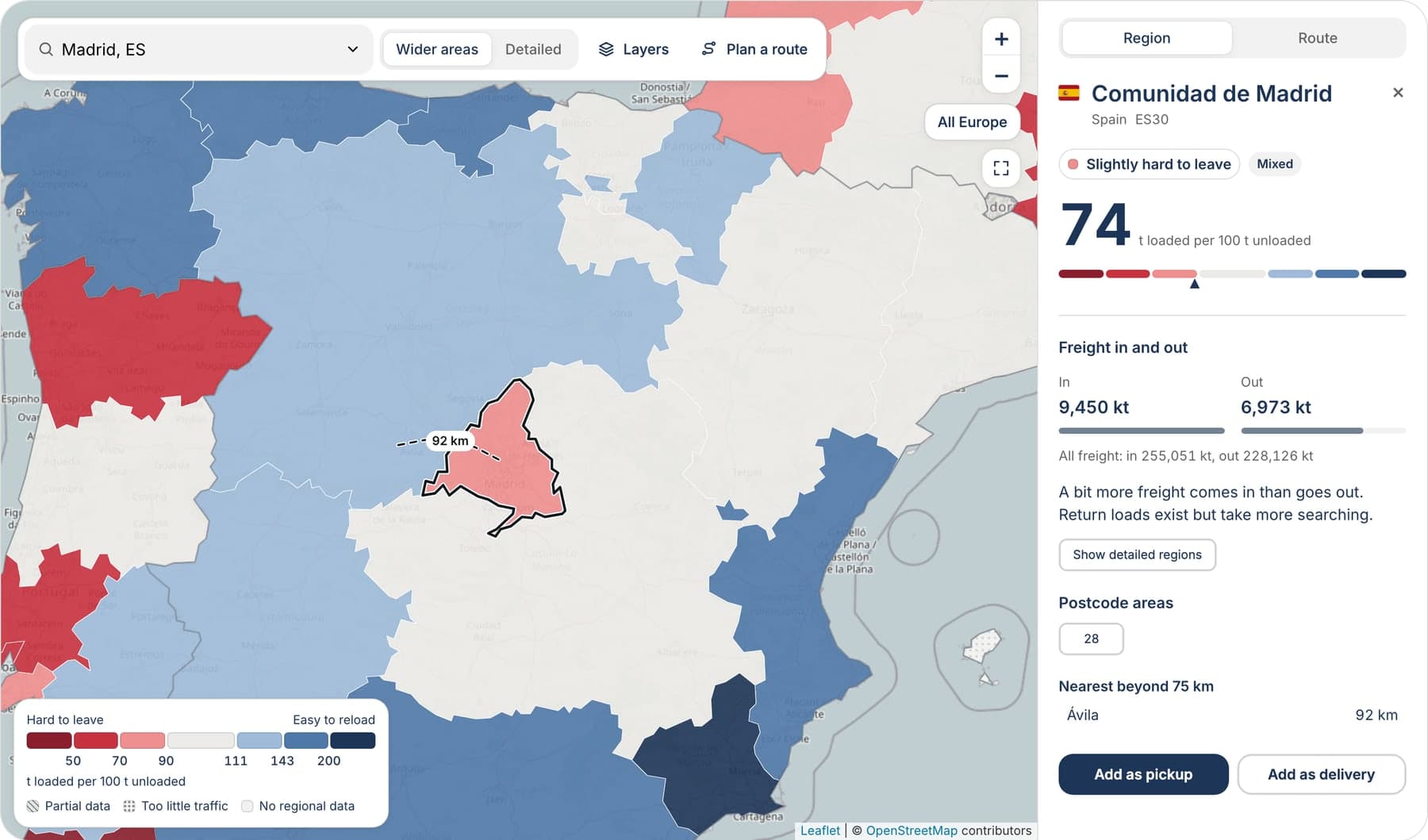
A return load from a capital city is harder to find because 21 of 26 EU and Norwegian capital regions load less international freight than they unload. Logifie's freight balance map, using Eurostat 2024 and 2025 data, shows 52 tonnes loaded per 100 unloaded in Bucureşti-Ilfov, 67 in Ile de France and 74 in Madrid.
A value of 100 means a region loads as much international freight as it unloads, and anything below 100 means more arrives than leaves. "Empty" in the headline means fewer loads out than in, not an empty trailer. Eurostat reports that in 2025 12.9% of international road freight vehicle-km in the EU were driven empty, against 26.0% for national transport .
Why is it hard to find a return load from a capital city?
Many capital regions take in more freight than they ship. Ile-de-France had 12,463,067 residents on 2023-01-01, which is 18% of the French population, according to INSEE (published 2025-12-18). Its logistics warehouses covered 15.3 million m2 on 2022-01-01, 71% of it in the outer ring, and 47% of the space belongs to wholesale trade that serves the region's own buyers, according to DRIEAT (June 2024). These figures describe demand and storage, not truck movements.
Cabotage also limits what a foreign truck can pick up locally. Cabotage is domestic carriage by a haulier from another country. After an international delivery, a vehicle may make up to 3 cabotage operations in the host country within 7 days of unloading, then faces a 4-day cooling-off period in that country, under rules applying from 2022-02-21 ( European Parliament Legislative Observatory ). Cabotage loads count as reloads in the figures below.
Which capitals are the hardest to leave, and which are not?
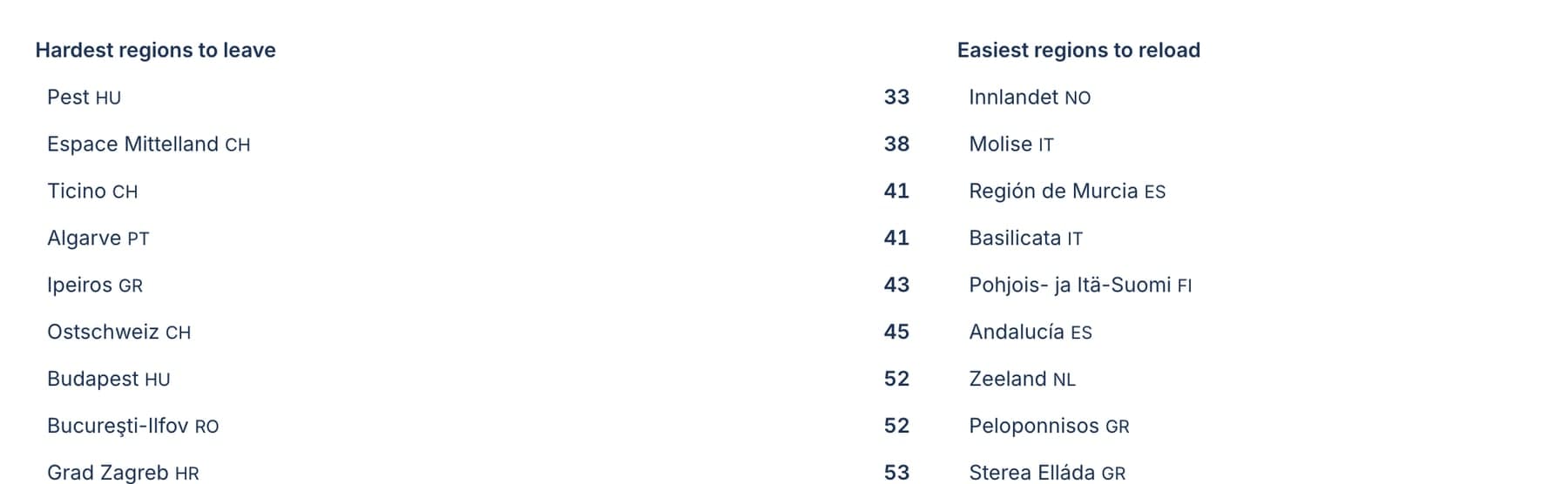
Bucureşti-Ilfov, Budapest and Grad Zagreb score 52 or 53, while Noord-Holland, Oslo og Viken, Zahodna Slovenija and Eastern and Midland score 100 or more.
| Region | Loaded per 100 unloaded | Verdict |
|---|---|---|
| Bucureşti-Ilfov (Bucharest) | 52 | Hard to leave |
| Budapest | 52 | Hard to leave |
| Grad Zagreb (Zagreb) | 53 | Hard to leave |
| Grande Lisboa (Lisbon) | 54 | Hard to leave |
| Brussels (Région de Bruxelles-Capitale) | 56 | Hard to leave |
| Berlin | 64 | Hard to leave |
| Ile de France (Paris) | 67 | Hard to leave |
| Luxembourg | 68 | Hard to leave |
| Warszawski stołeczny (Warsaw) | 69 | Hard to leave |
| Comunidad de Madrid (Madrid) | 74 | Slightly hard to leave |
| Wien (Vienna) | 75 | Slightly hard to leave |
| Praha (Prague) | 76 | Slightly hard to leave |
| Noord-Holland (Amsterdam) | 100 | Balanced |
| Oslo og Viken (Oslo) | 128 | Slightly easy to reload |
| Zahodna Slovenija (Ljubljana) | 136 | Slightly easy to reload |
| Eastern and Midland (Dublin) | 167 | Easy to reload |
Source: Eurostat road freight data 2024 and 2025 (tables updated 2026-10-06), international freight only, calculated by Logifie's freight balance map.
The number counts tonnes, not trucks or trips, and it leaves out domestic hauls by the region's own country's hauliers, so a French truck leaving Paris with a French load is not in the figure. Small regions are noisy. The confidence badge compares 2024 with 2025: Bucureşti-Ilfov is steady, while Budapest, Zagreb, Lisbon, Warsaw, Madrid and Vienna are mixed. Read each value as a pattern, not a promise of loads on a given day.
What should a driver do before delivering into a capital?
Check the region before accepting the drop, then look at the neighbours. Look up the region on Logifie's freight balance map , and use route check, which takes up to 8 stops, to see the verdict at the start and end of a route. These four neighbours score higher than their capital in the same 2024 and 2025 data, and they are not the whole picture.
| Capital region | Loaded per 100 unloaded | Neighbouring region | Loaded per 100 unloaded |
|---|---|---|---|
| Warszawski stołeczny | 69 | Mazowiecki regionalny | 116 |
| Comunidad de Madrid | 74 | Castilla y León | 123 |
| Ile de France | 67 | Champagne-Ardenne | 112 |
| Praha | 76 | Střední Čechy | 97 |
Neighbours do not always help: Brandenburg beside Berlin and Sud-Muntenia beside Bucharest both score 84, still slightly hard to leave.
Read how the freight balance number is calculated , or see the hardest regions to reload trucks in Europe beyond the capitals.
Frequently asked questions
Why do trucks go back with fewer loads from big cities?
Many capital regions unload more tonnes than they load, so there is less freight to collect than was delivered. Most international kilometres are still loaded, because Eurostat counted 12.9% as empty in 2025.
Is it always hard to find a return load from a capital?
No. In Eurostat data for 2024 and 2025, Noord-Holland scores 100, Oslo og Viken 128, Zahodna Slovenija 136 and Eastern and Midland (Dublin) 167. Scores from 50 to 69 count as hard to leave and 143 to 199 as easy to reload.
Does a low number mean the truck leaves empty?
No. The number counts international tonnes, not trucks or trips, and it excludes domestic hauls. A truck can leave a low-scoring region full, but a load is harder to find there.
Where can I find a load nearer than the capital?
Start with the neighbouring region, such as Mazowiecki regionalny at 116 beside Warsaw or Castilla y León at 123 beside Madrid. Distances on the map are straight lines, not road km.
Need a price for the way back? Get a quote for your return leg .

