Return loads in France: which regions make a load back hard or easy
Languedoc-Roussillon loads 57 tonnes per 100 unloaded, Champagne-Ardenne 112: French return loads by region, Eurostat 2024 and 2025.

Logifie Team
Logistics Technology Experts

Return loads (backhaul) in France are hardest to find in Languedoc-Roussillon, which loads 57 tonnes per 100 unloaded in Logifie's freight balance map, built from Eurostat 2024 and 2025 data. The north-east and centre are balanced or slightly easy, topped by Champagne-Ardenne at 112 and Franche-Comté at 123 (unsteady).
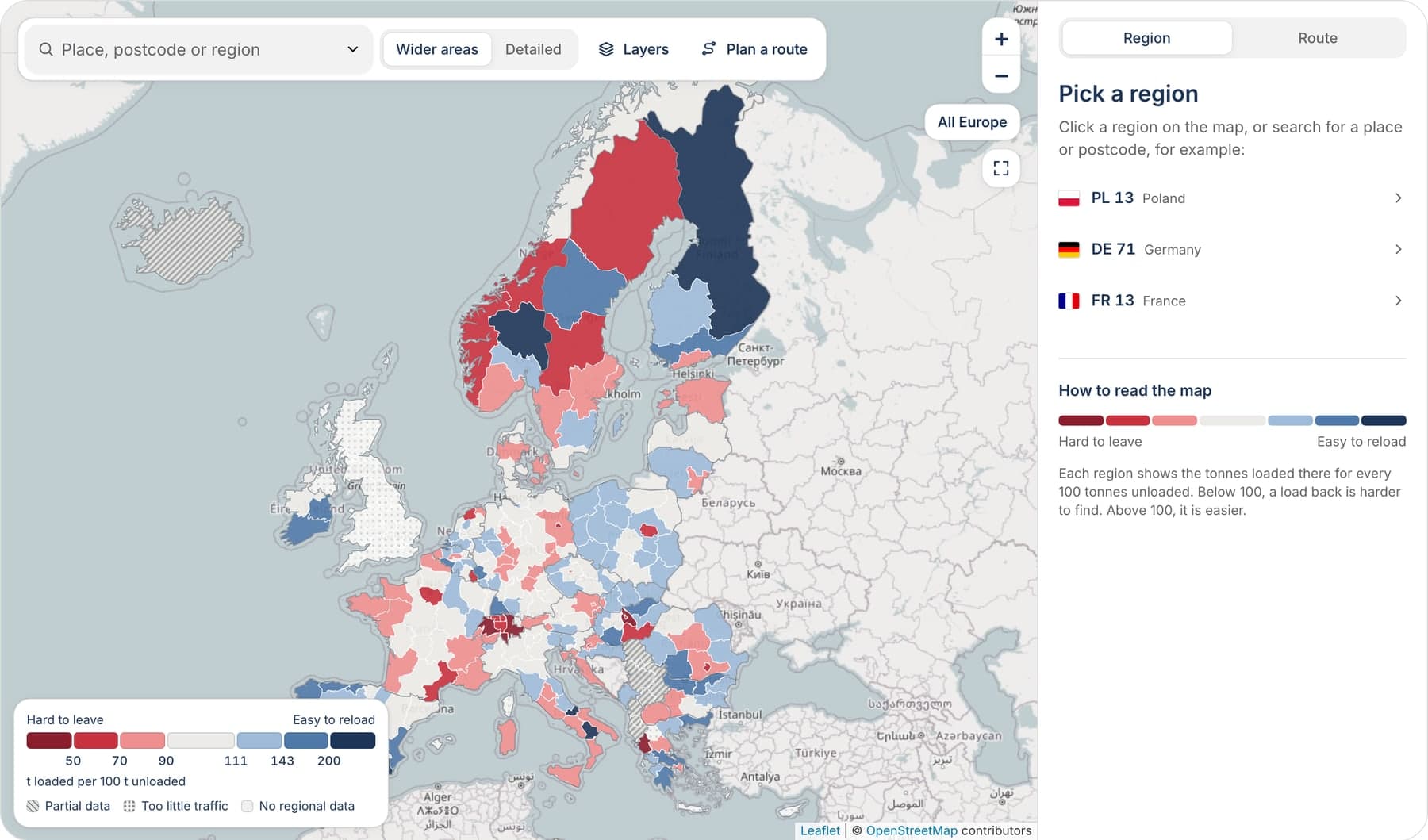
Which French regions make a return load hardest to find?
Languedoc-Roussillon, on the Mediterranean coast, and most other weak spots lie on the Atlantic and Mediterranean side. Over 2024 and 2025 it unloaded 18,417 thousand tonnes of international freight and loaded 10,587 thousand, a steady result in both years. Ile de France scores 67 and is covered in why trucks leave capital cities empty , so this guide looks at the rest of the country.
Seven regions are slightly hard to leave (70 to 89), among them Bretagne at 75, Aquitaine at 76, Rhône-Alpes at 78 and Provence-Alpes-Côte d'Azur at 82. All seven are steady. The data records the gap without explaining it.
The map uses the former regions (NUTS-2, the level used before 2016), so Languedoc-Roussillon and Rhône-Alpes differ from the Occitanie and Auvergne-Rhône-Alpes on road signs today. INSEE describes the NUTS levels in France .
| Region (NUTS-2, pre-2016) | Loaded per 100 unloaded | Verdict |
|---|---|---|
| Languedoc-Roussillon | 57 | Hard to leave |
| Rhône-Alpes | 78 | Slightly hard to leave |
| Provence-Alpes-Côte d'Azur | 82 | Slightly hard to leave |
| Nord-Pas de Calais | 89 | Slightly hard to leave |
| Lorraine | 97 | Balanced |
| Champagne-Ardenne | 112 | Slightly easy to reload |
| Franche-Comté | 123 | Slightly easy to reload |
Source: Logifie's freight balance map, Eurostat road freight data 2024 and 2025, tables updated 2026-10-06, checked 2026-11-15.
Where in France is a return load easier to find?
In the north-east and centre. Ten of the 21 regions in the data are balanced (90 to 110), including Lorraine at 97, Picardie and Midi-Pyrénées at 101, and Bourgogne at 105. Champagne-Ardenne and Franche-Comté are the only slightly easy regions, and none reaches the easy band. Corsica has no row.
Franche-Comté needs caution: it is the only unsteady French region, so its 2024 and 2025 results differ. Champagne-Ardenne is mixed, so treat its 112 with care too. Volume does not decide the verdict either. Nord-Pas de Calais handles the most freight in France (44,264 thousand tonnes unloaded, 39,219 thousand loaded) and still sits at 89.
What can these scores not tell a driver planning a French route?
Treat each score as a two-year pattern for one region. It divides the international tonnes loaded there by the tonnes unloaded there, using Eurostat road freight data for 2024 and 2025, and multiplies by 100. Domestic hauls by French hauliers are removed. Cabotage, meaning a foreign truck moving goods between two French points, stays in, so it counts as a reload. The European Commission cabotage rules allow 3 such operations in the 7 days after an international delivery.
The scores count tonnes, not trucks or trips, and small regions are noisy. The confidence badge only compares 2024 with 2025. Logifie derived the indicator from Eurostat tables, so it is not an official ranking. The map gives no empty kilometres, waiting days or rates, and it cannot show whether a load exists on a given day.
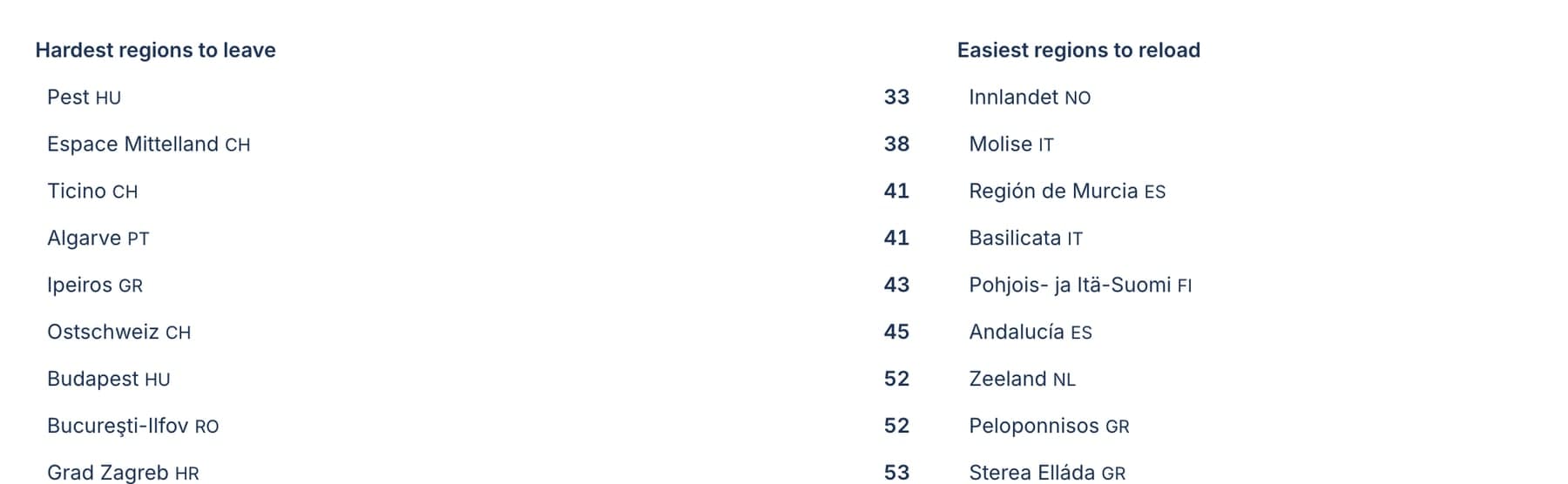
To check a delivery region, open the freight balance map . For the method across all countries, read how the freight balance map works in Europe .
Frequently asked questions
Which French regions have the most freight leaving per tonne arriving?
Franche-Comté at 123 and Champagne-Ardenne at 112, both slightly easy to reload on the 2024 and 2025 data. Franche-Comté is unsteady between the two years. No French region is rated easy to reload.
Does the map cover Corsica?
No. The data holds 21 French regions and Corsica has no row, so the map gives no verdict for it.
Why does the map say Languedoc-Roussillon and not Occitanie?
The map follows the NUTS-2 regions as they stood before 2016. Languedoc-Roussillon is now part of Occitanie, so look it up on the map under its former name.
What should I check besides the score before I unload in France?
The confidence badge and the volume. Alsace (91) is mixed, so its 2024 and 2025 results differ, while Lorraine (97) is steady on 21,786 thousand tonnes unloaded. Small regions such as Limousin, at 1,657 thousand tonnes unloaded, are noisy.
To price a French leg with a load back in mind, request a France freight quote .

